Showing posts with label archeology. Show all posts

Monday, April 8, 2013

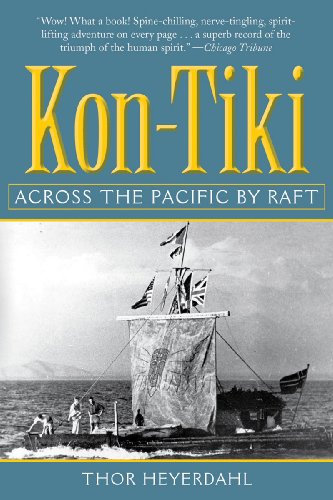
Stamp of the Day and Book Review: Kon-Tiki by Thor Heyerdahl


I recently reread a most amazing book that I hadn't read for probably 30 years - Kon-Tiki: Across the Pacific by Raft, by Thor Heyerdahl.

It was like seeing an old friend, and realizing that the old friend was even more interesting, nicer and fun than I remembered from before.  The book is a classic of course, and describes the rather crazy trip of 6 explorers on a small balsa raft from Peru to Polynesia and their 101 days at sea.  They proved that pre-historic people could have traveled such distances before modern navigation and metal tools.

Thor Heyerdahl's prose is great, he pulls you into the story and the diary, and there were only a few times I felt 'I want to know more! Give me details!'

Kon-Tiki is both an adventure story and an academic description of fieldwork, a great combination.  The thing I remember most from when I read this book as a teenager was the description of picking up the flying fish that had landed on board during the night, and making fried flying fish for breakfast each day. Somehow that image had etched itself into my memory.

Now I have more images, of whale sharks, crashing onto the reef around the final island, and the monotony of just sea, sky, and a tiny raft...

It is now 55 years since this trip was done, and it has been memorized on many postage stamps. Here are a few from Norway and French Polynesia:


Tuesday, May 31, 2011

Chimney Rock


This place has a natural name for a naturally formed geologic formation: Chimney Rock. 1000 years ago the Pueblo Indians lived here and now it is a San Juan National Forest Area in southern Colorado.  We stopped here, but since we were on our way to Chama, New Mexico (and happened to take a big detour, which was fun), we decided not to walk up to the ruins and the rock itself.  
vintage cars on the road - Chevrolet 1936 2-Door 5-Window Coupe 
We also ran into several early 1900s Chevrolets in the parking lot with people that were out road tripping in real old vehicles.  We saw them again later in Chama, great fun. .

Saturday, February 19, 2011

Gorgeous: Tiles in Samarkand

Samarkand is a magical place, an old market city on the old Silk Road and home to ancient scientists and poets. The old mosques are still there, and with detailed and large mosaic patterns, often in turqoise. Here is a tiny detail of a regular wall in one of the historic compounds. Each brick is painted, glazed and burned before you make the wall, so these colors are hundreds if not a thousand years old.

Wednesday, December 29, 2010

Setting a curved record straight

If you have heard, like me, that there now are more people alive than ever have been alive before on Earth, you have heard a myth that seems very resistant and impossible to kill off.  Apparently somebody in the 1970s uttered this false fact, and it has made the rounds many times now in articles and books.

The truth, as calculated by the Population Reference Bureau, is that "about 5.8 percent of all people ever born are alive today."  (That is today = year 2002). Read their article, it is very interesting how they calculated it, taking birthrates and death rates, world population sizes, average age of death, etc. In total, they estimate that 106 billion people have lived on Earth until now.

Imagine all those millions and billions of people!  I think it is strange we don't run into old archeological bones more often than we do. 

Wednesday, October 20, 2010

Bits and pieces from the internet

The stone age people ate plants, not just meat! ("Of course", is my comment to this.  What is easiest, hunt down a mammoth or dig up some cat tail roots? File this scientific paper among the ones classified as"obvious research results published in major journal due to the sexy topic". And the idea that cooking came before hunting has already been suggested by Wrangham.)

Inspiration for pumpkin carvings can be found here.

And you can check out the Fearless Dishwasher here.

Friday, September 25, 2009

Swedes are still viking descendants...

...but apparently not closely related to the very first hunter-gatherers that entered the Scandinavian peninsula when the last ice sheet from the ice age moved north starting about 12 000 years ago. This interesting article was just published and it concludes:

"Today's Scandinavians are not descended from the people who came to Scandinavia at the conclusion of the last ice age but, apparently, from a population that arrived later, concurrently with the introduction of agriculture."

So a new front of crop-bearing invaders came from the south around 4000 years ago and invaded the north. Interesting!

So, what happened to the old stone-agers that didn't do agriculture? Did they die out? Where did they go? Where they like the Neanderthals or American Indians, pushed back and isolated?

Monday, June 15, 2009

Day 6: These boots were made for walking, and swimming...

Another day in the Swedish Arctic from OK's iphone diary/camera (posted and translated by LS):

Idag tog vi bilen västerut till Kopparåsen, där jag klev av och mamma fortsatte med bilen för att hitta ställen att skåda och måla på.

(Today we took the car to the east to Kopparåsen (= The Copper Ridge), where I got off and mom continued with the car to find some nice places where she could bird watch and paint. )

Kopparåsen heter inte så utan skäl, på berget Koukkel inmutades 1897 en stor yta för brytning av just koppar. Detta var innan järnvägsförbindelsen mellan Kiruna och Narvik var byggd, men planerna var storstilade trots detta. Man planerade brytning och viss anrikning på plats vilket skulle ge arbete åt 500 man, och transporten ned fram fjället skulle ske med linbana.

The Copper Ridge isn't named that without reason, sine a large area was claimed on the mountain Koukkel in 1897 for mining of said copper. This was before there was a railroad between Kiruna and Narvik was built, but the plans were grandiose regardless. They planned mining and some concentrating right there which should give jobs for 500 men, and the transportation down from the mountain should be done with a cableway. )

Man kan på många ställen se var de brutit i grunda dagbrott, och invid har de staplat malmen i snygga rätblock. Detta gjorde man för att mäta hur mycket malm som brutits, lönen var nämligen 4,50 kronor per kubikmeter.

(You can see in many places where they mined in shallow open areas, and next to each pit they have stacked the ore in nice cubes. They did this to measure how much ore they had collected, since the wage was 4.50 Swedish kronor per cubic meter).

Det hus som gruvadministrationen använde finns kvar, med fin snickarglädje och strålande utsikt. Idag var dock molnen ganska låga och när jag fortsatte stigen norrut mot Vadvetjåkka nationalpark så gick jag upp i molnen och regnet. Molnen lättade efter ett slag och plötsligt fick jag en strålande vy mot udalen mellan Vadvetjåkka och Njunjes. Tog fikarast på en kulle nära Njuoraluspi.

(The house that the mining administration used still exists, with nice gingerbread work and gorgeous views. The clouds were a bit low today and when I continued the trail north towards Vadvetjåkka National Park I walked up into the clouds and the rain. The clouds eased up after a while and suddenly a fantastic view opened up showing the U-shaped glacial valley between Vadvatjåkka and Njunjes. I took a break on a little hill near Njuoraluspi.)

Vände åter i mina fotspår på den måttligt använda stigen, de enda skoavtrycken jag såg var mina egna. Stigen var trots bra rösning svår att hitta bitvis då den gick genom snölegor och över hällar ristade av isen. Per telefon avtalade jag med mamma att mötas vid Björkstugan, men stigen ned dit visade sig vara mycket vag och svår att följa. Väl nere i dalen fann jag bara brofästen men ingen bro över den forsande jåkken som jag behövde passera för att komma till E10:an.

(I turned back into my own foot tracks on the ligthly worn trail, and the only tracks i saw where my own. The trail was hard to find despite good stone markers [those stone mounds in the photos], since it partly went through snow and over large rockslabs engraved by the ice age glaciers. By phone I talked to Mom and we decided to meet at Björkstugan (The Birch House), but the trail down to there turned out to be very vague and hard to follow. When I finally got down into the valley I only found the remnants of the foundations of the bridge but no bridge over the rushing stream that I need to cross to get to road E10.)

Med hjälp av telefonens GPS visade det sig att jag kommit ned en km för långt österut och fick ta mig zick-zackandes genom tät vide och krokiga björkar till den bro västerut som faktiskt skulle finnas. Nästan framme hade jag nästa lilla äventyr, jag skulle kliva ned mot en forsande bäck för att sedan passera den. Då brast min vadringsstav och jag fann mig strax sittandes mitt i bäcken med vatten över naveln! Tur i oturen så klarade kamera, telefon, karta och annat inte så vattentåligt sig precis över vattnet. Numera vet jag att sarekstövlar rymmer mycket vatten! :)

(With the help of the phone's GPS I found out that I had come down one kilometer too far to the east, and had to get myself to the west zig-zaging through thick willow shrubs and gnarly birches to the bridge that actually should exist. Nearly there I had my next little adventure. I should step down into a little streaming creak to cross it, when my hiking pole broke and I found myself sitting in the middle of the creek with water up to my belly button! Lucky for me, the camera, map, and other not so waterproof things kept themselves right above the water. Now I know that Swedish Sarek rubber boots can contain a lot of water. )

Jag hittade rätt bro strax därefter och mötte mamma, som fick bistå mig att med stor ansträngning dra av mina stövlar. Väl hemma igen åt vi en välförtjänt middag bestående av renskavsgryta smasatt med messmör och färskpotatis.

(I found the right bridge soon thereafter and met Mom, who had to help with all her force to pull off my boots. Back home in the cottage we ate a well-deserved dinner consisting of reindeer stew with 'messmör" and new potatoes.)

Vy mot Tornehamn från Koukkel. (View towards Tornehamn from Koukkel.)
Historien om Kopparåsens koppargruva. (The history of the mine [LS note: Sorry, I won't translate it all])
Snyggt och prydligt staplat. (Beautifully and neatly arranged.)
Ett lite djupare brott, med snö på botten. (A little deeper mine, with snow at the bottom.)
Gruvhuset. (The mining house. [LS note: Try to locate this at coordinates 68.4166718, 18.4833336, it is out in nowhere])
Kopparmalm. (Copper ore.)
Veranda med snickarglädje och fin vindflöjel som sig bör. (Porch with gingerbread work and nice weathervane, just like it should be.)
Vy från trappen. (View from the porch.)
Tjohoo, jag hittade rost idag! Rester efter decauvillebanan. Det var länge sen nån smörjde dragbanan. :) (Yipee, I found rust today! Remains of the Decauville cableway. It was a long time ago since anyone oiled the gears.)
"Näfveqvarn 1270 kilo" ("Näfveqvarn 1270 kg")
Fjällbjörken håller en låg profil. (The birch is keeping a low profile. [LS note: Det är en liten dvärgbjörk, inte fjällbjörk :) )
Mot Vadvetjåkka! (Towards Vadvetjåkka!
Gammal snö. (Old snow.)
Uppklarnande mot Vadvetjåkka. (Nicer weather towards Vadvetjåkka.)
I de många småsjöarna fanns vigg, sjöorre och alfågel. (In the many small lakes were Tufted Duck, Common Scoter, and Long-tailed Duck.)
Fint flyttblock. (Nice boulder.)
Finare udal än Lapporten? Vadvetjåkka nationalpark. (Nicer u-shaped glacial valley than the Lap Portal? Vadvetjåkka Nnational Park.
Jag trampade nästan på en ruvande alfågel, vi blev nog lika förskräckta båda två. (I nearly stepped on a nesting Long-Tailed duck, we probably got equally scared both of us.)
Grönt te i det gröna. (Green tea in the green.)
Snön kalvar. (The snow is making babies in the lake.)
"Vintage Lapsang Souchong". Det var te i burken. Eller om det var en sten. Svårt att säga... :) ("Vintage Lapsang Souchong". It was tea in the jar. Or maybe a rock. It was hard to tell... :) [LS note: Definitely vintage!]
Rosling. Särskilt för LS. (Bog rosemary. Especially for LS. [LS note: Thanks! I love this wonderful plant in the blueberry family. Its Latin name is Andromeda polifolia. It must be a treat for a plant to have such a nice star-like name as Andromeda.)
Vy mot Tornehamn på nedvägen. (View towards Tornehamn on the way back.)
Någon sorts lav. (Some kind of lichen.)
Var är bron??? E10 är så nära men ändå inte. (Where is the bridge??? E10 is so close and still far away.)
Här är bron! Och telefonen fungerar fortfarande efter mitt mindre frivilliga bad. (Here is the bridge. And the phone still works after my unplanned bath.)
Louktatjåkka.
Monday, December 17, 2007

Book review: The Last Chinese Chef by Nicole Mones

This is a fantastic book. This is GREAT book. This is a book that made me change my view of China and Chinese food. This is probably one of the best books I have read in 3 years. The author Nicole Mones has written three novels that all center about Chinese and American culture shock, modern and history, contemporary love stories about art, food, and love.

The three books are unrelated, but related in that most of the stories take place in today's China. The first book I read by her was A cup of Light - also one of the best books I have read in 3 years. I can't remember books longer than 3 years, so that is my cutoff date :), (well not really true... I do remember some books forever). A cup of light is about ancient Chinese porcelain and ceramics and antiquity dealers. Her third book I am reading now, and it is called Lost in translation, and is about the search for the hominid skeleton called Peking Man.

But back to this book, The Last Chinese Chef. A woman has lost her husband in a car accident a year earlier and finds out that there is a woman in China that says her husband is the father of her child. So she has to travel to China and check it out. She is also a food writer for a magazine (think Gourmet), so the editor tells her to go and interview a new, young American-Chinese chef that cooks Chinese food the old-fashioned "imperial" way in Beijing. He has just been invited to be one of ten finalists for a competition to design and cook a banquet, and the two winners will form the Olympic team. You only get to have two helpers, and he has two old uncles that help him out. His father was a famous chef before he fled China with his family and settled in California - and in his new life he stopped cooking. I won't tell you what happens, you will have to read the book.

What makes this book such a great read is the descriptions of people, places, and details - from the food to the language to architectural details. The American author has lived in China for 18 years, and you can tell. It is like the book is a documentary, that is how true it feels.

I didn't know that food in China is such a social event - people never eat alone, and food is always shared on large plates in the middle of the table, never plated on separate, individual plates. And presentation is really important, and texture more than taste sometimes. Crunchy on the outside, soft on the inside. And 'fake' food that surprise you, such as a whole chicken skin stuffed with tofu and mushrooms so it looks like a chicken, but is not. Nothing is like the Chinese food you get at restaurants in America or Sweden! This sounds so much better!

Now I, 1) want to go to a REAL Chinese restaurant and order a sampling menu of traditional Chinese food, and 2) learn how to cook some of these dishes. Maybe not the chicken skin one, or boiled chicken feet (served in Princeton, in fact), but there are others that sound so good. Chinese cooking is not just soy sauce, fried shrimp and sweet and sour sauce with white rice... it is spareribs with ginger and scallion wrapped in lotus-leaves and crispy duck with aromatic herbs...

Other people like this too:

"The most thorough explanation of Chinese food that I've ever read in the English language." -RUTH REICHL (see my earlier book review)

On Nicole Mones website you can also get advice on how to find good real Chinese cooking in America. And she explains the paradox about Chinese restaurants in the US and their boring menus:

"Chefs have told me “American taste” means Chinese-style dishes prepared with a limited range of pre-mixed sauces, usually no more than 5-7 per restaurant. This is why a Chinese–American restaurant can have 150 menu items but only a handful of different flavors."

"Wherever you live, there may be better Chinese food than you think. More than one immigrant chef has told me he would love to cook and serve Chinese-style dishes, but he fears his American diners won't accept food prepared according to real Chinese tastes." (link)
