Showing posts with label steam. Show all posts

Sunday, February 10, 2013

Book reviews: Patagonian travels, one great, one not

 A few months ago I picked up an old Swedish book given to me by a friend, who I have long forgotten, but it was a book I had wanted to read for a long time: Bruce Chatwin's In Patagonia.  I think my copy might be the first edition from 1981 in Swedish.  I dug in and started to read, with high expectations, because this was a 'real travel writer'!.  As you might know, I mostly read right before I fall asleep, maybe half an hour a day, at the most.
  Bruce Chatwin leaves work and travels to Patagonia, seemingly unplanned, a place he has always wanted to visit.  His travel diary is not a diary in the regular sense, more broken pieces and fragments of text from his experiences in Patagonia with inserts of history, commentary, and cultural reflections.

And here is the main problem.  Bruce stands outside the whole travel experience.  He reports like a objective journalist, not a person present in the moment.  And he even fails at being objective, because many times you can clearly feel the aversion he has to the people he meets.  It is not a boring book, and the text is excellently written, beautiful in fact, but it is not a good book.  You don't get a feel for the place, and it is too fragmented.

The detachedness of Bruce Chatwin is disturbing.  I can't remember any of the persons he describes in such detail, no stories, no places, no names or characters. No recollection.  There is no focus at all.   How can that be?  It was like nothing as memorable.  I know that this is considered one of the best travel books ever written, but I will have to disagree, strongly.  So I gave up, 10-20 pages from the end.

A few weeks later I needed a book with me when I had to wait for my daughter at the dentists.  I looked in our bookshelf and found "The Old Patagonian Express" by Paul Theroux!  I remember buying this book for my husband, but none of us had read it yet.  I brought it with me, read a few pages at the dentist, and was hooked.  And last night, I finished it.  What a difference.  What joy.  I envy people that haven't read this book, they have such a good read in front of them.

Paul Theroux's book was published a year (1979) after Bruce Chatwin's book and they were friends.  The books are like night and day in difference.  While Bruce Chatwin talks about Patagonia, he never explains how he got there, and his book has not one structured path in it.  Paul Theroux, on the other hand, has a plan, and he loves travel, which for him means to GET TO another place, not BE IN another place.  And I think he is right.  True travel is the transportation phase, the active movement through places, not being dumped in a place and staying there.

The way Paul Theroux traveled to Patagonia is the focus, the structure, of the whole book.  He gets on the subway and then commuter train in Boston in a snowstorm, and then takes local train after local train down to Mexico, through Central America, along the Andes, through long Argentina, and then eventually ends up on The Old Patagonian Express, the narrowgauge steam train that goes to Esquel.  And then the book is over.

This book is not about Patagonia, this book is about human nature, nature and humans. Culture, politics, some natural history, pestering travel companions, good and bad hotel rooms, dusty old railroad cars, giant steaks in dining cars, delays, landslides, revolts, and rats chewing holes in the ceiling above your bed.  It also has great interactions between Paul Theroux and the people he meets, from street urchins in Colombia to impossible Mr Thornberry in Costa Rica and the Argentinians need to be superior while having the right to complain about anything in their own country (and nobody else should).

It is a fantastic story, a meandering travel path through not only North and Latin American geography, but also classic literature (Paul Theroux discusses the books he reads during the trip), and it feels real and human.  He is not trying to be some übermensch, not someone that stands above or besides his co-travelers or people he meets.  He just is.  Now I have to read his other travel books!  Wow, what a read!  Yes, A+ and five stars of course.

There are a lot of great passages in The Old Patagonian Express, and here is one that I think fits this review pretty well:

Reading alters the appearance of a book. Once it has been read, it never looks the same again, and people leave their individual imprint on a book they have read. One of the pleasures of reading is seeing this alteration on the pages, and the way, by reading it, you have made the book yours.

And now, The Old Patagonian Express is mine, forever.  The physical book is still my husband's book, of course. 

Tuesday, August 7, 2012

Track Speed to Port Jervis


Track Speed to Port Jervis, originally uploaded by ericwill.
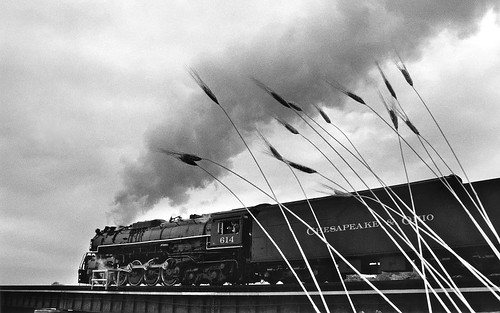
I just love this photo, taken by one of our friends. Isn't it gorgeous?

"Chesapeake & Ohio 4-8-4 614 crosses the Hackensack River with a Hoboken to Port Jervis excursion on October 18, 1997."

Tuesday, June 12, 2012

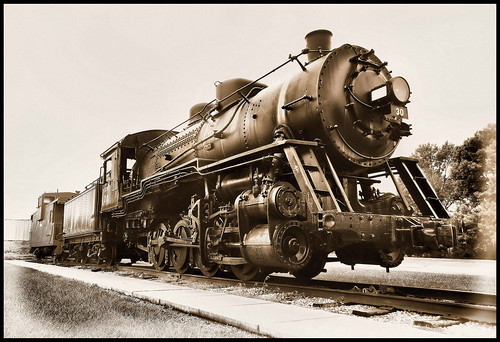
Here is another 0-8-0.
Technically it is a 0-8-0 T, for "tank" because it carries the water and coal on the engine itself not behind in a tender.

I love this engine.

For PP - 8 years!


0-8-0 Illinois Central Railroad #30, originally uploaded by rods pix. (Flickr)
Illustrated with a 0-8-0 steam locomotive of course.
How come this engine doesn't tip over front or backwise?

Friday, April 20, 2012

Philatelic blast from the past: Polish steam

I found these in my old stamp collection.  Steam locomotives on Polish stamps.  PP, can you help out with the ID? British engines?  The top one seem to have a horizonal cylinder with a very strange gear work.


Sunday, February 19, 2012

Soon to an IMAX theatre near you: Rocky Mountain Express


I have a feeling that there are plenty of people in this family who want to see this movie.

Sunday, October 2, 2011

Stamp of the day: piston, flywheel, and cylinder

Germany has some really nicely designed stamps, clean and simple.  Here is an engine piston (I think).  Maybe PP can interpret it better?  Looks like a flywheel with gears and a cylinder with a piston inside.  I am not sure if this is from a steam engine, gas engine, or what...

UPDATE: Our friend BV just sent me this, which explains the stamp in detail (thanks!!!!):

If PP hasn't let you know, the engine pictured on the stamp is a Otto
Langen Free Piston Atmospheric Engine, circa 1867.

A small flame, like a pilot light on a stove was at the base of the cylinder.
I do not know the starting procedure, but as the engine was running, if
the wheel started to slow down, a gas, like natural or coal gas, was
admitted into the bottom of the cylinder, and a little trap door would
open next to the base.  The flame would be drawn into the base, igniting
the gas, and drive the piston upward.  This would push the vertical rack
gear attached to the piston and engage the gear on the flywheel shaft,
increasing the speed of the wheel. The inertial energy would be stored in
the rotating wheel, which drove a load attached to it.  As the flywheel
slowed down to a certain speed, a governing mechanism would start the
process over again to keep the engine running until the fuel supply was
removed.

You can see one at the Rough & Tumble Museum at Kinzer, PA.
It is run for exhibition days.

Friday, August 26, 2011

A new steam boat!

Igår hade vi celebert besök i Södertälje. [Translation by LS: Yesterday we have a famous visit in Södertälje.]

Ångbåten Eric Nordevall
(II) är en kopia av en båt som trafikerade Göta kanal ( Stockholm-Göteborg) från 1837 till 1856 då hon sjönk. Det var en av Sveriges första ångbåtar.
[Steam boat Eric Nordevall (II) is a copy of a ship that once toured Göta kanal ( Stockholm-Göteborg) from 1837 to 1856 until it sank.]


Eric Nordevall is letting the steam whistle blow to salute another boat.
Below: Södertäljes own steam boat, Edjern on the way back to the Baltic sea through the #sluss#.
[sluss = lock in English]

Inside the hot machine room with the impressive steam engines visible left and right.

Eric Nordevall from back, below the deck are the passenger cabins.


Vraket hittades på 45 meters djup i Vättern i närheten av Vadstena 1980 och har väckt intresse då det är en hjulångare med sidohjul, med två separata ångmaskiner på vardera 7 hk. Forsviks bruk startade ett projekt att bygga en kopia och den är nu klar och ska döpas av HKM kronprinsessan Victoria på måndag i Stockholm. På fartygets dopresa har de angjort ett flertal hamnar och kom igenom Södertälje igår. Vill du se filmer så finns de här.

[The wreck of this boat was found at 45 m depth in Lake Vättern nerar Vadstena in 1980 and created a lot of interest since it is a paddle wheel steam boat with two separate steam engines of 7 horsepowers each.  Forsviks Bruk started the project to produce a copy of this boat, which is not finished, and it will be christened by Crown Prinsess Victoria on Monday in Stockholm.  During the ship's virgin trip they have stopped at several places and passed through Södertälje yesterday. If you want to see some movies of it, they are here .]

Vi klev ombord och intrycken var många. Det luktade nytt trä, ved, ångmaskinsolja, vedrök, tjära, nyoljade relingar. I pannrummet var det varmt, som i en vedeldad bastu och nytt och fräscht. Nordevall kan bara eldas med ved, 1 kubikmeter i timmen vid 5 knops fart. På däck låg vedtravar redo. Båten ger både intryck av att vara gammal och vara ny, då den är byggd enligt de gamla ritningarna. Ångmaskinen, båtens hjärta, är byggd av Motala verkstad, precis som den som en gång fanns på den första Eric Nordevall. Det är en lågtrycksbalansångmaskin med kondensering. Bilder finns här.

[We stepped onboard and the impressions were abundant.  It smelled like fresh wood, firewood, steam engine oil, woodsmoke, tar, newly oiled railings.  In the boiler room it was hot, like a woodfired sauna, and new and clean.  Nordevall can only be fired with firewood, 1 cubic meter per hour at 5 knots speed.  On the deck was heaps with firewood ready to be used.  The ship gives both the impression of old and new, since it is built using the original drawings.  The steam boiler, the heart of the ship, was built by Motala works (verkstad), just like the original steam boiler in the first Eric Nordevall ship. It is a low pressure balance steam engine with condensation (not sure if I translated that correctly, PP can correct in the comments).  More pictures are here. ]

Vi besökte Forsvik för ett antal år sedan och såg redan då bygget, därför var det extra roligt att möta upp båten här i Södertälje. Vi hoppas kunna resa ett stycke med denna båt i framtiden.

[We visited Forsvik a few years ago and saw this ship being built, so therefore it was extra fun to meet this ship in Södertälje. We hope to be passengers on this boat for real at some point in the future.]

Tuesday, August 9, 2011

Happy Birthday, PP!

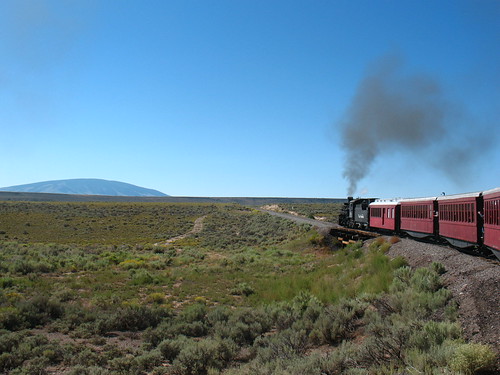
sagebrush and old volcanoes

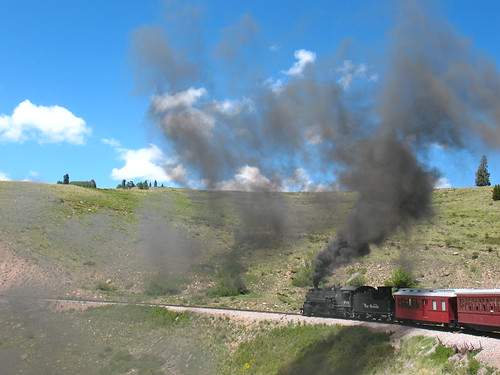
Full steam ahead! (through the sage brush in Antonito, Colorado...)

Tuesday, May 17, 2011

Bits and pieces from the internet: steam, meat, and mean edition

Interesting article in The New York Times about a car designed to run on steam, but never did, the Paxton Phoenix from 1960.

A new delicious monkey species have been reported on by the satirical magazine The Onion (funny!)

I am steaming after I discovered that someone stole my ATM card number and the pin too (how?) and have been taking out over $1700 dollars from my bank account.  The bank tells me I will get the money back.  Why are some people so MEAN? 

Apropos mean, they have started to steal human hair from salons.  What is next - cutting of a long braid or ponytail from someone's head in the subway?

In case you missed it, all three nuclear reactors in Fukushima have had nuclear meltdowns and are leaking radioactive water into the ocean.  The Japanese say a total shutdown will be done in 6-9 months (which is questionable if it is even doable).  Let's hope for no more tsunamis or big earthquakes between now and then... 

Poor world, too much is happening to it and us right now - tsunamis, earthquakes, flooding Missisippis, tornados, rain and drought....

Saturday, May 14, 2011

Happy birthday, BV!


BV is one of the frequent readers of this blog, and here is a 0-6-0 for you!

If you click on the photo you get to the Flickr page where you can read a lot about this switch steam locomotive, built in 1940 in Schenectady (I know, I don't know how to pronounce that either), New York. Thanks scenectady2009 (=Schenectady County, i.e., local government) for adding this to Flickr and letting us link to it.

Congratulations, BV! In a few (20) years I hope to post a 0-8-0!

Friday, May 13, 2011

True museums mark things up properly...


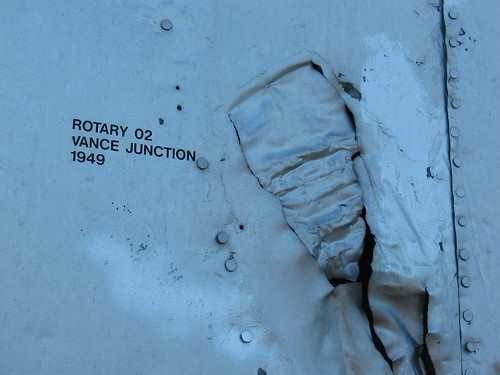
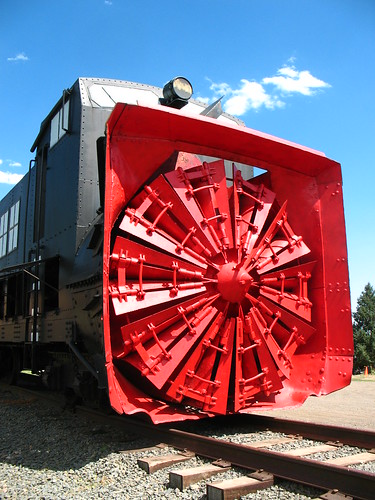
...like this damage to the back of a Galloping Goose train car marked "rotary 02 Vance Junction 1949" at the Colorado Railroad Museum in Golden, CO. In February 1949, during one of the snowiest winters on record, one of the rotary snowplowers at the Rio Grande Southern Railroad exploded at Vance Junction in Colorado and destroyed some other trains cars like this one (and itself). Rotary snowplows were steam-driven plows run first in a train set, being pushed by steam locomotives behind it, The plow boiler powered a giant lamprey-shaped sucking 'mouth' at the front, working like a giant drill/snowblower through deep snowdrifts in the Rockies and the Plains.  The general model is still used today on diesel trains. Here is a great video of a steam rotary snowplow in use in this area of Colorado.

I think this is from the paper at the time, cited on the Narrow Gauge Railroad Forum:

"February 10, 1949, Thursday
Rio Grande Southern Rotary Explodes
The RGS was dealt a severe blow last week when its only rotary snow plow blew up. A crew had brought the rotary in from Ridgway Thursday, leaving it at Vance Junction while they spent the night in Telluride. About 5:30 Friday morning, they received a call that the rotary had exploded.  The plow was extensively damaged, possibly beyond repair. Holes were blown in the boiler, the grates, and chuck were blown out, and the cab was pretty well wrecked. The rotary was to have gone on toward Rico Friday. Left with only a flanger for snow equipment, it is now very uncertain when the road will be opened. "

This happened at the worst possible time:

"1949 was a particularly harsh winter, and the northern/western railroads were buried. The then-standard steam rotaries proved incapable of dealing  with the snow. The railroads looked at several possible solutions to the problem of insufficient plowing ability."(link)

And rotary snowplows are still used nowadays:

rotary snowplow
(Diesel driven old rotary snowplow at the Colorado Railroad Museum.  Doesn't the front look like either an intestinal parasite ready to burrow into some flesh, or a lamprey or leech ready to take a bite?


"Heavy snows in January 1997 hit the northern/western US very hard,  crippling BNSF operations. BNSF called out at least 6 plows (5 ex BN, 1  ex ATSF), but two plows had severe mechanical problems, so they could not  plow. [...]  In addition to the BNSF and UP plow, two SP rotaries were  called to clear Donner Pass on 23-24 Janaury 1997. This extent and  duration of rotary use has not been seen since 1949."  (link)

Proof here that rotary plows are still being used:

Tuesday, April 5, 2011

Bend that hip!


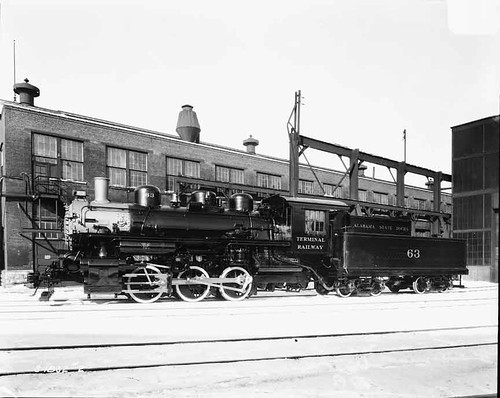
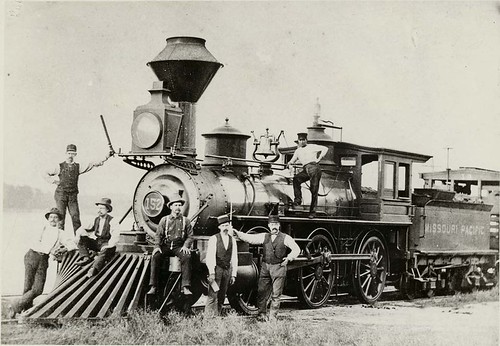
Look at the railroad men in this photo, and several of them are keeping the weight on one leg only, why? Tired? They are posing like girls! :)

I love the brackets that hold up the big light in front. I have this feeling that European steam locomotives had much smaller lights than American ones, but I might be wrong...

Thursday, December 30, 2010

Trains, snow, and Sweden - a good combination?

It has snowed in Sweden nearly every winter for the last 10 000 years (and before then too, but 10 000 years ago is about when humans showed up after the ice had retreated).  And for maybe the last 150 years or so, trains have been running through the snow and ice, with various success.  But apparently this winter the train systems have broken down with some trains stuck whole nights out in rural forests, without food and drink, thousands of canceled trains, and switches and rails that freeze and break.  Everybody blames each other (in Sweden that would be SJ [the railroad], Trafikverket [the maintenance company], and the government [currently a conservative-liberal minority coalition]) and the weather (ha!). People start talking about how better things were when the government owned the railroads, and the trains actually run on time.

As on cue, just like last year, the old reliable heavy-duty trains made for winter and to last are brought back to life - here comes the 50+ year old museum locomotives to use again, and in another place on Sweden a 100 year old snowplow is also being used.  One major problem is of course that Sweden has the harshest (coldest, snowiest, etc.) winter in over 100 years, but with global warming more and more snow and colder winters can be expected here.  Another is the lack of financial support for maintenance.  And the third, is that modern trains are too technologically vulnerable (just like our cars, computers, and stoves), and are more electronic than mechanic, and electronics and microchips break more easily.  Plus, the new modern locomotives do not have big good snowplows on them in the front.  It seems to me that a large part of the Swedish winter train failure is not just lack of money, but modern technology.

The Swedish railroad authorities just opened a new museum exhibit called "Oj det snöar!" (Wow, it is snowing!") about railroads and snow through time, which opened on Dec 11. I don't think they expected it to be as relevant as it is this winter.  But still, why is anybody surprised it is snowing?  In the Rocky Mountains a hundred years ago they had trains going through snowdrifts 5 meters tall and the trains were seen as reliable and functional ways of transportation.  And now the trains are having problems with 15 cm of snow. 

All the convenience and efficiency innovation we love so much doesn't work so well when, for example, electrically opened doors freeze shut and there are nobody to shovel off ice snow of a rail switch (apparently this takes 2 people 2 hours of work per switch, and there are 12 000 switches in Sweden, according to the Trafikverket).  What priorities should be prioritized? Convenience in the short term or reliability in the long term. 

I should add that American trains have huge problems too, especially during the last snowstorm.   Sweden has a fantastic train system compared to USA, for example, connecting many of the smaller towns and with fast and efficient trains.  The Swedish railroad system is an important part of public transportation together with commuter trains and bus lines that crisscross the nation and millions of people use these everyday.

My last comment (ha! you think so?) on this is that "Oh boy, it is snowing"!  Maybe we humans have to realize that the forces of weather and other Earth processes (remember the ash clouds from Iceland?) are stronger than we sometimes, and you just have to hunker down, stand back, and not try to travel in the worst weather. Sure it inconvenience us, but come on, it is only in recent years that we even have expected to always be on the go.  

In really severe weather it is best just to stay home (or away) and be flexible with your plans.  The problem is when a little severe weather breaks down systems that have worked before. Another problem is our demand for convenience because what we have to do all the time is so hurried, important, and can't be changed - come on, relax and throw a snowball, make a pot of soup and reschedule your plans. Reduce your need for instantaneous gratification from the web and other non-real sources of friendships, and appreciate the moment and the people around you.  And this summer, by a ticket and ride a reliable (non-plastic) train at a train museum to support their work in preserving the locomotives that are needed when the weather gods hit hard, at least in Sweden.

PS.  PP asked me to add this: Fire keeps both switches and people warm. (link to photo by Nick Suydam on Flickr).

Sunday, December 19, 2010

Summer memories from Cumbres Pass in Colorado

Aster and Melampyrum?
Summer flowers from the Rocky Mountains - red Scarlet gilia (Ipomopsis aggregata), blue Aster, and yellow monkeyflower (Mimulus).

Time to split
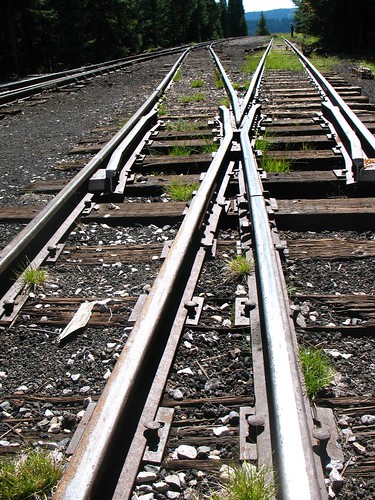
Which way to go?  The rail will make the decision for you.

through the Tanglefoot curve
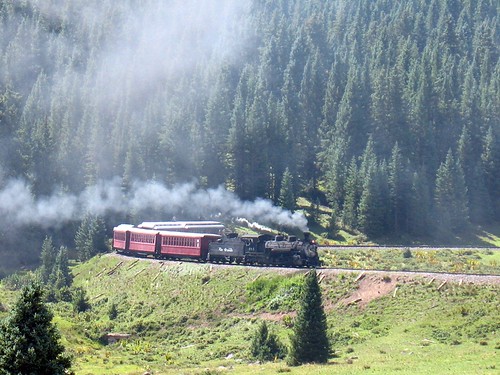
Here comes the narrow gauge steam train of the Cumbres and Toltec Railroad through the Tanglefoot curve, shaped nearly like a circle.  It is named after an event where someone jumped of the train at the beginning of the loop and run across to the other track, through brush and bushes.  But his foot got tangled, and he fell, so he missed the train he should have jumped back on.

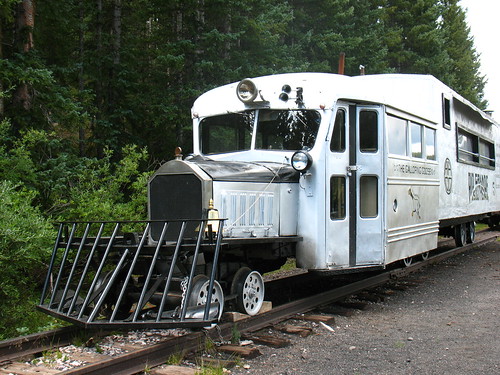
The Galloping Goose, a funny train contraption.
The Galloping Goose is a funny railroad contraption, unique to this part of the world. With its cowcatcher, silver box, and railroad bell, it looks like a hybrid of train, airplane, and small truck. When the narrow gauge railroads here started to do bad financially, one railroad (Rio Grande Southern) used these customized one-car trains to get mail and passengers to the different stations and save money. They were first made from Pierce Arrow cars.

baby fly agaric
The Rockies are home to lots of mushrooms, including ones that look just like Swedish 'flugsvamp' (fly agaric), which are popular Christmas decorations in Sweden (and on our Christmas tree too).  This 'baby' mushroom was about 5 cm in diameter.

Tuesday, November 9, 2010

Danger on the rail

Back in the late 1880s, railroading was a dangerous business. This map from the Spatial History Lab at Stanford University shows the number of accidents in Colorado during just 12 months in 1883-1884, with at least 100 accidents. It seems like most accidents happened at the Division Points (Denver, Pueblo, La Junta, and Salida), where there were large stations, with extensive railyards and a lot of switching trains back and forth.  Maybe those accidents weren't as bad as those happening out in the high mountain passes (such as Marshall Pass, up at 11 000 feet (over 3300 m) or so). Check out this amazing map of the Denver & Rio Grande Railroad's route up and through the Marshall Pass. The Marshall Pass is the home of the story about the famous phantom train, and has had many accidents over the years, like this one:

"Salida Record, Sept. 30, 1904: Yesterday evening train number 69 which leaves Salida at noon ran away down the western slope of Marshall Pass and as a result fourteen coal cars and the engine are a pile of wreckage at the bottom of the embankment. That no lives were lost is remarkable considering that this is as bad as any of the previous wrecks that have occurred at this exact spot, the last one having occurred about a year and a half ago when Harry Goldwater and Nelson Van Pelt lost their lives." (link)
  
Don't you find it remarkable that this text from over 100 years ago is using exactly the same grammar and words you might find in a newspaper today?  Or maybe, the person typing this in modified the text?  I don't think so though. This would not be true for Sweden, where the language was much more old-fashioned a hundred years ago, and quite different in both grammar and word choices. I wonder if this had to do with that the people that moved out west generally had less education and/or often immigrants and therefore needed 'simpler' grammar in their newspapers to understand better.  There is a nice absence of snobbishness and pretentiousness in these newspaper paragraphs.  Just the news, please. 

Just because of my thoughts above I had to look up a British newspaper from 1904 (Suffolk Free Press), and the grammar is more elaborate, just like I thought (I know, this is just one of hundreds of articles that day, so my statistical sampling is very poor...):
"On Wednesday afternoon a sad and terrible accident occurred to a little boy near Pentlow Mill. The little lad's name was Samuel Clarry aged 6 years, he was crossing the railway line opposite the flood gates near the Mill. His companions were on the other side of the metals and Clarry in his eagerness to join them did not notice the approaching train and essayed on to the line. In an instant the engine was upon him, the buffer knocking him down. The poor lad's right arm being completely severed from his body and his head frightfully mangled.  There have been many narrow squeaks at this place but this is the first fatality. P.C.Kent said the path over the railway was used a great deal during the summer as it led to the flour mill and to the overflow from the mill where children went to paddle." (link)

Of the places marked on this accident map, we visited Denver, Golden, Georgetown, Salida, Otto (which doesn't exist anymore, not even on Google Maps), Gunnison, Black Canyon, Montrose, Silverton, and Pueblo (now a horrific, run-down urban place).  Railroads, past and present, are really engraved into the Colorado landscape and history, and I don't seem to be able to stop writing about them.  Imagining the old times and tracing the steps of history fascinates me, and even more so in places where you can really see the old.  You can't really imagine steam trains in New York City anymore.

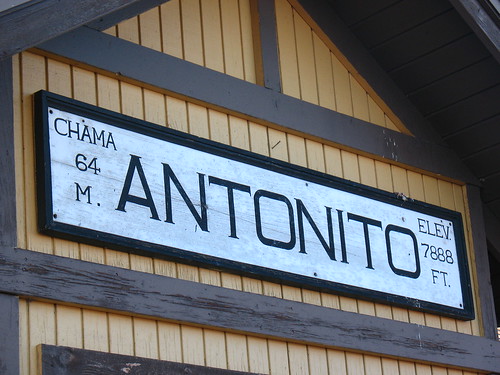
Antonito station, high altitude
 
I think it is interesting to note that there wasn't one single accident on the southernmost route from Silverton to Pueblo on this map (this is the line going through Durango, Chama, Antonito, and Alamosa).  Either they 'forgot' to report accidents, the mapmaker didn't have any data, there weren't any trains that year (I doubt that), or the southern engineers were masters at running trains.  That accident free route is the Denver & Rio Grande Railroad narrow gauge line that we rode, both from Durango to Silverton (will be posted here later), and from Antonito to Chama (see here). There weren't any accidents on this line in 2010 either, that I know of.

Wednesday, November 3, 2010

Rail thoughts...

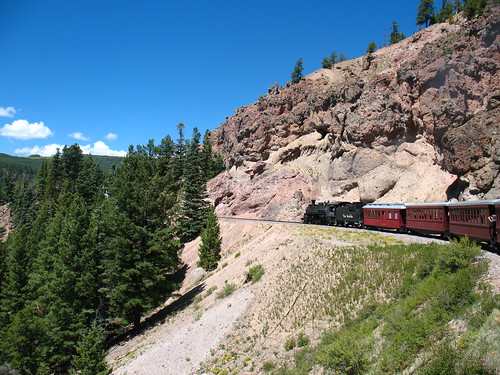
 passing the place of the old accident
A hundred years ago this was the way of traveling in style, but also out of necessity. Instead of bumping along in a stage coach over rocky roads, up and down for days at end, you could have a (rather) smooth ride in a railroad car - what a treat! Today we drive in our air conditioned or heated cars, up and down mountain passes, across deserts, through mountains, and over gulches on steel bridges and take it all for granted.  Only the weather can stop us, but rarely does.

million dollar highway
I wonder how many of us could survive if we suddenly were dumped back in the late 1800s - when basic things like hot showers, shampoo, clean clothes, edible food, and lice-free beds were scarce, non-existent, or only for the really rich. But the really rich would have had to take the stage coaches or steam trains into the mountains as well; when it came to transportation people became more equal.

Silver Plume station, 9178 feet above sea level
Riding the narrow gauge steam train on the "high line" over Cascade Canyon and Animas River might have been the thing to do back then as a tourist, just as today some people bungee jump, swim with sharks, and go whale watching. But the railroads, at least in the Rockies, were not built for tourists even if they filled that role later.  The railroads were built for financial reasons, and out of necessity.  The silver, gold, and iron needed to get out of the mountains to fill the pockets of the rich, and the food and supplies needed to get into the mountains to feed the miners. The rich tourists followed the iron tracks, up into new exciting territories.

leaving Osier with lots of smoke

An iron horse with many cars behind it was far more dependable and could pull so much more weight than stage coaches and mule trains (large packs of mules carrying supplies). Pork (bacon!), whiskey, flour, shovels, and hay were pulled into the high valleys to feed everybody, mostly men and mules. Before the railroads came, towns like Silverton were often isolated from the rest of the world for many months during the harsh winters.  What a life, and what a difference the steam trains must have made.

(written during our Colorado-New Mexico trip this past summer)

Monday, November 1, 2010

Cho-cho-chocolate-train

Carl Warner makes the most amazing things out of food, like this chocolate steam locomotive.  See more here.

Saturday, August 28, 2010

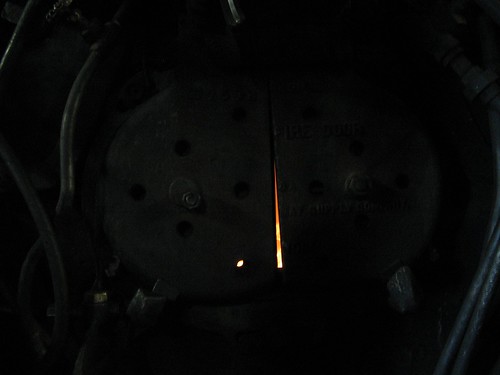
fire slit

Imagine that the only thing between you and a very hot, boiling steamy firebox that leads to a steam boiler that leads to pistons capable of hundreds, if not thousands of horse powers are two iron doors that you can open with a small handle - here it is! This is the closed doors to the firebox of steam locomotive 487 on the Cumbres & Toltec Scenic Railroad, the former narrow gauge part of the Denver and Rio Grande Western railroad in southern Colorado and northern New Mexico. The steam is still going strong, but only because of fantastic volunteers and other workers. We just happened to walk by and were invited up in the cab to see the real work environment of the engineer and fireman, thanks to some nice workers at this railroad in Chama. I have to say that I have never met such consistently nice people as in these areas. More photos from the center of the United States are coming, but I have 1500 photos or so to sort through :)

Wednesday, August 25, 2010

Shaking light

I can see the light at the end of the tunnel!   Literally... in this case.  This is from one of the tunnels on the Cumbres & Toltec Scenic Railroad, which goes between Chama (in New Mexico) and Antonito (in Colorado). We rode the 65 miles at 2500+ m elevation through forests, undeveloped valleys, and along sharp bends and high lines. That is higher than the highest mountain in Sweden. Gorgeous country, this America...

Being in a tunnel pulled by a 1925 K-36 steam engine gives you smoke and cinders in your hair, ears and nose, but it is a great experience. The photo above is a color photo by the way :)
More photos from our trip will be coming soon...