Showing posts with label metal. Show all posts

Tuesday, March 19, 2013

Art, art, art...... from the capital

A little less than a year ago I was visiting Washington DC and took a few hours to visit some of the amazing museums they have here.  Here is just some quick snapshots of some great art and design I saw, for your enjoyment:
Neil Jenney: Coat and Coated
Neil Jenney's 'Coat and Coated', Corcoran Gallery.  This is a self-referential piece of art.

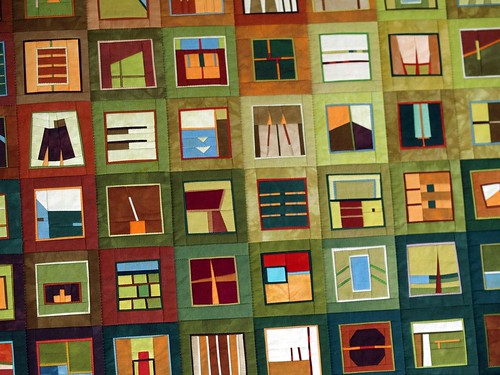
John Garret: Mixed media
 John Garret's 'Mixed media', Renwick Gallery.  Metal quilting...

Nest of Fifteen by Darryl and Karen Arawjo
Darryl and Karen Arawjo's 'Nest of Fifteen' handmade baskets, Renwick Gallery.

Larry Fuente: Game Fish
Larry Fuente's 'Game Fish', made from toy pieces mostly, Renwick Gallery. 

Michael James: Quilt #150, Rehoboth Meander
'Michael James' 'Quilt #150, Rehoboth Meander', Renwick Gallery.

stairs
Stairs inside the Museum of the American Indian.

facade, like a rock wall of sedimentary rock
The outside of the Museum of the American Indian, designed as a sedimentary rock wall.

Freer Gallery
Window into the courtyard of Freer Gallery.

Which one is your favorite?

Tuesday, February 26, 2013

American Craft Council Show in Baltimore, the good stuff

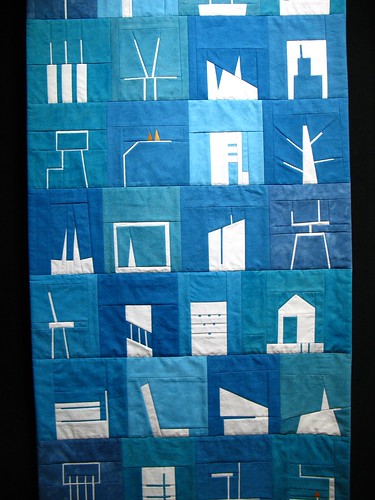
It all started with that I went to the Philadelphia Craft Show about two years ago and met the quilting artist Erin Wilson, whose work I love.  PP bought a little piece of her work for me (thanks) and from there it went down hill (which is a good thing!).  We saw her work again in May in Morven in Princeton, with several new pieces, including a quilt in green, browns, and reds that I am now the happy owner of!  I look at it every day. Here is a piece of it as a taste for you all.
A new amazing art quilt by Erin Wilson

And now Erin was exhibiting her new work again in Baltimore, at the American Craft Council Show.  I really have been pulled into the craft world through that first visit in Philadelphia. (Well, we also went to Baltimore to feed AREA who is in art school there :)

So, the American Craft Council Show is a giant thing, with maybe a thousand selected exhibitors. Everybody that is someone in the craft's world in the US is apparently there.   Everything is small-scale, handmade, and based on craft techniques.  Not everything has to be utilitarian, but I think the idea is that it has to be built on the idea of crafts in the past.  I am not sure, and I think the Craft Council isn't really sure either, because some things that I expected to see at this show are totally lacking.  More on that later some other time.  Now on to the good stuff.

new amazing quilts by Erin Wilsonnew amazing quilts by Erin Wilson
Two new amazing quilts by Erin Wilson.  The white one reminds me of winter and fog...  What do you see?

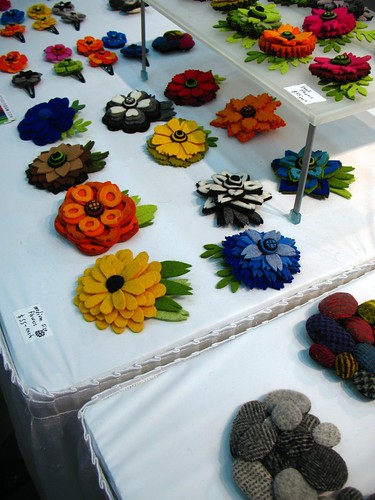
Great art in felt! Flower and rock brooches
I love the felt art by Danielle Gori-Montanelli. She cuts and glues felt together as legos, licorice pieces, flowers, rocks, and all kinds of other fantastic things.  Chocolate too!

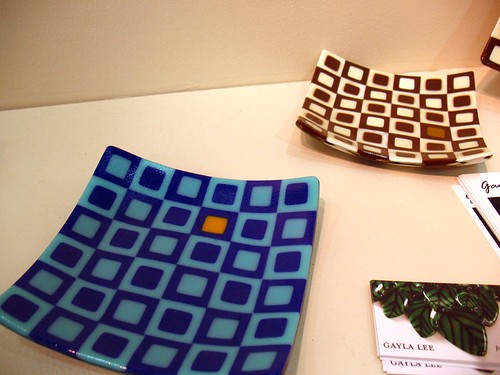
glass art by Gayla Lee
Gayla Lee's glass pieces were fascinating. 

painted bowls (geranium, grapes, apples, etc.) by Sherwood Forest Design
And this photo is for EH, look a bowl with painted geraniums! The bowls are made by Sherwood Forest Design. I think this was the only painted wooden bowls I saw there.  There was plenty of turned bowls in plain wood, but not much in this 'old-country' style.

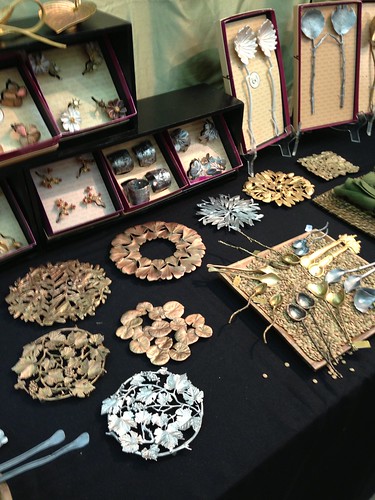
Michel Michaud metal designs from botanical objects
This I like!  Michael Michaud takes nature's designs, mostly botanical, and cast jewelry pieces out of them.  I own several and love them!  Actually, right now when I write this I am wearing his lilac flower ear rings.

mediumberriesdkblue659longpodsamber584
And here is my new find!  Andrea Haffner's designs, jewelry with natural twists and turns.  She collects natural objects, mostly plants, dries them them embeddes them in resin inside small metal boxes.  It is all handmade, unique, fantastic and gorgeous.I bought one of her small pendants, a darkblue box with a tiny mussel and three pearls inside, like a piece of a moonlit beach. [images from Andrea Haffner, used with permission]

There were many more interesting things to see, but I was running out of battery in my camera.  If you want to explore some more things we liked, check out: 
 Bryan Hopkins, Functional and Dysfunctional Porcelain
Deborah and Richard Bloom, obsidian windchimes
Holly Tornheim, wood carvings
Liz Alpert Fay, hooked rugs and much more
Wendy Stevens, metal handbags
Laura Baring-Gould Studios, bronze sculptures
JAK designs and their tulip scarves

The not so great stuff gets a separate blog post at some other time, maybe, maybe not.  We will see.


Thursday, February 2, 2012

Book review: Wildwood Wisdom by Ellsworth Jaeger

This is a most wonderful book.

I have read this book nearly from the first page to the last, and looked at the over 400 handdrawn wonderful illustrations, and contemplated the ways and means that people in the past survived and thrived in the wilderness.  This book has been my late-night companion before my eyes close for sleep for maybe a month or more, and it has been a great read.

Wildwood Wisdom by Ellsworth Jaeger was published in 1945, and has recently been reprinted by First Shelter Publishing, a company that specializes in 'keeping worthy old books in print'.  Jaeger also provide all the amazing and lovely illustrations.

So, what is the book about?  It is about how to survive in the North American wilderness pre-1950s, before nylon, Goretex, GPS, cell phones, and all the fancy equipment we have today.  It builds a lot on Native American tools and techniques, as well as the European trappers and explorers of the 1700s and 1800s.

It is a how-to-book for anything you might need to know while living outdoors.  How to start a fire?  Jaeger presents a dozen ways.  How to skin a skunk? No problem, just be careful and cut off the skunky glands by the tail.  How to make snowshoes?  It is here too.  Food, shelter, bathroom issues, edible and toxic plants, making buckskin and pelts, stalking animals, building shelves out of tree fungi, and how to cook over open fire - just open and read.  And admire the illustrations...

Everything is practial and with exact enough detail that you can copy the methods and sew your own buckskin coat, make a pancake on a hot rock, or built a tepee (see image to the right).  I learned so much from this book; things I might never need to know, but that I love to know.  Today someone at work said - "you are like a sponge soaking up knowledge, and that is so wonderful", and I feel just like that.  THere is so much interesting things out there, from the past, from today, from the future, and real things, hands-on things that exist.  I am not sure things on the internet really exist, but an ax or a pancake, they do really exist.

So, for anybody that goes camping, kayaking, or hiking, this is the book to get them for Christmas.  It works in Europe too, even if you don't have skunks, rattlesnakes, or poison ivy.

The only thing I noticed that was wrong was some of the information about edible fungi.  Some of the mushrooms that were considered edible in the 1940s have now been reevaluated to 'Don't ever think about eating these'.  Otherwise, the book is a true goldmine of great information.  Get it while you can!

Sunday, October 16, 2011

What do you think about this ceiling lamp?

Gorgeous? Ugly? Weird? Wonderful?  It is called ”Alaska”, and costs 7600 SEK (which is about $1500). Photo credit Fredrik Funk, and the lamp is sold by Watt & Veke in Sweden.   They have more of the same mixed style, look at this: Aspen and Finere.

I think this lamp is very ugly.  When you see sticks like this out in nature, they are gorgeous.  When Andy Goldsworthy puts together his art of a jumble of sticks along a seashore it is gorgeous (see link and photo here). But this, this reminds me of a crow nest, and feels far to 'over-designed' ("utstuderat" is what I wanted to say, but I don't know that expression in English). The contrast between the wood and the black is too much!  I also think it will make weird shadows from the lamps, so not very functional either. OK, that is my opinion, what is yours? I bet you think differently! :)

More crazy nature-inspired design things here. 

Wednesday, October 5, 2011

Stamp of the Day: Eskilstuna

Can you believe it?  My hometown in Sweden has a Swedish stamp! This is Eskilstuna, a town about an hour west of Stockholm.  Listed at the bottom of the stamp is the friendship cities of Eskilstuna in Norway, Finland, Iceland, and Denmark.  The images are typical for the town, the double-towered cathedral (not as old as it looks like), a sculpture in Torshalla by local artist Ebeling (I think), and the old 16th century blacksmith houses in the old historic town area for traditional trades (Rademachersmedjorna).  When I grew up it was mostly famous for being the home of Volvo BM's factory of giant dump trucks, a hospital, the home of one of the ABBA girls, and... I can't remember.  I am sure it has changed now.

Friday, August 19, 2011

Container art

I find this facinating, not only from the perspective of art but also math.

Great work, Michael Johansson. Haven't you thought about this - how much can you fit into a specific scale and also keep it upright, without falling over?  It is just that Michael works on a larger scale than we usually imagine (not the three stories in the building behind the art.). I think the Volvo cars are great for this purpose, due to their particular angular shapes. Fantastic work! It is well worth your time to check out his website.

(Photo copyright Michael Johansson, from his installation in Umeå, Sweden)

Monday, August 15, 2011

Perimeter grilling? Good or bad?

Are these bent grill skewers from Sagaform smart or just another thing we do not need and the companies want us to spend money on?  I haven't really decided yet, but I am leaning towards the unneeded.  First, you can't fit many of these on the grill, with the straight ones you can fit many, many.  Second, you just take the food off the spit anyway before you eat it, so who cares if it fits better on the plate.  OK, that's it.  It is a stupid thing. Probably invented by someone that only sets tables and designs interiors, and never really grills for many for real.

Thursday, June 2, 2011

Stamp of today is an adjustable wrench ('skiftnyckel' =adjustable key), a Swedish invention patented by Johan Petter Johansson. I love these old drawings with their letters and lines for the hollow parts you can't see from the outside.  I like the design with the postage inside the mouth of the wrench too, 2 kronor 70 öre. growing up in Sweden I didn't think these wrenches were such a big deal, but I learned better after hearing from the experts. 


You can see on the picture how these developed from the ones made in Enköping, Sweden, in the 1880s to today's wrenches sold by Bahco (still in Enköping). They are nearly the same! (Click on photo for larger version.  Photo by Theresemk and from Wikipedia. )

Thursday, May 5, 2011

How about some classic, simple and beautiful design?

I love clean lines, organic forms, and purposeful meaning to shapes and parts on things made by humans.  Not a mess, not a mix of too many colors, and functionality.  In the past, what was beautiful and well-made and worked well lasted. These days you buy a salad spinner knowing it will break in a few months or a year (even if it has 'lifetime warranty').  Nobody would have made or bought a rake a hundred years ago if they thought it would just break fast.  I really, really, really dislike things that are not made to last and be used for real.

Anyway, we spent an evening in Hopewell, NJ, recently, looking at vintage cars, and here are some reflections in and about shiny objects:

classic clock on a night of classic cars
A classic.  Reminds me of the clocks outside my elementary school in Sweden.

old Ford truck
What - no GPS?  No Check Engine light? (Which always comes on, at least on my Subaru, and then goes off, for no reason at all.)  But this is all you need, I think, and it was on a 1932 Ford truck. Red, of course.

lamprey mouth on the Corvette
I can't decide what this Corvette grill reminds me of.  A grill of course, but more a lamprey mouth, a leech with sawing teeth, or a shark? Or jail cell window? It looks pretty mean. And here is a different one, similar style.
gangster car from the 30s
I love these 'gangster cars', which I think look like something out of movies about Al Capone's Chicago.  Did you know he had a bullet-proof car?
a classic VW
A classic.  Practical. Box. Works. Well. But mint-green?
US in Lotus
The US in LOTUS.  OK, you can drool with these guys.  I think older cars are a lot more fun than these, so how about this one? Porsche 911 T Targa from 1971 - first owned by the King of Sweden. But most things with four wheels that don't look like today's mainstream cars are interesting.
gorgeous blue
I love blue.  There is no other reason for this photo.
flipped up
Tiny engines under giant hoods. Flip-flop.

Thursday, April 21, 2011

Chicago memory, part 3 - fake copper

If this had been real copper it would have been gone by now, but it is painted wood on the outside of the historically landmarked Auditorium building in Chicago. It is located on S Michigan Avenue, a street that goes from the fanciest addresses (think 5th Ave in NY) and down south to areas that have been very run down for many, many years (kind of like 5th Avenue in New York going up into Harlem, but here it is southwards). Along S Michigan Avenue are many old classic hotels and buildings, and it is also next to the large city park with the Shedd Aquarium and Field Museum, veterans from the last-last century (that is the 19th century, not 20th..).
smallest No Trespassing sign I have ever seen
On this building, which now seems boarded up, was the tiniest and nicest No trespassing sign I have ever seen - about 4 x 8 cm and in brass.

Tuesday, December 7, 2010

immature scrap metal without bones


Book covers can be great.  Which one of these would you like to read?  (Click on the images to see larger versions.)

Sunday, October 17, 2010

Like a snake nest...


rusty chains, originally uploaded by Vilseskogen.

... are these old rusty chains at the Argo Gold Mine in Idaho Springs, Colorado.

Saturday, July 31, 2010

Friday, July 30, 2010

Happy Birthday, OK!

rust eats away

Here is some smily rust for you!
(Seen in Susquehanna Depot, NY State, on an old Erie railroad box car, which had seen better days. More photos from this place in my photostream.)

Friday, March 19, 2010

Stamp of the day: Power tower


Not that many stamps have radio towers on them...
"The VLF transmitter Grimeton was used until the 1950's for transatlantic radio telegraphy to Radio Central in Long Island, New York, USA. From the 1960's until 1996 it was used for transmitting orders to submarines in the Swedish Navy." read more here...

Sunday, March 7, 2010

OK Snapshot: Älg å svälj

OK reports: I found this on the street just half an hour ago. I picked it
up, thinking of the Americans in the family. :)

LS adds: this must be from a 'mousserande öl' (moussing beer). Or maybe the
Moose Drool beer?

Wednesday, August 12, 2009

Mining down in history - a visit to Falu Gruva

Falun Historical Mine (Falu gruva) in Falun and the province of Dalarna in Sweden is a great place to get a sense of many things, such as history, hard work, darkness, and the power of minerals. It is also called Stora Kopparberg (Great Copper Mountain, and the company Stora started in 1288, must be one of the oldest in the world). We went there during our roadtrip to descend into the areas of the mine that was mined in the 1700s and 1800s. First they used fire and water to get the copper ore out (fire mining), then gunpowder, and finally, thanks to Nobel, dynamite. The 45 min tour took us through low tunnels, dripping walls and ceilings (thanks for the hats and raincoats!), and large open rooms inside the mine. Down at 67 meters we saw a living Christmas tree, green and fresh, but it hadn't been watered for 4 years. It had been totally preserved by the minerals in the water in the mine. (More photos from Falun on Flickr.)

The miners had it hard, they had to descend on long stairs or by riding the ore bucket down and jump off at the right tunnel entrance, the bucket didn't stop. More miners apparently died from missing the jump, than in other accidents in the mine. The mining started already in the 1300s, and this area has been the center for the mining and metal industry in Sweden since then. One wall is a guestbook with signatures from many of the kings and queens of Scandinavia. The all so common red paint on Swedish buildings also comes from this mine and is called 'Falu rödfärg' (Falu red paint). It was a mining byproduct and was the cheapest paint available, so it became very popular.

Linneaus visited the mine in the 1700s as part of his travels in Dalarna and was horrified by the conditions and drinking habit of the mine workers.
'Linnaeus had the opinion that the people of Dalarna lived a sober and healthy life apart from those in Falun connected with the mine. The miners often died of stone dust in their lungs. These miners also used to drink great quantities of ale. A new guest was expected to drink, without pausing, two or three great tankards of ale when he arrived and Linnaeus wrote: "your belly might burst, your head crack open and your health, the joy of all life, be abandoned." '

Linneaus was on the trip as the world's first ethnobotanist and noted that: "when there was a shortage of flour, trees were chopped down and the bark ground to eke out the flour. Linnaeus thought the people should grow potatoes instead, but many were still skeptical as to this new-fangled vegetable."
People didn't understand that you could only eat the tubers and not the leaves of the potatoes, so rumors that it was a deadly plant abound. (link to more Linnaeus information)


Outside the mine there were other historical things to look at. The Swedish Ferguson Tractor organization had its local meet with about 5 old grey beasts on display. Inside the Mining Center, you could admire some classic motorcycles, including an old American Indian, an iceracing bike (with nasty dubbs on the tires), and the bike that Sweden won VM in Speedway with. An old Swedish SJ railroad boxcar was displayed on the plaza, painted in the ubiquitous red of course with white lettering and a white royal crown. I have always wondered what all the numbers on the box cars mean. There were also prominently displayed posts with dog poop bags on the plaza - in Sweden the owner is always responsible to 'pick up after your dog'.


PS. Falun is a World Heritage site. The mining stopped in 1992.