Showing posts with label nature writing. Show all posts

Monday, December 31, 2012

October skies

(I wrote this in October while driving to work, but forgot to post it until now. There should be a photo from the Delaware-Raritan Canal path with this, but that seem to have been lost. I think you might be able to imagine this anyway. )

October skies have high ceilings.
Suddenly there is light again in the forest.
Dark tall trees stand naked, with ther leafy clothes on the forest floor.
Gold, amber, umbra shimmer along suddenly invisible paths.
Pure iceblue sky.
A red, red maple holds fast against frost and fall storms, but even it will give up its foliage.
Despite destruction, death and decay this is a happy time.
We are tired of hot, humid and hellish summers, the overbearing greenishness of if all.
The overabundance of tomatoes, zucchinis, and peppers.
It is a time for a pause, a piece of rest.
Brown branches reach out in October air, filled with spores, smells of soils and moisture, and interveawed by glittering spiderwebs.
We are all prepared for November now.

Monday, November 5, 2012

Book review: We Took to the Woods by Louise Dickinson Rich


I had heard about this classic book first published in 1942 and never out of print since then, as a must read for people that were interested in sustainable living and organic farming. When I started reading it, I immediately realized that this wonderful gem of a book doesn’t really have anything to do with sustainable living and organic farming, however, it is a great and fun read about how to survive as a family that lives partly isolated among the mountains and lakes of northwestern Maine. They lived on a 5 mile long road that connected two lakes that functioned as waterways.  Every fall and every spring they were totally isolated while the ice on the lakes froze or unfroze, until either a car on the ice or a boat on the water could again connect them to the ‘outside’.   

Their life is content, but not sustainable in our sense that you can live on the land without anything from the outside – they get their income from transporting tourists and logging supplies along their 5-mile road, they need to ‘import’ most food and all other supplies like gasoline, engine parts, and kerosene, and only get deer meat, fresh fish, and some corn locally (their back yard).  

Louise moved to ‘the woods’ when she got married, and subsequently had a baby during a winter storm (without problems), and at one point didn’t leave the ‘neighborhood’ of the few neighbors within a couple of miles away for a few years.  But people came to them, timber workers in logging camps in the winter, tourists looking for wilderness in the summer.  She describes her life, her practical problems with food, storms, clothes, and cooking, and her love for the nature and culture of the local people with great love and humor.   

You smile when you read it, and the writing is suffused with common sense that is ever more important in even today’s world, 70 years later, and eons away from a cottage without electricity.   It is a wonderful read, and Louise puts life in great perspective, looking out from a mountain top in Maine onto the world and its stresses and overabundance of things we don’t really need to thrive. So read the book, it is great!

And of course, in light of the recent horrific hurricane Sandy, an experience that will taint our lives in the future more than we expect, I think, a book like this is even more relevant.  What is important in life, really? What do you need to survive, to love, and to be happy?  It certainly isn’t instant gratification through fast food, expensive clothes, or pretty, but useless things.  Recently I have been very happy over having a non-damaged house and a safe family after the storm, over the incredibly orange sunrises we have had, and the fact that great books work without electric power of any kind.  That is, real printed books on paper, my favorite kind of book.

Some select quotes from this book to illustrate these points, and remember, this was written in 1942, not 2012:

“Christmas in the woods is much better than Christmas on the Outside. We do exactly what we want to do about it, not what we have to do because the neighbors will think it’s funny if we don’t; or because of the kids, who will judge our efforts not by their own standards but by the standards set up by the parents of other kids. We don’t have any synthetic pre-Christmas build-up – no shop window displays, no carol singers in department stores, no competition in the matter of lighting effects over front doors.”

“Here I can be a rotten housekeeper, and it doesn’t make much difference.  After all, this is the woods. People don’t expect quite so much in the line of shining silver, polished glass, and spotless woodwork. […] Now I am learning to spend my time wisely; and I don’t think it’s very wise to spend two hours waxing the living-room floor on a lovely day when I could be out fishing. “

“We went up the road and across Pond-in-the-River Dam just as the sunlight struck the tops of the trees on the ridge. The valley was still in shadow, with steam rising white from the churning water and turning to a lovely pearly pink as it reached the sun-shot air above. I knew how fish feel as they swim about in the depths and look up to see the light of day above them.”

Saturday, April 2, 2011

Book review: The outermost house by Henry Beston

Henry Beston decided to try to live a full year in a tiny cottage on the sand dunes of Cape Cod, that little shoe-like stretch of land that juts out below Boston on North America's East Coast and frequently battered by stormy Nor'Easters.  This was in 1926, and his only human companions were the people at the Coast Guard Stations, who walked the beach nightly to look for ships in distress, since this is a famously disastrous coastline with many sandbars, bad weather, and stormy skies.  But the ships and people form only a small part of his diary, which is probably among the best nature writing I have read in English.

He describes, feels, and paints with words the migration of the seabirds, the swallows in the air, insect life, stranded fishes, and grassy dunes.  Straightforward, gorgeous, and filled with impressionistic sentences, this is a wonderful book to read.  Beston describes a different time, without phones and regular transportation, but the same birds are still flying north every spring, and the same beach plums are ripening in September.

I got my 1949 edition on Bookmooch, but this title is still in print.  It is considered a classic, but I have read many classics that don't live up to becoming my own classic books.  This one is far beyond classic.

Beston's cottage and land was given to the Audobon Society in 1960, and was finally reclaimed by the sea in 1978, when the storms had eroded the beach so much that the house was swept away during a big winterstorm.

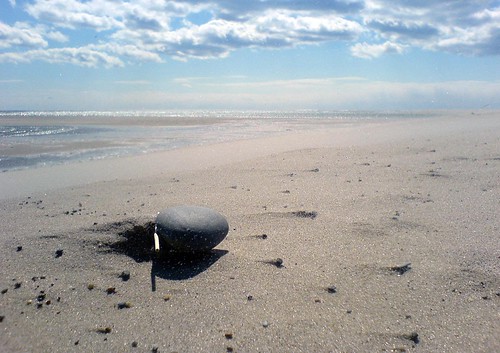
 Cape Cod Beach Sandstorm
(Cape Cod Beach Sandstorm in April by Bob Gaffney on Flickr)

Here are just a few examples from the book:   

[Beston's foreword]   "Nature is a part of our humanity, and without some awareness and experience of that divine mystery man ceases to be man. When the Pleiades and the wind in the grass are no longer a part of the human spirit, a part of very flesh and bone, man becomes, as it were, a kind of cosmic outlaw, having neither the completeness and integrity of the animal nor the birthright of a true humanity."

[autumn, ocean and birds]  "For the animal shall not be measured by man. In a world older and more complete than ours they move finished and complete, gifted with extensions of the senses we have lost or never attained, living by voices we shall never hear. They are not brethren, they are not underlings; they are other nations, caught with ourselves in the net of life and time, fellow prisoners of the splendour and travail of the earth.  "
 
[midvinter] "A year indoors is a journey along a paper calendar; a year in outer nature is the accomplishment of a tremendous ritual. To share in it, one must have a knowledge of the pilgrimages of the sun, and something of that natural sense of him and feeling for him which made even the most primitive people mark the summer limits of his advance and the last December ebb of his decline."
 
[midvinter] "Animal life has disappeared into the chill air, the heavy, lifeless sand.  On the surface, nothing remains of the insect world.  That multiplicity of insect tracks, those fantastic ribbons which grasshoppers, promenading flies, spiders, and beetles printed on the dunes as they went about their hungry and mysterious purposes, have come to an end in this world and left it all the poorer."

Friday, October 30, 2009

Very Swedish childhood...

"Hösten städar sig själv med vindar."
(The autumn is cleaning itself with winds.)
(first line in a poem named "Höst", Fall, by Harry Martinson).

This summer we went to the Nordic Watercolor Museum in Skärhamn and saw an exhibit of the paintings by Elsa Beskow. In the early 1900s she started to write and illustrate children's book in a style that became famous and much loved in Sweden. When I grew up we probably had all her books, even if it was 50 years at least since they were first published. Her drawings, made at the kitchen table while she was taking care of her 5 children, are amazing in their clear colors and accurate depiction of nature, both animals and plants. But there is magic and wonder in there too - a feeling of amazement and joy. Here are some more of her drawings (click on the small images to see them bigger). I always thought that the yellow aspen leaves (falling in the drawing on the left) looked just like golden coins, but I am not sure if I read that in her book first or came up with it myself. It was probably Elsa Beskow...


Enjoy!

Monday, June 8, 2009

Black light

Crows - Towards the sun i fly, not as Icarus.

This poem was in my inbox today, and I really liked it, especially the visual contrasts of red and black, crows flying against light skies, and sunflower fields...

Night in Day

The night never wants to end, to give itself over
to light. So it traps itself in things: obsidian, crows.
Even on summer solstice, the day of light's great
triumph, where fields of sunflowers guzzle in the sun--
we break open the watermelon and spit out
black seeds, bits of night glistening on the grass.


sent out through the American Life in Poetry e-mail column, hosted by Ted Kooser (one of my favorites), which is worth subscribing to and is free. You can sign up on the American Life in Poetry home page. (photo by Hashmil on Flickr)

Wednesday, May 21, 2008

"Archeological" find on my desk

I was digging through old papers and found some paragraphs I had written the first year we moved to this house, now 4 years ago. It is in Swedish, I could never write this well in English, so the translation isn't the same thing. I thought it really describes the area here, so different from where I grew up in Sweden, and still similar.

"I USAs mest tätbefolkade stat, bortom motorvägar och flygplatser, finns ett skogsklätt berg. Det är egentligen ingen märkvärdigt berg, bara drygt 300 m över havsytan, men det sträcker ut sig över några mil mot Delaware-floden. Sourland Mountain, det näringsfattiga berget, reser sig från de bördiga åkrarna runt omkring. Överdådig intensiv lövskog klär nu berget och under vårnätterna kväker de små bruna lövgrodorna livligt. Grackle-fåglarna med sina metalliskt skimrande huvuden på sned väntar ivrigt vid fågelbordet. När de flyger vrider de den breda stjärten som ett vindroder genom luften, styr ömsom hit, ömsom dit. Ovan dom i den blå skyn hänger kalkongamarna i osynliga trådar från himmelen, med majestätiskt stela vingar spanar de efter skrovmål."

Simple translation:
"In the most densely populated state of the US, away from highways and airports, there is a forested mountain. It really isn't a very special mountain, only about 900 feet above the sea, but it stretches itself out for a dozen miles towards the Delaware River. Sourland Mountain, the nutrient poor mountain, rises up from the fertile farmland around it. Amazing intensive deciduous forest now cloaks the mountain and during the spring nights the small brown leaf frogs are quaking lively. The grackles with their metallic shimmering and tilted heads are eagerly waiting at the bird feeder. When they fly they turn the broad tail like a wind rudder through the air, first this way, then the other. Above the, in the blue sky the turkey vultures hang like in unseen strands from heaven; with royally stiff wings they search for the big feast."

That is really how it is here, New Jersey nature at its best.