Tuesday, July 23, 2013
Sunday, February 17, 2013
As per request: Homemade pizza recipe

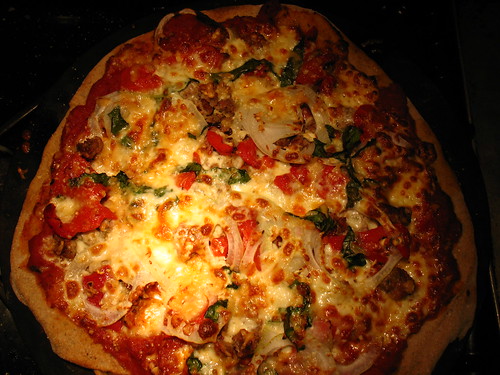
We have a Friday night tradition since the last couple of years - homemade thin-crust pizza. After maybe 100 times of making pizza dough, tomato sauce and toppings, I think we have it down to near perfection now. So, dear readers, as per request from several of you, here are the instructions.
Our dough was initially based on this recipe by Barbara Kingsolver, but we have modified it slightly. Look for the heading for the part of the recipe you need.
TOOLS
As for tools, we use a KitchenAid mixer to mix the dough (optional), a rolling pin (just regular wood), and a ceramic pizza stone (you can use a regular cookie sheet, but a stone makes a big difference if you are going to make pizza often).
Our stone is as large as possible and round, and so light that you can lift it in and out of the oven easily. I wouldn't recommend those superthick real stones. I can see a lot of crushed toes and achy backs from using those in a regular kitchen. Our stone is made of ceramics, very durable, started out as white but is now black (which is normal), and less than 1/2 inch (1 cm thick). It is very easy to lift the stone out of the oven with the pizza on it, so no need to fiddle with wooden paddles or peels and other things you don't really need. Just get a thin stone and use your regular tools to lift the pizza over to a serving plate or serve it on the stone. And of course you can bake bread on the stone of you like too.
A pizza slicer is good, but think about what is below the pizza. Soft aluminum might get scratched, and I don't really know if you can use it directly on the stone (we use heavy-duty scissors to cut our pizza mostly).
The recipe below makes 4 wonderful 16-inch pizzas (30 cm).
PIZZA DOUGH (partly whole-wheat, healthier style)
Time (active): 10 min. Time (waiting): 2-10 hours.
Ingredients:
- 1.5 cups of hot water (not boiling, about 42 degrees C, so varm but not superhot - I just use it out of the hot water faucet)
- 1 package of dry yeast
- 1 tablespoon olive oil
- 1 tablespoon dried basil or other Italian herbs
- 1 teaspoon salt
- 1 tsp ground flaxseed (totally optional, just adds fiber)
- 1.5 cups whole wheat flour
- 2+ cups white flour (organic bread flour is good, but any regular all-purpose flour is OK)
Time: Most often I just make the dough in the morning, leave it out on the counter the whole day (8-10 hours), and when I come home for dinner the dough has risen and is ready. You can of course make the dough 2-3 hours before you want to make the pizza, that is fine too, but then you might have to put the dough in a slightly warmer place than we do.
Using a standing mixer or not: This is totally up to you. If you don't use a mixer, just mix by hand and knead the dough very thoroughly. No clumps here.
Making the dough:
- Put the hot water in the bowl. Add the dry yeast. Let sit a minute or two.
- Add olive oil, salt, and dried herbs. (And flaxseed if you use it). Mix thoroughly.
- Add 1.5 cups of whole-wheat flour. Mix thoroughly.
- Add white flour 0.5 cup at the time and mix in-between. How much you need to add depends on how dense your flour is. So go slowly and add enough so that the dough becomes soft and slightly sticky, not dense and not sticky at all (=too much). You should be able to lift up the dough in one ball without it falling apart, and the dough should not stick to the wall, but it should still be slightly sticky. Most often I add about 2 cups of white flour, sometimes slightly more, sometimes slightly less.
- Let the dough sit in peace in the bowl under some plastic wrap and or kitchen towel for a few hours (up to 10 hours is OK). Don't put it in the fridge. The dough will double in size, so make sure your bowl is big enough. Some people spray or coat the dough with olive oil, I put plastic wrap over the bowl instead to avoid it drying out during the day.
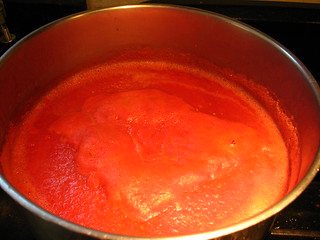
TOMATO SAUCE (homemade from canned tomatoes)
Time: 1 hour
We like chopped or strained, fire-roasted, San Marzano, plum or any other kind of Italian tomatoes for our sauce. Pomi is a good brand. Watch out for canned tomatoes with a lot of salt or other things added to them - you just want plain tomatoes (with none or a little salt). Fresh tomatoes in the summer are wonderful, but need to cook down a bit, since they are quite watery, so add cooking time then. Don't even try making this from flavor-less tomatoes from the store in the winter, then just use canned tomatoes. Your own sauce will be better than store-bought pizza sauce, but if you don't have time, buy a good brand of good sauce without funny things in it.
Ingredients:
- 1 large can of tomatoes (28 oz or so, or use two small cans)
- 3-6 cloves of garlic
- 1 tablespoon olive oil
- fresh basil (chopped, as much as you like)
- black pepper
- salt (maybe)
How to make the sauce:
- Chop up the garlic into tiny pieces.
- Add the olive oil to a pot, heat it up a bit, and then add the garlic. Stir and let the garlic become yellow (not brown!), and then add the tomatoes.
- Let it all simmer on low temperature for a long time (the longer the better), but don't let the sauce become so thick it burns at the bottom, then just turn it off. You start out with a thinner sauce and the simmering will make it thicker.
- After simmering for a while, add cut up fresh basil leaves and black pepper, to taste.
- When the sauce is done, check if you need to add some salt. It all depends on how much salt was in the canned tomatoes.

TOPPINGS
All our pizzas have some kind of cheese on them, and this layer is added last, on top. Mostly it is grated mozzarella, sometimes parmesan, and sometimes ricotta or goat cheese. We never use other kind of 'regular' cheeses, like cheddar, jarlsberg, etc. They just don't act the same good way on top of a pizza and are only emergency-cheeses.
For all ingredients (except the sauce), try to make them as dry as possible. Remove wetness by draining them or blog away fat with paper towels.
- Italian sausage, hot or mild. Cook this in a frying pan before adding to the pizza (this also gets rid of a lot of fat). (Swedes: this is NOT hot dogs. This is ground up meat sold as fresh sausage, uncooked. If you want to imitate this in Sweden, buy ground meat, add lots of spices and herbs, and then fry it up so the meat is all in little chunks).
- Pepperoni sausage or chorizo (cut up, not cooked)
- Thin-sliced onion, raw, or cooked so it caramelizes
- Thin-sliced mushrooms, fresh (we NEVER use canned)
- Fresh basil
- Fresh green or red peppers, thinly sliced
- Roasted red peppers, canned, drained and dried on paper towels
- Olives, pitted and cut in half, drained. (Black olives are best)
- Artichoke hearts, canned, cut in half and drained
- Shrimp, thawed and shelled, dry on paper towels (you cook these on top of the pizza, so you add them raw to the pizza)
- Anchovy, drained on paper towels
- Very thinly sliced eggplant
- Arugula leaves, fresh (to add at the end)
- Spinach, cooked, or fresh spinach (which can be watery)
- Tomatoes, fresh from the garden in summer, great, but watery :)
- Asparagus, fresh or slightly cooked
Here are some of our favorite combinations (all have tomato sauce):
- Margarita: tomato sauce, basil, and mozzarella.
- Prosciutto special: Bake a pizza with tomato sauce, basil and mozzarella. When 2 min are left on the baking time, take out the pizza and add large thin slices of prosciutto over it, and a little parmesan. Then back into the oven for a minute, then take out and add fresh small arugula over it.
- Mushroom, sausage and onion: This is just what it is called. Yum!
- Anchovy and onion heaven: Add lots of sliced raw onion and then anchovy and parmesan plus mozzarella.
- SAR combination: Shrimp, artichoke and roasted red pepper.
- Burger pizza: Instead of sausage, cook burger meat and add to pizza with some onion. Then the pizza is cooked, add fresh, chopped lettuce on top. Eat. Good. Food.
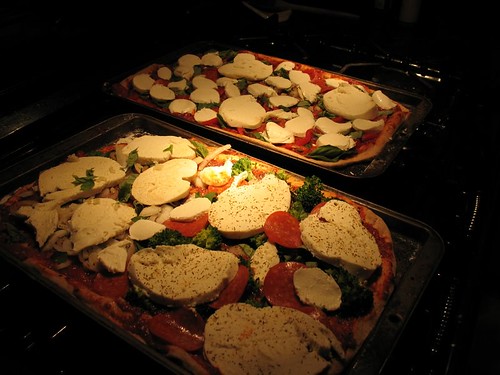
MAKING THE PIZZA AND COOKING IT
(Start this at least an hour before you want to eat.)
- Put the pizza stone in the oven. It needs to be put into a cold oven, not hot (this is important!), and needs to heat up for at least 30 min. (Skip this step if you don't use a stone)
- Turn the oven to highest temperature (450 F for us). [This is why you should NOT use baking paper for pizza. It might ignite at these high temperatures). We have a convection oven, if you don't, just use the regular setting for overall heat.
- On a large clean surface, add some white flour and put the dough on top of it. If the dough is very loose, you can knead in some more flour now, but usually you don't have too. It depends if it sticks or not. Cut the raised dough ball into 4 pieces, and put three pieces aside. Take one of the balls and roll it out into a round area with a rolling pin, use flour underneath and flip it over now and then so it doesn't stick. When the size is right, stop. The dough is thin, this makes thin-crust pizza (so, much less carbs than thick crust pizza.)
- When the oven is hot and the stone has warmed up, take the stone out of the oven. It will be very hot. Put the rolled out dough on the stone, let it sit for 2-3 min to cook on the lower side, then flip it over with two spatulas so the other side can cook a little. Add tomato sauce and all the toppings.
- (Note for people that don't use baking stones. Add your dough to a floured cookie sheet, and cook the dough by itself in the oven for 5 min or so, than take the dough out and add the toppings, and then back in the oven.)
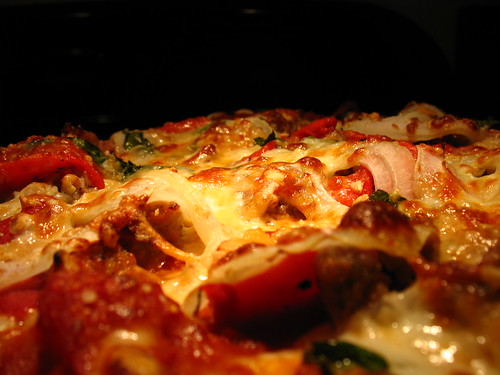
- Put the pizza in the oven, cook it for 8-12 min (this depends on your toppings and your oven). You want the edge to be a little brown and the cheese to have started to brown on top. If your pizza is done but still very wet and saucy, that is probably because you used very wet ingredients (shrimp, fresh mozzarella, fresh peppers, etc.). Don't worry about it, just eat it with fork and knife.
- Take the pizza out, slice and eat. Enjoy!
- If you want to make more pizzas (you have 3 doughballs left!), just remove the pizza you made from the stone, put the stone back in the oven to reheat for 5 min, and make one more. We eat and make 3-4 pizzas every Friday night and make them as we go along, since they only need to cook for such a short time.
You can freeze the dough, just put it in a plastic bag and seal. To use frozen dough, remove from freezer, thaw at room temperature or slightly above in a bowl with some flour. Remember that the frozen dough has already risen, so it will not get bigger than the piece you have. So roll it out, and make the pizza bottoms as usual. I find that fresh dough is better, because it is slightly fluffier when you bake it, but frozen is OK too.
The dough is also perfect for flatbreads, pierogies, and other small pockets of food.
RESULT
Posted by
LS
at
9:55 AM
2
comments
Monday, December 24, 2012
Christmas stories from New Jersey
Reflections and lessons learned this year.
1. It is actually snowing on our Christmas Eve! Snowing, unexpected, and wonderful. We are getting a white Christmas after all. Lets see if it lasts until tomorrow morning.
2. I know you should buy local, but sometimes you need to buy further-local to get the really good stuff: Christmas ham from Dakins Farm in Vermont, and many kinds of Vermont cheeses... And yes, red currants from Chile, which is a sin, but they tasted better than expected. Homemade green tomato chutney balanced it all out on the cheese plate.
3. Our little gingerbread train put together by AREA and AC. The kit didn't come with a smoke stack on the locomotive, so that had to be added, and then moved to the right spot (I will say no more... you would think that based on the number of train pictures in this house that the position of a smokestack wouldn't be a strange fact :) Note the siding track, and the rock sugar trees that fell over in the Sandy hurricane. Chocolate and licorice fills up the tender.
4. Never get a blue spruce as a christmas tree. They look great - dense and full, but the needles are horror stories. I had to put on a raincoat with the hood up to be able to get under the tree to get the tree stand attached. This is a really mean tree - we wore thick gloves when we put on the lights. I prefer the softer Norway spruces... So, our tree this year is a true sharpie... and decorated similarly.
5. If you make Jansson's temptation with cream instead of milk it tastes about 50 times better.
6. After you make Swedish meatballs, save the drippings and fat from the pan and add it to the brunkål (brown cabbage), and that will also taste 50 times better.
7. For gravlax, simplest is the best - salt, sugar, dill, and black pepper.... and a giant hunk of sockeye salmon from the wildest of Alaska. If you want the recipe, just holler here on the blog.
Tuesday, January 10, 2012
Swedish food: Falukorv
When I grew up we had this sausage made in three versions.
1) you slice it into 1/4 inch slices and panfry it, and serve with mashed potatoes and ketchup.
2) you cut it into 1/4 inch thick sticks and make something called 'sausage stroganoff' with it, including lots of ketchup and cream.
3) you keep it whole, but slice it 2/3rds through and put slices of apples, onions and cheese into the cuts, and then bake in the oven. Ketchup and more cheese is good on top!
Both 1 and 2 were served as lunch food in the public schools.
I don't really miss falukorv here in the US, and for me this is real childhood food. And yes, there was lots of ketchup when I grew up. Next week we will go on to another Swedish childhood food - blood pudding.
Photo 'Inbäddad Falukorv' =Embedded Falu Sausage (copyright Cayene on Flickr).
Posted by
LS
at
10:05 PM
6
comments
Thursday, July 28, 2011
Book review: The Feast Nearby
Well, it wasn't what I expected. Not at all. I feel kind of bad writing this review, because I bet Robin Mather is a very nice person in person, but her book fell flat. There are a lot of books out there right now about back-to-the-soil, back-to-the-rural, or just plain back-to-the-kitchen and I wonder if she just thought she could ride the wave. After all, the author had been a food journalist over many years so she could write.
I actually believed that the book would be about "How I lost my job, buried a marriage, and found my way by keeping chickens, foraging, preserving, bartering, and eating locally (all on $40 a week)". In smaller print on the cover it also says "essays and recipes". Here is the first revelation - half the book are recipes. Long, winding recipes. If I want a cookbook I buy a cookbook. If I want an autobiography I buy that. I am not sure what to do with this hybrid book. It won't be among the cookbooks, and if it is among the novels, then I will never find the recipes. And there is no list of the recipes in the book. There is an index, but that covers everything, not just the recipes. I am sure some of the recipes are very tasty, but they were used to fill up a thin book into a thicker one.
What I wanted to read about was how she lost her job, how she overcome her sadness over the marriage that was gone, and how she only had $40/week to live on and budget with. But the book lacks depth and details about these things. Nowhere is there a budget. Her marriage is just mentioned in the beginning as a side issue, something that forced her to move to a little cottage. It is not really a book about moving to a new place - she already knew a lot of the suppliers and had friends in the area. In fact, it often reads like a marketing piece for her friends that provide local food. (Which is not bad, but not what I want to pay for.)
And the foraging and bartering is minimal, honestly. We are not talking about someone that picks 20 kinds of weeds and make a salad out of it because she has nothing else to eat. She is not growing any of her own food (despite the cover picture, which is not of her or her carrots). For example, how could she buy that expensive coffee and still be under $40/week? There are other things that I wonder about - didn't she get unemployment insurance after she was laid off? That would be more than $160/month for food I would think... I just wonder, especially since she never clarifies her economic circumstances. At one point she needs to earn money to pay for fuel oil, so she then freelances a few weeks and then gets the money, so why couldn't she do more of that at other times. I just don't feel like we are given the whole picture. This might be because of privacy reasons, but if you hold back on those things, you can't have such a subtitle on a book.
Part of the book is rambling, preaching arguments about the bad food industry, the goodness of local food, the great thing about having chickens, and details about her pets. Barbara Kingsolver has written so much better about the first themes (and Michael Pollan too, even if he is too rambling and fact-and number-crazy as well), that it feels old in this book. We have heard this before.
It would have been so much more interesting to read about the author's own feelings, fears, frustrations, happiness, and experiences, instead of reading another 'eat-local-it-is-good' book. I believe in eating local and fresh food too, but I don't want to be preached and lectured to. Why spend so much time on explaining UHT pasteurization, CAFO animal farms, and coffee roasting facts? I just didn't find her writing interesting. It was well-written, factually accurate, but boring. Why is each chapter focused on mostly one ingredient? Wasn't this to be about her life, not food ingredients? Why is half the book recipes? It honestly feels a bit like a copycat of Kingsolver's Animal, Vegetable, Miracle book, but not even half as good. Sorry, I might be harsh, but at least I am honest.
Instead of this book, I suggest you read Animal, Vegetable, Miracle by Barbara Kingsolver (about local food), or The Dirty Life by Kristin Kimball (about growing your own food and starting a farm), or American Terroir by Rowan Jacobsen (about food ingredients). All of these three books are fun, fascinating, and great entertainment and education at once.
Now, there is some good things about this book too. The book is exceptionally well designed and printed with nice font choices and paper. But I still can't recommend it for reading. I know I might be in the minority on this, but I think that with the limited time we have in the world, it is best to stick to books that are fun to read. This books get a C+, sorry.
Posted by
LS
at
11:00 PM
2
comments
Monday, February 14, 2011
Recipe - almond apple cake from Rosendal
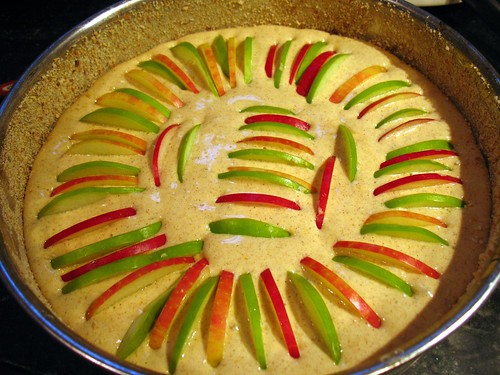
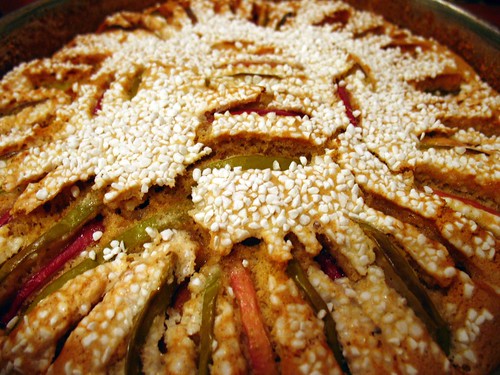
My mom gave us a wonderful cookbook, The Garden Cafe at Rosendal, which is filled with recipes, photos and stories from the organic garden and cafe Rosendal on Djurgården in Stockholm. For Valentine's Eve I made one of the recipes, Apple Cake with Almond, with some slight modifications (I didn't put shaved butter on top, like the recipe says). It was dense, luscious, and delicious.
Ingredients (American measurements):
5 eggs (an egg is an egg in the US too!)
3/4 cups granulated sugar
1/2 cup vanilla sugar (can be bought at IKEA, if you don't have it, use confectioners sugar and two drops of vanilla extract)
5 oz almond paste (look in the baking section of the supermarket, Odense is a good brand)
2 tbsp cinnamon (we had extra strong cinnamon so I used only 1 tbsp)
1 3/4 cups white flour
4 large apples (I used 2 green and 2 bright red, organic is best, do not peel)
1/2 cup (or less) pearl sugar (can also be bought at IKEA)
5 tbsp butter (I didn't include this, too many calories... but it makes the cake more moist and fresh...)
Turn on oven to about 375 degrees F. Whisk the eggs, granulated sugar and vanilla sugar a lot so it turns into whitish foamy mix. Grate the almond paste using a cheese grater (large hole size), and mix in separate bowl with flour and cinnamon. Add the egg mix, mix in slowly. Cut apples in half, core them, and then slice very thinly. Take a round pan with removable sides and butter it and then add breadcrumbs, so the cake will not stick in the pan. Add the mix, and then stick the apple pieces into the pan. Put MANY apple pieces in. I added them in a circular pattern that looked great, but I should have added more apples, will do next time (I will probably add the mix and the apples in horizontal layers next time too, then I can add more apples and maybe use a bit less egg and flour mix. Add the pearl sugar on top. At the end you are supposed to shave off thin slices of the cold butter and add on top, I skipped this step. I am sure it will be just more delicious if you add the butter. Put in oven, takes about 40 min (check with toothpick to see if it is done). Before and after photos below (click for larger photos on Flickr). Mmmmm!


Posted by
LS
at
10:32 PM
3
comments
Labels: baking, cookbook, cooking, fruit, home cooking, recipe, Sweden
Monday, October 11, 2010
Maybe the best sandwiches in the world?
Sometimes I get really homesick for Swedish food. I was just downstairs in the kitchen and opened the fridge and thought about the Swedish things that are great but hard to get here in the US. So here you go, my list of the best traditional Swedish sandwich toppings (smörgåspålägg [ha, there is a Swedish word for you Americans to master!]), in no particular order (they are all amazing). I know, some of you will not agree, feel free to comment. :)
- Skivat hårdkokt ägg med Kalles kaviar (Sliced hardboiled egg with smoked creamed fish roe) (photo)
- Skivat hårdkokt ägg med ansjovis (Sliced hardboiled egg with anchovy-pickled herring sprats [these are not real anchovies]) (photo)
- Skivad kall kokt potatis med kaviar (Sliced boiled cold potatoes with smoked creamed fish roe) (photo)
- Smörstekta kantareller (Wild-collected yellow chanterelles fried in butter) (photo)
- Räksmörgås (Shrimp sandwich, with little tiny pink shrimp, mayo, sliced boiled egg, lettuce, thinsliced lemon) (photo)
- Rökt renkött med pepparrotsvisp i tunnbröd, renklämma (Smoked reindeer meat with creamed horseradish in thin bread) (photo)
- Greveost och rökt skinka med färsk röd paprika (Greve cheese and smoked ham with fresh sliced red pepper)
- Gravad lax med senapssås och dill (Gravlax/Brined salmon with mustard sauce and dill) (photo)
- Köttbullar (kalla) med rödbetssallad och sallad (Cold meatballs with beet salad (with youghurt or sour creme) and lettuce) (photo)
- Gratinerad varm smörgås med allt möjligt, kantareller, ost, tomater, osv. (Oven-broiled sandwiches with different toppings, such as chanterelles, cheese, tomatoes...) (photo)
We Swedes have much less toppings on a sandwich than Americans (well, we used to, I think Swedes are becoming richer and add more nowadays). I only think Dutch people have less. And they put butter, chocolate sauce and chocolate sprinkles on their breakfast sandwiches.
We don't cut off the crust and make little triangular double sandwiches with white mush in them like the Brits (I do like these too, but they are for people that are afraid of getting messy).
We don't overload giant subs and heros with salamis and other meats like American-Italians (which can be great to eat, but isn't Swedish). Ever heard of a muffaletta? They are giant. Giantly tasty too.
We don't make peanut butter and jelly sandwiches, a combination I personally think is kind of... disgusting. Each one by itself is quite fine.
We don't make smörrebröd, that is the Danes specialty (overloaded warm or cold sandwiches you have to eat with a knife and fork - also delicious).
Sometimes Swedes invent crazy sandwich topping combinations. I have a vivid memory of a cousin, who will rename unnamed, who ate a sandwich with cheese, kaviar, and orange marmalade. And here is a crazy one too!
So, what is my favorite breakfast sandwiches here in the US? Well, since there aren't some of the Swedish things... smoked ham, cheese and Frank's Hot Sauce... cottage cheese and fox point seasoning... hummus.... goat cheese... sliced cold potatoes and kaviar (everybody else in the house thinks I am crazy to eat that)... sliced egg and real anchovy... marmalade.... blueberry jam (homemade, more about that later)... cheese and pickles, or cheese and sundried tomato tapenade...
Posted by
LS
at
11:12 PM
11
comments
Labels: bread, Cultural History, Denmark, Europe, food, mushrooms, photo, recipe, seafood, Sweden, Swedish, the netherlands, United Kingdom, USA
Saturday, March 13, 2010
Book review: The United States of Arugula
The book The United States of Arugula: The Sun-dried, cold-pressed, dark-roasted, extra virgin story of the American Food Revolution by David Kamp, is not a book that is easily categorized despite its title, which is longer than the ingredient list to many recipes. It is a documentary story, supposedly very factual, about the chefs, TV kitchen celebrities, cookbook writers, and food journalists of the last ca 100 years in the US. I say supposedly factual, but as we know, the truth is sometimes a very fleeting and subjective thing.
David Kamp writes about James Beard, Julia Child, Alice Waters, MFK Fisher, and all the other famous food people, and spice it up with stories, rumors, and a-friend-of-a-friend-said... He clearly admires many of them, but sometimes he goes for the sensational. Do we really care what somebody did lewdly to a farm animal as a little boy, and who is crazy and who slept with everybody in their kitchen? That part reads more like a gossip magazine and really has nothing to do with the actual food history of America.
The book does describe the food revolution very well , from the frozen TV dinners in the 1950s and 60s to our current fascination and desire for local, pesticide-free, and naturally grown and produced food. I enjoyed the book, but it is a bit too long and could have used some editing to cut out some slow and repetitive parts. Parts of it are based on interviews and the book therefore includes many quotes. He describes the origin of the supermarkets, the celebrity chef phenomenom, free-range meat, microwaves, and the loss of the corner groceries and farmer's markets (now on their way back).
You learn a lot in this book - that the first people to sell Chemex glass coffeemakers (we have one in our kitchen), were the two guys who later started Starbucks. That before Dean and DeLuca opened a little food store in New York City, you could not get balsamic vinegar and sundried tomatoes here. This is how trends and tastes started. Now we take it for granted, but I remember the 1970s in Sweden - there simply was no international food in the supermarkets except for spaghetti. Food has changed so fast, and with the increased international travel and immigration/emigration in the last 20-30 years we are now much more global.
I recently was asked about typical Swedish food, and after thinking about it for a second I said: boiled cod, white sauce with eggs, and boiled peeled potatoes, all flavored with salt and white pepper, maybe if you are lucky also some peas and parsley ('kokt torsk i äggsås' in Swedish). That is what we were served in school sometimes when I grew up, but I don't think many people in Sweden eat that anymore. Then I added meatballs ('köttbullar'), with gravy and lingonberries ('lingonsylt'), more potatoes, meat stews ('kalops', for example), potatoes, meat loaf ('köttfarslimpa'), cabbage, and onions. Really, quite boring even if good, but this is not Swedish food today. I have heard that the two most popular dinners in Sweden are now spaghetti and meat- or tomato sauce (like this!) and pizza, which is similar to common family dinners here in the US. It is the Italian take-over! :) (Those of you that live in Sweden can correct me if you like).
Arugula is ruccola in Swedish (Eruca sativa in Latin), and has become the symbol of elitist food snobbery in the US, at least the Republican Party thinks so. I love another species also called arugula, the Italian 'Rustica' kind (the species is Diplotaxis tenuifolia). We have Rustica growing in our garden as a perennial, self-seeding weed. It is so good, especially with beets. After reading this book I am grateful we have all the food options we have - dinner tonight will be locally raised herb-marinated poissons (young chickens), served maybe with green chili and cilantro polenta produced in Pennsylvania and fresh artichokes from California. Mmmm...
Posted by
LS
at
8:40 AM
0
comments
Labels: book review, books, fish, food, food writing, gardening, history, marketing, meat, recipe, Sweden, USA
Friday, January 1, 2010
1/1/2010 = 5 stars
A new year have started, quite surprisingly too soon. I wasn't ready, but here it is. We started the year by making Friday night pizza, like so many times before (yum!), and watching the movie Mr. Smith goes to Washington. The movie is from 1939, so it is over 70 years old, but still extremely relevant. I should have seen this a long time ago, it taught me a lot about how Congress works and the politics-as-usual which we still have in the US today. If you haven't seen it, watch it. It is definitely a 5-star movie. James Stewart gives the performance of his life. Happy New Year to all our blog readers, and It's a Wonderful Life we have here on Earth! Sleep well everybody!
Friday, October 23, 2009
Good stuffing!
When I moved to America, I didn't know much about winter squashes and not much about cooking. But I learned quickly. PP taught me this dish, which is absolutely fantastic and still probably unknown in Sweden, since winter squashes are so rare there. You take a large winter squash (Hubbard for example, but could work with others), cut it in half, and bake it until nearly soft (upside down, after removing the seeds, which can be saved and roasted). In the meantime you cook onion, peppers, and sausage (the real kind, not falukorv, so in Sweden you would have to use ground meet and lots of herbs) in a frying pan, until nearly cooked through. Fresh herbs and garlic helps. You take out the squash from the oven, turn it over and scoop in all the meat-onion mix in the center of the squash and put it back in the oven for 30 min of so. Then you eat. The squash takes up the flavor from the sausage mix and vice versa and it is incredibly delicious. A favorite fall dish and a favorite at our house. Thanks PP, for teaching me how to make this.
Posted by
LS
at
9:49 PM
1 comments
Labels: food, home cooking, New Jersey, photo, recipe
Wednesday, October 21, 2009
Vegetable of the day: Homegrown Chioggia beets
I love beets. Others in the family not so much (well PP does). I have three favorite beet dishes:
1) cook them, cool them, peel them, slice them, serve with arugula, goat cheese, and tyhyme vinagrette (our salads are not really like this..)
2) grate them raw with potatoes and fry them up (like Swedish rårakor)
3) pickled beets on top of Swedish pytt-i-panna
Mmmm... they taste best if you pull them out of your own garden, and beets are nearly foolproof to grow, at least here in NJ. (photo by me)
Posted by
LS
at
10:57 PM
0
comments
Labels: food, gardening, home cooking, photo, recipe
Saturday, October 17, 2009
"most perfect processed forcemeat stuffed inside of an animal intestine"
For those of you with little or no experience with the Swedish cuisine, I would like to explain the classic 'Falukorv', the main ingredient of a recent post here on the blog. Falukorv is like bologna sausage, but smaller and one of the least expensive meat products (at least when I grew up). It comes as a long straight sausage or tied into a ring, and always in plastic red casing (no intestines here!).
Swedish parents have come up with many ways to enliven this rather-unknown-content meat product. We often cut slits in the ring so the pieces held together at the bottom or sides and then in each slit we stuffed apples or cheese, squirted it all with ketchup and mustard, put it into the oven, baked it, and then ate it. At desperate times when camping I am pretty sure I have seen people eat it raw, but usually it is fried and served with cramy macaroni or mashed potatoes. It is even used in 'korv Stroganoff' - a dish that has nothing to do with the original Stroganoff since this version has tomato sauce, onions, and lots of ketchup in it. Yes, Sweden is a ketchupy nation, but no more than the USA.
The reputation of Falukorv is mixed, to say the least. When I grew up, we had a lot of falukorv, and I remember it fondly, even if the origin of the extremely finely ground meat (etc.) is a bit suspicious at times. You can't buy Falukorv here in the US, not even at IKEA. Falukorv has "Traditional Speciality Guaranteed (TSG)" status in EU, but I am not sure what that really means. That Falukorv can't be made by a German butcher in the US?
Hat tip to Mr. Lebo for the title of this post.
Go a posts below below to see OK's innovative use of Falukorv as a bedding for mozzarella and basil (how was it?).
Posted by
LS
at
8:17 AM
0
comments
Labels: family history, food, meat, recipe, Swedish, tradition
Sunday, September 27, 2009
When life gives you habanero chilies...
... and your habanero-nibbling brother (OK) is not around, and you need to dispose of 30 hot-as-hell chilies in some fasion, you make JERK. Jerk is not some kind of misbehaved right-winger in this case, but a Jamaican seasoning that is fantastic on shrimp or chicken. And it freezes well, so you can make a lot and it will last forever. Habaneros are among the hottest of all chilies, so this is not the kind you can put in your salad or quesadilles. Or rather, 'you COULD do that', but it would not be good except the first microseconds.
You take the fiery hot chilies and remove the seeds while wearing latex gloves, nostril pluggers, and safety goggles, plus plastic bag and waxpaper on the cutting board - all to avoid unpleasant surprises later when you touch your eye or cut a good cheese on the same cutting board. (The recipe here is not exact - if you want the exact recipe a la our friend Dana, let me know in the comments. )
In a blender, a most magnificent innovation, you then dump the chilies (no seeds!), lots of scallion, lots of cheap yellow mustard (think hot dog kind), fresh ginger and garlic, and spices (coriander, cumin, allspice and LOTS of black pepper), and salt. Thanks LA for grinding 9 tablespoons of black pepper! Sorry about your bleeding thumb. You run the blender fast so it all gets mixed into a thick gue.
OK, it doesn't look tasty, but it is. Depending on how many peppers you put in, you might or might not be able to taste it without burning yourself. You freeze the jerk paste in little plastic bags, about 3 tablespoons in each, which is enough for a pound of shrimp or chicken. When you want to use it, take a bag out, dump the seasoning onto the meat, let sit for a few hours, and then grill. So incredibly good, and HOT.
OK, maybe we can find a way we can send this over to you in Sweden, for your yearly habanero dosage...
Posted by
LS
at
4:37 PM
1 comments
Labels: chili, food, home cooking, New Jersey, photo, recipe, spice
Monday, September 7, 2009
Albondigas!
We made a fantastically tasty dish on Saturday last week: Albondigas with ancho chili-tomato sauce. Albondigas are Mexican meatballs, and these had not only ground turkey in them but also lots of corn, onion, pinto beans, garlic, parsley, egg, and flour. You don't fry the meatballs, you boil them in a tasty sauce made from dried ancho chilies, tomatoes, and lots of spices. That way the sauce flavors the meatballs and vice versa. It was incredibly good! We made extra meatballs, so now we have enough for a second dinner. We served it with basmati rice with zucchini and sweet peppers and a few green beans. Perfect dinner, thanks PP! (link to recipe here)
PP and I have been reading Michael Pollan's long article in New York Times about the evolution of cooking during the last decades, starting with the TV dinners of the 1950s to the fast food and 'halv- and helfabrikat' (prepared foods) of today. There are some amazing facts in it, such as the AVERAGE time people use to clean up after dinner: 4 min. 13% of all dinner cooking is done by men (that is about 3 days a month). When you buy food in the store, 80% of the cost does not go to the farmer but to other companies. Michael Pollan argues that we no longer cook or really know how to cook, but we love to watch cooking shows on TV instead. Our family doesn't fit into these statistics, since we cook all the time, doesn't watch the shows, and try to buy as much as possible directly from farmers (moist and fresh!). I feel sad for the children and adults that live on fastfood burgers, frozen french fries, and instant noodle soup all the time. And here in the US, that seem to be most people, unfortunately. I don't agree with all Michael Pollan has to say, but it is worth reading. He misses the fact that local food and home cooking has had an enormous upswing recently and that many people are becoming more aware of the origin of their food and how to cook from scratch. I think blogs and politics have a lot do with this. Here is the article.
Some excerpts:
"Those corporations have been trying to persuade Americans to let them do the cooking since long before large numbers of women entered the work force. After World War II, the food industry labored mightily to sell American women on all the processed-food wonders it had invented to feed the troops: canned meals, freeze-dried foods, dehydrated potatoes, powdered orange juice and coffee, instant everything. As Laura Shapiro recounts in “Something From the Oven: Reinventing Dinner in 1950s America,” the food industry strived to “persuade millions of Americans to develop a lasting taste for meals that were a lot like field rations.” The same process of peacetime conversion that industrialized our farming, giving us synthetic fertilizers made from munitions and new pesticides developed from nerve gas, also industrialized our eating."
"Earlier this year, Richard Wrangham, a Harvard anthropologist, published a fascinating book called “Catching Fire,” in which he argues that it was the discovery of cooking by our early ancestors — not tool-making or language or meat-eating — that made us human. By providing our primate forebears with a more energy-dense and easy-to-digest diet, cooked food altered the course of human evolution, allowing our brains to grow bigger (brains are notorious energy guzzlers) and our guts to shrink."
I am reading the Catching Fire book right now, book review will follow. Now, go and crack some eggs in a frying pan and feel like a hominid.
Posted by
LS
at
7:26 AM
3
comments
Labels: cooking, evolution, food, home cooking, Humans, photo, recipe
Monday, May 12, 2008
What do to with 'kirskål'?
While surfing today I came across a recipe for muffins with ground-elder. What is that? Turns out it is the same as the horrible kirskål weed in EH's garden (and at Barking Dog plaza too). It spreads with underground rhizomes like a green plague. So here EH, time to take out the muffin pans and send out the boys to cut down some weedy leaves. I remember mom cooking this for us as kids and trying to make us believe it was spinach, but we weren't fooled. In muffins it probably tastes better.
Posted by
LS
at
2:41 PM
6
comments
Saturday, March 8, 2008
Recipe: Tiny birds in the oven
What do you do a day when it just rains all day? We cook. Italian chicken filled with cheese and spinach, wild mushroom tart, cevapcici (long Turkish meatballs), braised fennel with parmesan crust, while we wait for the rivers, roads, and our driveway to become completely flooded. The driveway has already flooded and I had to dig two diverting trenches to get most of the water towards the meadow instead of the front door. In the basement the sumppump is keeping up so far, but there is a little waterfall the cats like to play with.
This recipe is from a dinner a few weeks ago, but it is so good I think you all should try it. I bet it works with chicken too.
This is a fantastic recipe we adapted from the book Under the Tuscan Sun. Mmm, so good! Try it.
Slowly braised Quail with Juniper Berries
6 servings (2 quails per person)
Take 12 quails and dip them in flour. Brown them in a dutch oven pan or cast iron frying pan in olive oil on top of the stove, turn the quails so they get brown all over. Arrange quail in a oven-proof dutch oven pan with a tight lid with backs up. Pour 1/4 cup balsamic vinegar over quails. Add strips of pancetta on top of each quail and sprinkle minced shallots over. Add sprigs of thyme, crushed pepper, and about 1-2 tablespoons juniper berries. Cook in oven (275 degrees F) for 2-3 hours (check for doneness, the meat should fall off the bones). After an hour turn the quail over so the breast side is up, make sure pancetta is still on top of each quail. Add liquid (red wine, sherry or balsamic vinegar) if pan gets dry. Eat.
PS. Griggstown Quailfarm in New Jersey is the best place on this side of the Atlantic for quail.
Posted by
LS
at
2:24 PM
2
comments
Labels: birds, cooking, home cooking, New Jersey, recipe, weather
Friday, November 9, 2007
The perfect fall dinner
Sorry guys, there is no picture of our dinner tonight, but I though I should describe this perfect fall dinner since it is so perfect.
Take one free-range chicken from Griggstown Quail Farm, not one of the fatty store-bought, mass-produced ones. Cut slits in the skin, insert thin slices of lemon. Rub the chicken skin with lots of Northwoods seasoning mix bought from Penzeys, the best spice company on earth.
Take a few carrots (morot), parsnips (palsternackor), turnips (??), and leeks (purjolokar), and clean and peel them, cut them in pieces, and mix them with some olive oils, salt, pepper and Penzey's Tuscan Sunset seasoning mix. Put foil over the ovenproof casserole dish after you pour the veggies in it.
Take an acorn squash, cut it in half, remove the seeds, and drizzle some olive oil and salt an freshly ground black pepper inside, then put them upside down in a glass container. Add a fingerheight of regular water.
Turn the oven to 400 degrees Fahrenheit, and put chicken, veggies, and acorn dishes in the oven when hot. Leave alone for 1 hour. Take out, cut up chicken, scoop out the acorn squash flesh and mix with a little bit of butter, and then serve.
Oh, ah, oh, ah, so good! Even better with a tiny bit of locally made Hoboken Eddie's barbecue sauce, or even Curtis Barbecue sauce. We also had a fresh green salad with it, as usual. I can't imagine a better cold evening meal for a November night.
Just wanted to share....
Posted by
LS
at
9:25 PM
1 comments
Labels: agriculture, cooking, food, home cooking, plants, recipe
Monday, August 13, 2007
The fruits of our labors
The day before I made tomato sauce from kilos and kilos of fresh Roma tomatoes. Here it is, ready to the frozen and served on pasta. We added lots of fresh basil and garlic.
Next project was pickles. LA helped me with this, and he was a bit concerned thatvinegar eels could survive in the pickle jars. He learned about those in science class last year. Here we are chopping up lots of pickling cucumbers I bought at a roadside farm stand, locally grown little cukes. I don't know what kind they were, they were just sold as 'pickling cucumbers'.
Sterilizing jars by boiling them, I learned this from mom when I was a kid. I remember lots of jars and bottles being boiled, and then put in the oven to dry. We never used the canning method that is so common here in America, where you boil filled jars with food. Mom used to make pickled cucumbers, beets, saft, lingonberry jam (sylt)... probably lots more I don't remember. Grandma KE's rhubarb-strawberry jam was a classic, a must on grandpa RE's pancakes.
This is the 'pickle juice' as LA calls it. Distilled vinegar, salt, dill crowns, and sugar. I called mom in Sweden to get a real recipe, so what we are making here are 'Skånsk ättiksgurka" (Scanian pickled cucumbers).
After the chopping block.
And then you take the hot jars, fill them with cucumbers, dill crowns and brown mustard seeds and pour the pickle juice over. Close the lid, let cool, and store in fridge. Everybody in the house wondered when we could start tasting them, but we will have to wait two weeks. The cucumbers have already started to loose their fresh green from the acid in the vinegar - the photo was taken immediately after I closed the lid, but this morning they are more yellowish.I felt so productive after this kitchen work. It is like Martha Stewart says: "If you make it, you own it. If you buy it, you don't own it." I feel like I really, really own these pickles. Also, both the tomatoes and cucumbers are grown here in New Jersey, not in faraway Chile or Guatemala.
Posted by
LS
at
7:10 AM
4
comments
Sunday, July 1, 2007
Travels in Vermont: Bennington Pottery
PP and I are back from a week long trip to the three wonderful states of Vermont ("The Green State"), New Hampshire ("Live Free or Die"), and Maine ("This is how life should be"). I will blog a little about what we saw and did, but it will be in random order as I sort through my photos and memories. First, but nearly last on the trip, was a visit to the Bennington Pottery, in Bennington, Vermont. It is a small pottery famous for their old-fashioned, handmade items, often glazed in either earthy tones (blueberry, sky blue, ochra, whitewash) or 'flammig' in two opposing colors. We bought new dinner plates in the blue agate series, which is white and cobalt blue glaze mixed together, like this:
On the pottery website, they say this about this glaze, so I guess we are not alone in our choice: " Bennington's signature glaze color - Blue Agate ("ag get") is a thick splatter of deep cobalt on a warm clay underglaze. This glaze color works well with a wide variety of kitchen, dining room, and country home decors. For nearly 60 years Blue Agate has been our customers' favorite pottery glaze choice."
Pottery has been made in Bennington, which is in the southwestern corner in Vermont and about 4 hours from New Jersey, since late 1700s. They used to have great clay here, but that is now all used up so they need to get it from other states.
You can go into the pottery and see them make the different things by hand (well, some machines are used, but most is really by hand). They make only 800 pieces a day and are famous for their pottery. We have several things from them earlier, but after seeing the pottery itself, I have a better appreciation for them. We also got a little bowl in the more turquoise-sky blue color, which became the temporary home for this year's first harvest of chanterelles in New Jersey, on June 30. Sauteed with a little garlic in butter - oh they were good!
Tuesday, June 12, 2007
Snapshot: Борщ для обеда

Inspired by recent russian posts I made myself Borstj (russian beet soup) with sour cream for lunch.
Mmmmm...
Edit: Here is the recipe I used, should be enough for 4 (big, O.K.-sized) servings:
6 beets (0,5 kg)
3 potatoes
2 onions
1 l vegetable broth
salt, pepper
crushed caraway
1-2 tablespoons red wine vinegar
Peel beets, onions and potatoes and slice them thin. Boil in broth for 30 minutes. After that, mix the vegetables with half of the broth to a smooth purée. Put back in pot and dilute with the rest of the broth. Add spices. Serve with sour cream.
/O.K.
Posted by
O.K.
at
10:31 AM
22
comments
Labels: food, home cooking, language, recipe, Russia, snapshot