Showing posts with label mining. Show all posts

Thursday, November 6, 2014

Photo report from Gotland

O.K. is on the island of Gotland in the Baltic Sea this week, in the cold, blustery November fog.  Here are some of his photos, posted by me.  Enjoy!

crane
 elephants
 Elvis

 grill
 handle
 handsome
wheels
 panorama
 the bottle
the stick
 
the door
the rock
 train I
the tower
 train II
the perspective

Saturday, July 30, 2011

Summer in northern Sweden (from EH)

Fröå mine, a coppermine in Åre, Sweden. In the bakery they make
flatbread in a woodfired oven. 'Rallarros' (fire weed) is the flower in
the foreground.

Sunday, February 20, 2011

Gorgeous: Strange colors on rocks


In northern New Jersey, USA, is a little mine called Sterling Mine, now a museum, filled with unusual rocks that have UV fluorescence. We walked into the mine, which is literally horizontally into a mountain wall, and then our guide turned off all lights. After a few seconds he turned on his black light (UV) and we were surrounded by glowing red and light green on the rock walls. Eerie, yes. Beautiful, yes. Could people have known about this before electricity and light bulbs? Are there more things like this that we do not yet know about because we don't' have the tools to see them? I wonder about things like this when I go on my walks, and I think that maybe what we see and perceive is maybe just a tiny bit of the reality that is surrounding us. The photo is from the Sterling Mine Museum, a must see place, where they have a whole room with rocks that fluoresce in different colors.

Wednesday, November 3, 2010

Rail thoughts...

 passing the place of the old accident
A hundred years ago this was the way of traveling in style, but also out of necessity. Instead of bumping along in a stage coach over rocky roads, up and down for days at end, you could have a (rather) smooth ride in a railroad car - what a treat! Today we drive in our air conditioned or heated cars, up and down mountain passes, across deserts, through mountains, and over gulches on steel bridges and take it all for granted.  Only the weather can stop us, but rarely does.

million dollar highway
I wonder how many of us could survive if we suddenly were dumped back in the late 1800s - when basic things like hot showers, shampoo, clean clothes, edible food, and lice-free beds were scarce, non-existent, or only for the really rich. But the really rich would have had to take the stage coaches or steam trains into the mountains as well; when it came to transportation people became more equal.

Silver Plume station, 9178 feet above sea level
Riding the narrow gauge steam train on the "high line" over Cascade Canyon and Animas River might have been the thing to do back then as a tourist, just as today some people bungee jump, swim with sharks, and go whale watching. But the railroads, at least in the Rockies, were not built for tourists even if they filled that role later.  The railroads were built for financial reasons, and out of necessity.  The silver, gold, and iron needed to get out of the mountains to fill the pockets of the rich, and the food and supplies needed to get into the mountains to feed the miners. The rich tourists followed the iron tracks, up into new exciting territories.
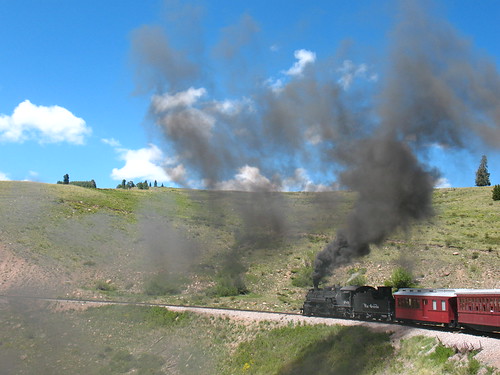
leaving Osier with lots of smoke

An iron horse with many cars behind it was far more dependable and could pull so much more weight than stage coaches and mule trains (large packs of mules carrying supplies). Pork (bacon!), whiskey, flour, shovels, and hay were pulled into the high valleys to feed everybody, mostly men and mules. Before the railroads came, towns like Silverton were often isolated from the rest of the world for many months during the harsh winters.  What a life, and what a difference the steam trains must have made.

(written during our Colorado-New Mexico trip this past summer)

Sunday, October 17, 2010

Like a snake nest...


rusty chains, originally uploaded by Vilseskogen.

... are these old rusty chains at the Argo Gold Mine in Idaho Springs, Colorado.

Wednesday, October 13, 2010

Alternative uses...


ski fence, originally uploaded by Vilseskogen.

We have a saying in our family in Swedish that is something like: "All ways are good except the bad ones", implying that there are many ways of doing things, and some things just don't work out the way you thought. Here is an innovative new way of using broken skis as a fence in Colorado. The photo is from Idaho Springs in the Rockies, a place that is also home to the Argo Gold Mine and the Argo Tunnel. We stopped by the mine and admired the old rusty machines and restored mining building through the locked fence. More photos of Argo here.  It is amazing how much old history is visible in the Rockies.  Here there are no vines (grapes, rosebushes, briars, etc.) that are covering up the old buildings, and the dry air preserves both wood and metal much longer than the eastern and southern humid summers.  There are also a lot less people, more space, so a metal nail that was dropped 80 years ago, might still be laying on the side of the road. 

Tuesday, October 5, 2010

Loopy Georgetown

There is a Rocky Mountain pass along Clear Creek in Colorado that is very steep, and for a long time flummoxed the railroad engineers that wanted to lead the train up to the higher altitude silver mines (Silver Plume, etc.), so the silver could come out and the necessaries come in without having to be transported on long 'mule trains'.  Many times a mule or donkey (called 'burro' from the Spanish) couldn't get through the high passes during the winters, and a railroad could also take so much more weight.  But Georgetown was a steep, steep problem (since locomotives can't go up as steep hills as mules, diesel trucks, and mountain goats).

 
(Pack mules at a mine, photo by W.G. Chamberlain)
But the Union Pacific Chief Engineer, Jacob Blickensderfer, had a heureka moment, and designed and built something completely new - a loop.  You go up on side of the mountain, turn in the inside of the valley, continue up on the other side away from the direction you want to go, higher and higher, and then, aha!, build a trestle (bridge) across the valley to get the train across at a much higher altitude so the train can continue up and pass the pass. Silver Plume was reached by train in 1884.
(1899 colored photo, Public Domain, Library of Congress)

So they built the railroad, got the silver out and the people in. In the late 1800s this was one of the wonders of the world and railroad tourists came here just to see the trains pass across the valley. 
( Beaver Brook Station in Clear Creek Canyon, photo by W.G. Chamberlain)

The rail was narrower than normal, narrow gauge (in Swedish: smalspår = small track), which is common in the mountains. It was both cheaper and better, since trains were lighter and could also turn sharper corners if they had less space between their wheels. When the railroads closed down and went bankrupt (for several reasons, more on this later), the trestle and rails rusted away and were taken down. In the 1970s some real railfans (that is their nick name) decided to build up an exact replica of the Georgetown Loop and put in the rails ago to let the trains run. They raised the money, built it, and here it is again. So you can see it, with original steam trains on it.  Of course we went there on our Colorado trip for a short stop on our way into the mountains. 

the tall trestle across the valley

The trestle (photo by me, more here)

Georgetown Loop Trestle

Georgetown Loop Railroad - a new and old tourist attraction.(photo from Flickr copyright by El Engr).
