Showing posts with label 1950s. Show all posts

Thursday, February 21, 2013

A trip to nostalgia land

The Swedish Museum of Art (Nationalmuseum) in Stockholm is now closed for a several year long renovation, but we visited it one of the last weekends when it was open and I was in Stockholm.  One of the most fun exhibits was the one on functional and industrial design.  It was filled with so many items I know so well from my upbringing in Sweden, and some of them have even made it over to the US.  Here is a selection, with annotations:

Chair, 'Lamino', design by Yngve Ekström, Swedese Möbler 1955
When I grew up we had a Lamino chair at home, covered with gray woolskin, and it was wonderful.  I had no idea then that it was a classic bent-wood design.  The chair and its footstool is still in my mom's apartment and I sat in it just a month ago.

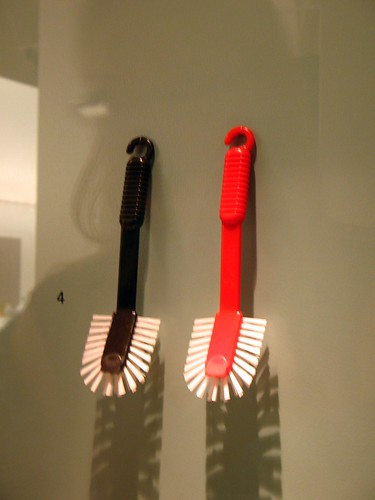
The Swedish dishbrush!
Swedish dishbrushes!  Once I went to a summer camp with a girl whose father had the patent on the straight line on the front that you use to scrape off hard pieces from your plates if you turn the brush around.  I bet he got a lot of money from all the dishbrushes that have been made in the last many decades.

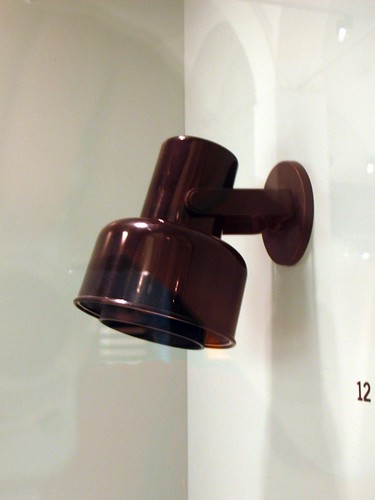
I remember these lamps! They were incredibly plastic.
This kind of very plastic and cheap-looking lamp was common in youth hostels and rented cabins.  I think we had one too, orange maybe, and I have a vague memory that it nearly caught on fire once, but I could be wrong.  They weren't very good lamps, but popular.

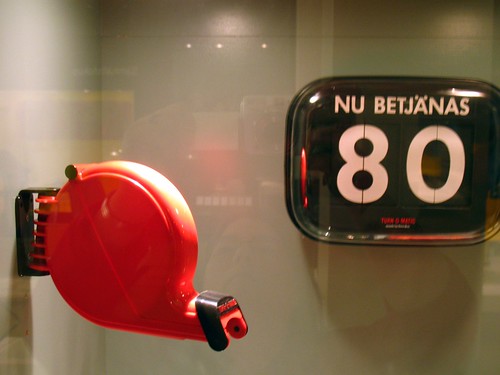
Queue system with papernumbers (kölappsystem)
The very practical Swedish queue-system.  Used at every postoffice, bank, police station, you name it. I actually like this a lot better than standing in lines.

Swedish LM Ericsson phone in bakelit
A classic telephone, of the type that was provided by the phone company.  Back then you couldn't buy your phone, it was provided and owned by the phone company.  I think this one was made by Ericsson for the state-owned telephone company (which is no more, it is now privatized).  These were still in use in the 2000s, but I think they are gone now, since the outlets are different now.  Oh all the times I sat and dialed the numbers on the turning dial.... You couldn't hurry it, it took its time.

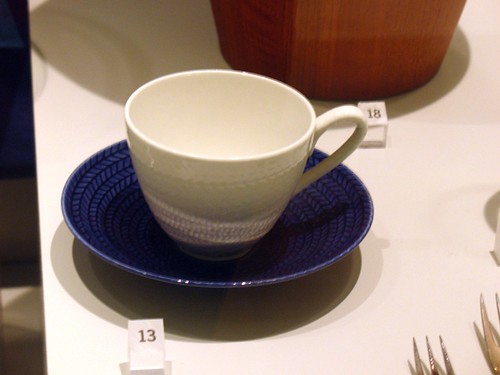
china, 'Blå eld' by Hertha Bengtzon,1951,  Rörstrand & Printed fabric, 'Pythagoras' by Sven Markelius, 1952, NK's textilkammare
This line of china is one of my favorites, and we had some at home when I grew up.  Blå eld means Blue Fire, and my sister collects this brand.

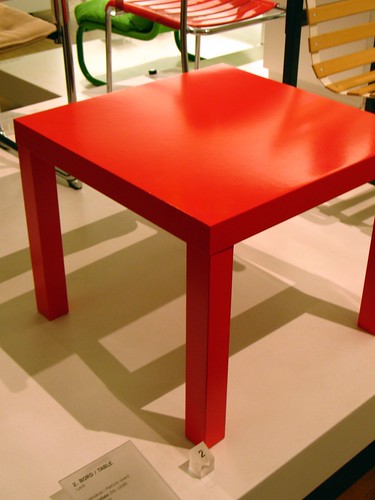
Table, 'Lack', IKEA, design by Jan Hellzen, 1979
This is probably the most common object in the whole exhibit.  IKEA's table LACK, which is still being sold.  We have several here at home in the US.  IKEA furnished so many homes in Sweden, it saved our budgets and book collections (thanks for Billy!).  I didn't realize that the LACK design was over 40 years old by now.

Swedish milk cartoons, Tetrapak, Arla
I don't know the year of this collection of dairy containers, maybe late 1980s?  Featured here are: regular milk (3% fat), 'middle milk' (1.5% fat), light milk (0.5% fat - too watery for me), mini milk (0% fat or nearly so),  'vispgrädde' heavy cream (40% fat), and 'gräddfil' (sour creme, but runnier, 12% fat).  The containers are Tetrapak, paper with plastic on the inside.  Oh, the memories....  :)

Tuesday, May 15, 2012

Stamp of the Day: Then and Now

Then: Phone booth.  Now: iPhone

Then: Printed maps. Now: GPS.

Then: Ice boxes.  Now: Refrigerators

Then: Black and white TVs.  Now: Flat-screen TV.

Then: LPs and record players.  Now: iPods.

The technological development during the last 50 years is featured on these Australian stamps.  I can write a million words on this, about its pros and cons, but that will have to wait.  In the meantime, I'd like to point out that phones used to function without having to have batteries or being plugged into an electrical outlet, maps work when the power is out, and I don't think anybody would like an icebox in their regular kitchen.

Tuesday, January 5, 2010

Mastering art, cooking, and life...

This is two book reviews, a movie review and a cookbook review all in one post. A few nights ago we watched the movie Julie & Julia, which is based on Julia Child's life. Julia Child died a few years ago, but she was the person that popularized French cooking in home kitchens in America in the 1960s and onwards. She had a TV show, very barebones and very loved, and a personality that I would call 'sprudlande' in Swedish. I don't know how to translate that - maybe like an overjoyed fountain. She LOVED food. In France she went to cooking school, and went from someone that like to eat to someone that could make food you fall in love with. I imagine this at least, since I never tasted anything she cooked... I can't think of any Swedish chef that is as famous in Sweden as Julia Child is in the US.

Mixed in with the story in the movie Julie & Julia is another story about (and by) Julie Powell in post-9/11 New York, who in 2002 decides to start a blog called Julie/Julia Project (nearly the same title as the movie, and nearly the same title as the book published from the blog) about her attempt to cook all recipes in Julia Child's cookbook Mastering the Art of French Cooking (hereafter MAFC) in one year. That is 524 recipes. She succeeds, but not without lots of marriage and cooking troubles, some that are shown in the movie. Her current blog is here. (Julia Child didn't like the blog project either.)

I have read the blog book by Powell and her original blog, the biography My Life in France about Julia Child's years there in the 1950s, and now seen the movie. But I had never cooked anything out of the classic MAFC cookbook until yesterday when I took PP's mom's copy from 1967 [good vintage] out of the bookshelf and looked up French Onion Soup, which is what we then had for dinner. The soup was great. The recipe was supereasy. But the best part of the cookbook (from the two parts I read) is the foreword. It is wonderfully and uniquely written. Here are some examples (but get your hands on a copy and read the whole thing! and remember this was written in 1961):

This is a book for the servantless American cook who can be unconcerned on occasion with budgets, waistlines, time schedules, children's meals, the parent-chauffeur-den-mother syndrome, or anything else which might interfere with the enjoyment of producing something wonderful to eat. Cooking is not a particularly difficult art, and the more you cook and learn about cooking, the more sense it makes. But like any art it requires practice and experience. The most important ingredient you can bring to it is love of cooking for its own sake.

So here are my reviews:

The cookbook, Mastering the Art of French Cooking: Based on the Foreword and one French Onion Soup recipe, this is a wonderful book. I want to tackle the deboning of a whole duck at some point, but maybe I should start with something simpler first, like roasted duck with orange sauce on page 276. [grade A]


The book, My Life in France: I could have sworn I had reviewed this wonderful biography here in the blog but I am glad I didn't swear on it, because it appears I never did. This is a great book, based on letters and stories. I loved it, and many scenes from this book make it into the movie. You don't have to be a food freak to love this book. It also wonderfully describes the very loving marriage between Paul and Julia Child. [grade A+]


The book, Julie & Julia: This book was also not reviewed on the blog, and I know exactly why. I read the book (which is based on her blog), but I didn't like it too much. A 20-ish woman blogs and whines about everyday life and miseries and successes in her tiny kitchen. The attitude was so different from Julia's attitude to life. I have sympathy, it is just that I didn't think it was great literature or very interesting. (Sorry Julie, if you are reading this... but I don't like swear words in print.] Her husband at the time must have been a very patient and understanding person (and is a great character in the movie). I actually didn't keep the book, I gave it away and I remember forcing my way through some pages. But it lead to something good, the movie... [grade C]

The movie, Julie & Julia: Meryl Streep plays Julia Child and is the best I have ever seen her. Incredible. Just see the movie to see her! Julia's husband Paul, is a wonderful person and done by a great actor. The actress that plays Julie Powell, the blogger, got criticized for being 'too nasty and grumpy' in the movie, but they actually toned her down compared with the book. There are many other great actors as well, so the acting is outstanding. Nora Ephron (Sleepless in Seattle, remember that one?), was the director and she is also a former food journalist, and also had part in meshing the two stories together in the script. It works OK, but not great, to move back and forth between France in the 1950s and New York in 2002, and when you are in the New York scenes you just want to get back to France. But I would say New York is rather accurately depicted, after living there myself. The food looks amazing in the movie, it is nearly so you can smell it.

After seeing the movie, I slept bad the night after and woke up repeatedly with yummy images of giant whisks with whipped cream, tarte tatin, and sole in lemon butter... mmmmmm... However, some parts of the movie story made no sense, and were disconnected from the rest of the story, such as the government 'are you a communist'-interview in Washington DC of Paul Child, and the wedding of Julia Child's sister. But overall, it is a great movie, and the married men of both couples are wonderful, wonderful husbands. There is a lot of love in the movie, and not just love of food. Nora Ephron manage to show life and love and the art of living and cooking all at once. So rent it, it is gorgeous.

Grade A for the movie, would have been A+ if not for the lobsters that had to be put in misty cold water (looking like hot water) and "off camera representatives from the American Humane Association monitored the creatures’ health" - come on, guys, there is death and dying of seafood in every restaurant, why does this matter in a movie?! And to all you vegetarians, did you know that plants scream when we cut and cook them too? We just can't hear them. I am all for humane treatments of animals, but not being allowed to throw a lobster in boiling water in a movie is a bit too much. These people should worry more about pink slime in hamburgers. New York Times review here

Real Julia Child (left) and Meryl Streep as Julia Child (right).

Monday, December 14, 2009

Blast from the past: Pirate Island Board Game (Sjörövarspelet / Sjörövarön)

Pirate Island board game from the 1950s

This is THE board game we grew up with in my family, and the one my mom played as a kid too in the 1950s. It has everything you want and is by now not only tradition in the family but a must. This summer we played it several times during our visit from the US.

Pirate Island board game from the 1950s

The story is simple, as are the rules, and still, no game is the same. The captain of the pirate ship has died but before he did, he hid the treasure on a pirate island in one of nine possible places. He ripped the island map into nine pieces, ate the piece where the treasure is, and handed the other eight pieces out to his six surviving pirates on his death bed. The survivors immediately set off for the island, each in its own boat, to shoot each other, get the map pieces, and then dig up the treasure and leave the rest behind. Nobody dies, if you get shot you just have to wait three turns, and there is no way of telling who will win, since you can easily steal the treasure from each other after it is dug up.


Players scheme, alone and with others, run in the wrong direction to fool the pursuers, shoot with the cannon to stop an escaping pirate that has the treasure, and you might fall into rivers or down cliffs if you are unlucky. Once the poor treasure drifted to sea on the escape raft, all alone, since the pirate that had it had gotten shot and fallen into the water off the raft. In that game, nobody won.

It is a classic game, and it is so well made and can't be bought anymore. The game board is printed paper but has fabric where it folds, and the six figures are heavy lead die cast (I think) and hand-painted (see photo above). They all have special names - it is the Chinaman with his yellow coat and hat and one gun in each direction ("Tjo-Pang"), the red-coated tall and skinny "Markisen" with two piccadillos aristocratically aimed for an imminent duel, the muscular African-American man named "Hannibal", a black and white man that looks like a lunatic ("The Rat from Marseille"), the fat, bare-bellied white "Svullo" with green pants, and the black-dressed "Kapten Hook-up" that shoots up in the air. They are all designed so you can hang the little metal treasure chest on them if they are on the run. Today's games are either electronic or plastic. Sigh.

Fredrik in Sweden decided to remake the gameboard into 3-D with styrofoam. Check it out, it is great, and they have a little film trailer on Youtube of the final version (see below). (Game rules in Swedish here). It is strange, but there is very little information about this game on the internet.

Monday, August 4, 2008

Spartan diner

LA and I had lunch at the "New Diner in Sparta" in northern New Jersey on Saturday, a place that turned out to be not so new. The whole place had seen better times, probably around 1950 or 1960. The pink vinyl seating and the personal juke boxes, unfortunately now non-functional, could have been in the movie Grease. The food was OK, not the best, and the ice tea was horrible. I won't dwell into a long restaurant review, it wasn't worth it. But the atmosphere was cool as a historical flashback. The pink seats looked like giant lips up close.


Ice tea. Looked better than it tasted.

Monday, July 21, 2008

In memoriam, kind of, and Quote of the Day

TV dinners, say no more! Wink wink, nudge nudge... No, Monthy Python never made a skit about TV dinners but they could have done that. Imagine a dead parrot filet inside a foil package. "This parrot is not dead, it is just stunned!"

OK, I admit I have bought and eaten TV dinners earlier when my life was rather despaired (PP will be horrified by these news). In Sweden I don't even know if you can buy them, but I guess so, even if I have no idea what they are called. "TV-middagar?" It is simply overcooked, overfrozen, divided dishes in minuscule portions in a plastic or foil tray so you can eat it while you are watching the latest show on TV, and it saved lots of times for housewifes and men alike. Originally they were heated in the oven, but these days it is all microwavable.

TV dinners started in the 50s and apparently are still going strong based on the meters and meters of freezer space in the store that are occupied by HungryMan's steak and gravy, Swanson's turkey meatloaf, etc. I am often filled by a mixture of amazement and sadness when I see what people have in their shopping carts at the store - TV dinners, soda, cheese sticks, chips, and maybe some ready cut carrots and fruits. And this is the regular, not the unusual.

I haven't eaten a TV dinner in probably 10 years, and I am not planning to eat any more ever. I remember them as being bland, salty, boring, and ugly. But when you are hungry, you eat. I remember that the kids hated them - good job kids, you knew better already then. More pasta with homemade pesto, beer butt chicken, and green chili stew for the people!

Woody Allen is the source for the quote of the day:
"Why bother to cook TV dinners? I suck them frozen." (Woody Allen)

Sunday, May 11, 2008

The dangers of movie remaking

Last night we saw the remake of 3:10 to Yuma from 2007 with Russell Crowe as the wild west gangster and Christian Bale as the honest farmer trying to make a living. We saw the 1957 original a few months ago. For those of you that haven't seen either, please, please, see the 1957 first, otherwise you will not understand what is going on, why things are happening, all you will see is great photography and people shooting each other at close range with lots of blood coming out of pouches under their clothes. The new movie is great, but the plot line is confused and some major connections are missing.


I liked the 1957 version much better, it was more understated and it told a story of how good and bad is not always to easy to tell apart and how people can change. I think the contrast between the movies are also telling in historical movie sense. The older one is black and white and is slower and takes the time to let you follow the story, while the new one is fast, colorful, and drastic, but you don't always get what is going on. Sort of how the world is these days.