Sunday, October 9, 2011

Stamp of the Day: Vallmokapslar (poppy fruits)

Sweden does have gorgeous stamps.  In the US, stamps have to be so politically perfect, fit the general population and absolutely fit the political climate.  In Sweden, there is a different sense of what is beautiful, like these poppy fruits.  These are from three species of poppies, two are common agricultural weeds, and the third is, you guessed it, opium poppy, commonly grown as an ornamental, advertently or inadvertently, but still part of the unofficial Swedish flora.  Lovely stamp, don't you think?  BREV means letter, which for practical purposes is the same as first class stamps in the US. (For the botanically inclined, Papaver is the Latin name for poppies.)

Thursday, October 6, 2011

Tranströmer - oh yes.

Another great Swedish poet is getting the Nobel prize: Tomas Tranströmer.  The other one was Harry Martinson, one of my absolute favorites.  I haven 't read much of Transtromer, but what I have seen so far id fantastic. it is very different from Martinson's poetry, indeed. Congratulations!

Some reactions from American press:
The New Yorker
The New York Times
Poets.org
NPR


and a poem, with translation by me:

MINUSGRADER by Tomas Tranströmer (ur SANNINGSBARRIÄREN 1978)

Vi är på en fest som inte älskar oss. Till sist låter festen sin mask falla och visar sig som den verkligen är: en växlingsbangård. Kalla kolosser står på skenor i dimman. En krita har klottrat på vagnsdörrarna.

Det får inte nämnas, men här finns mycket undertryckt våld. Därför är detaljerna så tunga. Och så svårt att se det andra som också finns: en solkatt som flyttar sig på husväggen och glider genom den ovetande skogen av flimrande ansikten, ett bibelord som aldrig skrevs: 'Kom till mig, ty jag är motsägelsefull som du själv.'

I morgon arbetar jag i en annan stad. Jag susar dit genom morgontimman som är en stor svartblå cylinder. Orion hänger ovanför tjälen. Barn står i en tyst klunga och väntar på skolbussen, barn som ingen ber för. Ljuset växer sakta som vårt hår.


BELOW ZERO by Tomas Tranströmer, translation by LS

We are at a party that doesn't love us.  Finally the party lets its mask fall off and shows what it really is: a railroad switchyard.  Cold giants stand on rails in the fog. A chalk has scribbled on the rail car doors.

It can't be mentioned, but here is much suppressed violence.  Therefore the details are so heavy.  And so hard to see the other things that also exist: a reflection from the sun that moves along the building wall and glides through the unknown forest of unaware faces, a bibel quote that never was written: "Come to me, because I am as contradictory as yourself."

Tomorrow I work in another town. I whirl there through the morning hour that is a large blackblue cylinder. Orion is hanging over the frozen ground. Children are standing in a quiet group and waiting for the school bus, children that nobody is praying for.  The light is growing as slow as our hair.

Weird real quotes: Waiter

While having lunch here in New Jersey a few days ago, the waiter came up after we had received our food and said:

"How did everything come out so far?"

Excuse me, but I am not in the bathroom. I am eating!

Wednesday, October 5, 2011

Stamp of the Day: Eskilstuna

Can you believe it?  My hometown in Sweden has a Swedish stamp! This is Eskilstuna, a town about an hour west of Stockholm.  Listed at the bottom of the stamp is the friendship cities of Eskilstuna in Norway, Finland, Iceland, and Denmark.  The images are typical for the town, the double-towered cathedral (not as old as it looks like), a sculpture in Torshalla by local artist Ebeling (I think), and the old 16th century blacksmith houses in the old historic town area for traditional trades (Rademachersmedjorna).  When I grew up it was mostly famous for being the home of Volvo BM's factory of giant dump trucks, a hospital, the home of one of the ABBA girls, and... I can't remember.  I am sure it has changed now.

Tuesday, October 4, 2011

Stamp of the day: the power of wind and lines

We are continuing our little series (2 so far) of energy related stamps, here with a Swedish stamp featuring wind power (vindenergi).  I love the clean lines... Sweden stuck to real engraved stamps for along time, and some are still done this way, but I think most American stamps by now are made with less time-consuming graphical techniques. The engraver of this one, Czeslaw Slania, was the master of Swedish engraving, and in fact, the world master of stamp engraving and world famous for his work for 28 countries.  He was hired by the Swedish postal office in 1959. Here is the 1000th stamp he engraved: link.

Sunday, October 2, 2011

Book review: The Help by Kathryn Stockett

After a long stretch of semi-interesting to really bad books (see this, for example), I opened up this book and just loved it.  I don't want to write a long review, because the book has to be experienced, be loved, and be enjoyed on its own terms, because this is what it deserves.  The Help by Kathryn Stockett is about the black maids in southern US in the 1960s, their lives, loves, and despair, and about the white women that hire them, use them, depend on them, and sometimes, respect them.  I insisted on reading it before I watched the newly made movie based on it, so now I am ready.  If you have read the book, the movie is never better than the book, I think. But this book gets a 9 out of a 10, so I am not worried about the movie being really bad. I heard some had complained that a white woman shouldn't write a book about black women, but come on, that is the stupidiest thing I have heard.  If that is so, then women can't write about men, Swedes can't write about Norwegians, and black men can't write about white men.  We are foremost people, humans, and not our color, citizenship, or gender.  Compassion and understanding is deeper than skin color or culture, at least it ought to be.  So, if you want a great read, a good story, and deep thought mixed with fun stories, this is the book.  It is just like life is. Just read it. A++

Vote for the most bizarre comment from a service tech....

This is from an online chat today that I had with a service tech for an online course system.  After this morning, it was no longer possible for me to upload any files to the course website, and the error message was "the files do not exist or are empty".  They were there and they were certainly not empty. The problem - their system does not support Firefox 7 and now they want everybody to go back to Firefox 3.6.  Ha. Firefox 4, 5, and 6 worked fine, and suddenly Firefox 7 doesn't work, and then they want me to take 3.4 steps back in versions?

So, here are selected quotes from the chat:

1. Abel: I can only tell you what we know.

2. Abel: The decision is yours.

3. Abel: It is a decision above my pay grade. 

So, which one do you vote for in as the most bizarre or weird? I won't tell you my favorite, not yet.


Stamp of the day: piston, flywheel, and cylinder

Germany has some really nicely designed stamps, clean and simple.  Here is an engine piston (I think).  Maybe PP can interpret it better?  Looks like a flywheel with gears and a cylinder with a piston inside.  I am not sure if this is from a steam engine, gas engine, or what...

UPDATE: Our friend BV just sent me this, which explains the stamp in detail (thanks!!!!):

If PP hasn't let you know, the engine pictured on the stamp is a Otto
Langen Free Piston Atmospheric Engine, circa 1867.

A small flame, like a pilot light on a stove was at the base of the cylinder.
I do not know the starting procedure, but as the engine was running, if
the wheel started to slow down, a gas, like natural or coal gas, was
admitted into the bottom of the cylinder, and a little trap door would
open next to the base.  The flame would be drawn into the base, igniting
the gas, and drive the piston upward.  This would push the vertical rack
gear attached to the piston and engage the gear on the flywheel shaft,
increasing the speed of the wheel. The inertial energy would be stored in
the rotating wheel, which drove a load attached to it.  As the flywheel
slowed down to a certain speed, a governing mechanism would start the
process over again to keep the engine running until the fuel supply was
removed.

You can see one at the Rough & Tumble Museum at Kinzer, PA.
It is run for exhibition days.

Thursday, September 29, 2011

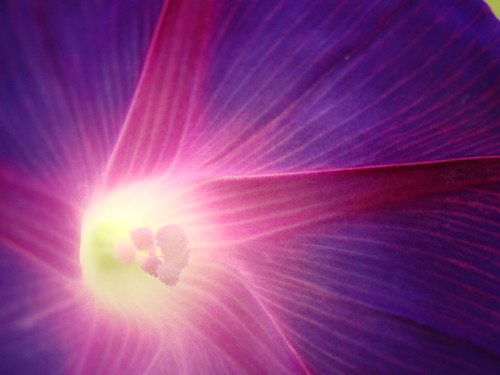
looking in...


morning glory studies, originally uploaded by Vilseskogen.
... into the center of a morning glory (blomman för dagen).

Sunday, September 25, 2011

They are back... en masse!

The Asian invasive species, brown marmorated stink bug, is once again crawling over the outside of our house in hundreds, maybe thousands...  Every little crack for them is a possible place to overwinter.  What a stinky pest. Here is how you identify them, and we think the best way to kill them is to take a glass of water with some soap in it, and drown them in there.  They smell less when they are in the water, and they die quickly.  More good information about these pesty insects here.  (I can smell them where I sit in the living room, from the outside.  Ick.

Stamp of the day: Tulips


It might seem strange to choose tulips, a spring flower, for a stamp of the day in autumn. I have a good reason for that, it´s planting time if you want spring flowers.

Tulips originate from slopes of the great Asian mountains. Small, exquisite flowers. Nothing like the ones we grow as cultivars.
I have some concern regarding the tulip growing environmental impact, since swedes love tulips. We buy them as bulbs in autumn for our flower borders and we buy them as cut flowers in stores all the spring months. The environmental impact is possibly pretty large, since the bulbs are grown in large fields in Holland with lots of fertilizing and then shipped here. Or grown in heated greenhouses and shipped here by truck. To get the right bloom, the bulbs are also store in temperated climate during summer. Chilling and heating takes energy. These bulbs are always bigger than the ones you can grow yourself in your garden.

But there are alternatives, if you like. Old tulips that where grown for perennial behavior still exist. I have tried to choose these rather than the large blooming "annual" bulbs.
There are several kinds you can choose from. The botanical species such as Tulipa tarda and Tulipa clusiana among others. Old Darwin tulips like Couleur Cardinal from 1845, this is my favorite. All the Apeldoorn tulips, good perennials. This year I am planting Carnaval the Nice, Marilyn and Verona, which has a scent of lemon!

Deers love the taste of tulips too, so I prepare my tulips with a mix of oil and tabasco sauce. And I fence them.

Saturday, September 24, 2011

Stamp of the Day Citroen

There is nothing like a French car, right!?  Here is an old Citroen, Traction Avant.  Nice! We have been watching a great French movie "The secret of the grain" (link to review), which is set in southern France among Tunisian immigrants.  It is fantastic!  See it if you can.  OK, so there are no old Citroens in it, but that is OK. It is filled with cous-cous, emotions, and great moments.

Friday, September 23, 2011

Equinox


Today is Equinox, the day when day and night are the same length. Wikipedia has an article about this astronomical and earthly fact here.


I checked up the English name, in Swedish it´s "höstdagjämningen".


Equinoxe...thoughts go back to childhood and music of Jean-Michel Jarre, a french musician who made music with synthezisers only. Very futuristic at the time, by 1978. LS used to listen to this at home a lot. Do you recall the music, LS?

Monday, September 19, 2011

Late bloom in my garden

Såhär på hösten är det bara några få växter kvar i blom. En sommarens sista hälsning innan allt börjar vissna ner när temperaturen sjunker. Nu börjar det bli kallare på nätterna men dagen är fortfarande varm, upp mot 15 C grader.
Nävan Geranium 'Rozanne' blommar envist vidare och och sommarljuset Gaura linderheimi i vitt ackompanjerar med vita fjärilsliknande blommor.


Chokladblomman (Cosmos atrosanguineus) från Mexicos pinjeskogar har blommat hela sommaren. Den ska jag övervintra torrt för ny njutning nästa sommar! Dessutom doftar den kakao.
En solhatt Echinacea purpurea har bekänt färg i år. Den första blomman (och enda) från fröer som LS har skickat mig.


Här tillsammans med en annan blomma, drakmynta,Physostegia virginiana, som jag drivit upp från en liten stickling. Blommar länge på ett tätt ax med stora gapliknande blommor. Jag hoppas den kommer att trivas och blir en tät planta med tiden.


En älskad höstflox, Phlox sp., från torpet, nu hitflyttad till Södertälje.


En senblommande trädgårdsstormhatt, Aconitum sp. En blomma som välskyddad ut för regn och rusk, vilket passar bra idag när vädret är ruskigt ute.

Om jag vore humla skulle jag ta skydd i en stormhatt!


Chokladblomman, med en härlig doft och sidenglans.

Thursday, September 15, 2011

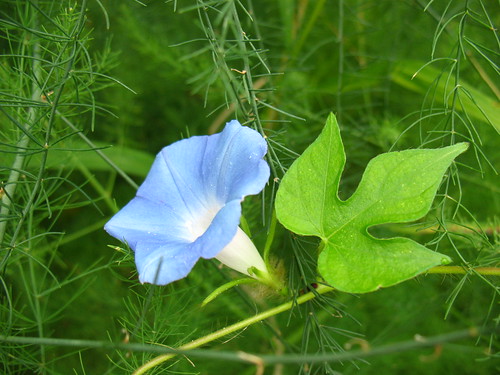
Gorgeous weed in our garden

Isn't it beautiful, climbing around in the asparagus?

It is Ivy-leaved morning glory (Ipomoea hederacea).

Things have slowed down here on the blog due to too many things that needs to be done, but there will be more interesting things soon. This weekend is BioBlitz, and I am sure there will be stuff to report!

Sunday, September 11, 2011

Today's stamp: Kantarell (Chanterelle mushrooms)


Har du sett herr Kantarell?...uti i enebacken! Han är glader, han är snäll och är så gul på hatten....

(Translation of Swedish childrens' song: "Have you seen Mr Chanterelle? On the juniperslope!  He is happy, he is kind and so yellow on his hat...)

Today's  mushroom picking results: 13 liters of prime kantarells and 3 liters of trattkantarells. (Sorry for the svenglish, guys!) All found in the vicinity of Barking Dog Plaza!

(Update - translation by LS)

Wednesday, September 7, 2011

A visit to Longwood gardens

A few weeks ago we had reason to drive to the other side of Philadelphia, about 2 hours away, to pick up a great machine we bought, a Gravely mini-tractor! The pick up place was only 10 min from Longwood Gardens, one of the most famous gardens in the US, so of course we had to stop and visit.  I have been there several times, but each time is a little different.  It was an overcast day, and pretty hot, but still a real garden experience.  Here are some impressions, and click on the photos for larger versions on Flickr.
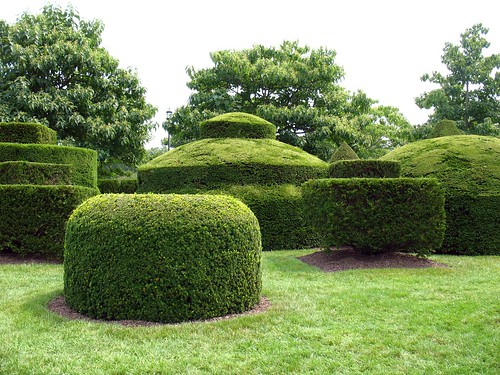
topiary craziness
This just doesn't do it for me.  Totally artificial, and all about having controlling power over nature and shape it into unnatural forms. Topiary craziness, indeed.
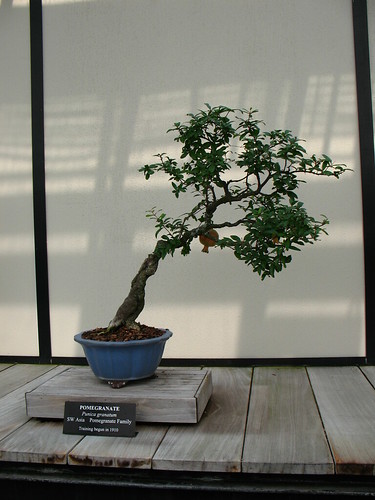
pomegranate bonsai
Bonsais, like this pomegranate, are also about power over nature, but somehow this is more based on nature's own circumstances.  The plants will simply die if you don't take care of them at all, and the plants are meant to look natural, even if in smaller, dwarfish shapes.
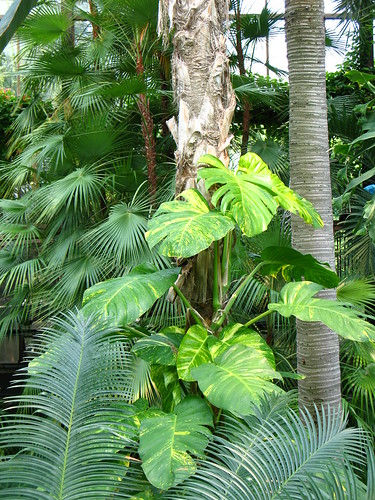
palm house
The palm house with cycads and Monstera's is always such a lush and overwhelming place.
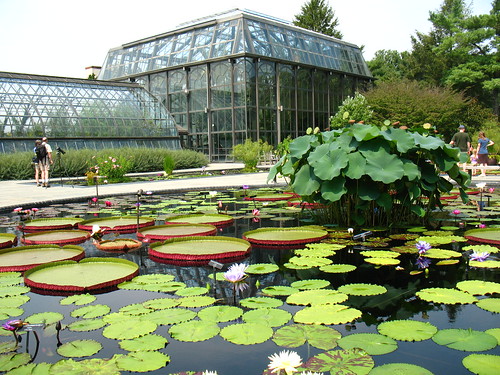
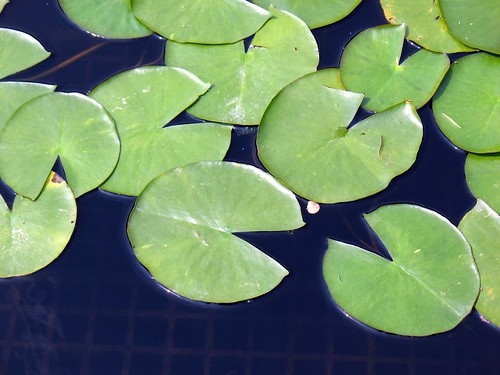
greenhouses and waterlilies
I love the water lily ponds.  Even if they add black dye to the water to get better reflections.
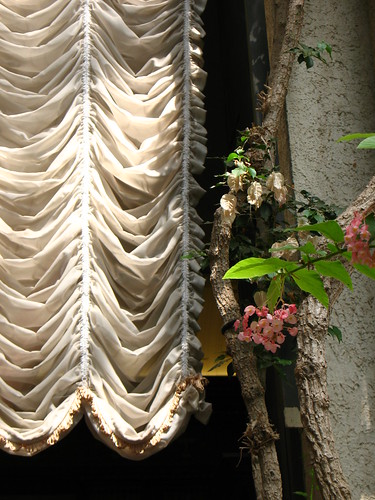
curtain and plants
From inside the greenhouse, between one of the greenhouse rooms and a music room.  I liked the contrast between the soft fabric and the climbing plant.
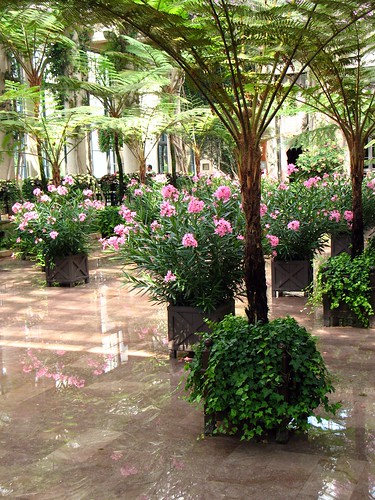
tree fern greenhouse
Nice reflections in the sunken tree fern greenhouse, with pink plumerias.
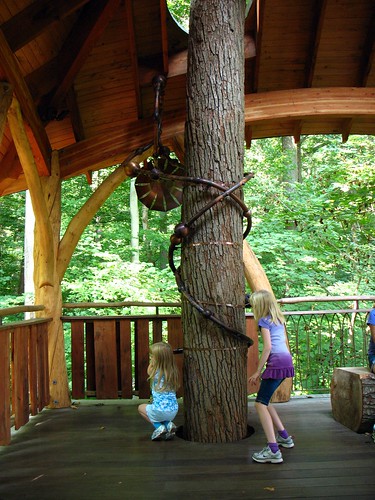
treehouse
In the tree house you can listened to the sound of the forest. We didn't hear anything.  It is not only light pollution at night around here, but also sound pollution in the daytime.
the green of the Northeastern US forest
Green, green, green forest. Nice.

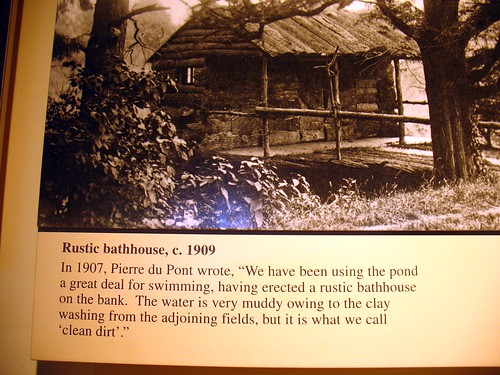
"clean dirt"\
From the Du Pont Mansion's exhibit: Just like this figure caption, my mother also told us to differentiate between 'clean dirt' and 'dirty dirt'.  The clean stuff was, for example, if you dropped your sandwich in the forest and it was down for a few seconds, then you could pick it up, blow the pine needles off, and then continue eating it.  Dirty dirt was somehow more related to humans and other animals.
too neat (and totally weed-less)
Too perfect landscaping is boring and stressful.  It is like a painting with geometric shapes, not how living things really want to be. Again, all about control.  this kind of landscaping is like painting with plants, forcing them into your own design, without any respect to them and what they can and will do. And not a weed, as far as yo can see.

Monday, September 5, 2011

Book Review: and I shall have some peace there by Margaret Roach

I like biographical books describing someones sudden change in life, travel to new places, or how they deal with new environments and experiences.  There are many great books about such challenges, from very introspective, to nature writing, to childhood tragedies.

So, when I picked up this book, I thought it would be about something similar, how a person did find peace on her own little dirt road.

Margaret Roach was an editor at Martha Stewart Living for many years, and lived a fast and stressed Manhattan life.  On the weekends she drove up to a cottage she owned a few hours north of New York City, where she tended a garden on a slope near the Berkshire mountains.

In the book she describes how she quits her job, leaves the city, and moves up to the cottage (hmm, I just realize that I have no idea how big her house is or how it looks), to live there full-time.  This is when the trouble starts, both in reality for her, and with the book.  She never describes WHY she left, what it was she wanted to get away from.  It is just very vague. Same thing when she is in her cottage, WHY is she lost and feel invaluable?  Her writing is great, but the content is fragmented, and there is hint after hint, but very little data about her (except she needs to point out several times that she is very petite and only a size 2, and a vegetarian for 30 years... it gets a bit tiresome).  I wish that she had described the situations and challenges better.  After reading the book I can't even picture her garden or house, nor the landscape it is situated in. I can picture many of her snakes though...  It is just not descriptive in a sense where you can understand, it is just fragments, like specks of paint on an old T-shirt.

She leaves her job at the start of the American recession in 2008, while the health care debate is going full steam and we are about to elect a new president.  The world is full of war, environmental problems, health care issues, unemployment disasters, and stock market crashes.  But all she cares about is to move to her little cottage, tend her garden and be alone.  That is all well, but she never seems to realize that she is incredibly lucky by obviously having amassed a fortune big enough to buy such a place, not work for pay, and still be able to have health insurance, enough food, and all others of life necessities. This is not how most people's lives are, so if she want us to understand her personal challenges and life story she better have to describe them better because most people would LOVE to be in her position. But, I have a feeling she thought that writing this book would be a great way to get some more money (she says so), so the content of the book was less important than that it was a book, period.

Maybe many upper-class women at a similar age (50s) can connect with her feeling of being lost in the world, but I cannot.  Is that because my world is filled with valuable things such as education of a new generation and research that improves society, knowledge and people around me...?  I can see that if you work at Martha Stewart Living how mostly caring about wall color, having a perfect geranium, and collecting green glass could get tiresome in the end.  Tiresome and maybe with a loss of doing things that really matter in the world.  But the solution to this would not be to create a garden just for you, but to do something that matters and brings change to many, I would think.  But Margaret Roach did not. There is a lack of balance here, and the lack of balance consist throughout the whole book.

She really lives a luxurious life in that she could make this decision and spend 2 years gardening and write a book...  but she seems totally unaware of what is going on in other people's lives and the world and is 100% self-centered.  In fact, after reading the book I must say that she portrays herself as very selfish.  Many people would love to have a garden they could spend all their time in, but few can realize this dream.  Margaret does, and she opens up her garden to the public a few times a year, but the rest of the time it is mostly her and the garden and a few friends.  The worst things that seem to happen is when a gray fox family moves into the garden and starts a communal fox bathroom in a corner, which she fights day after day with coyote urine. She comes through as a spoiled Manhattan rich girl, unfortunately.  I am sure she is a nice person, but her self-centered focus gets tiresome early on in the book.

Her deep fear of snakes is a theme in the book, as is her longing for 'being someone'.  So, there are snakes, and I am afraid of them too, and eventually she deals with them and manages her fear.  But everything is so personal, in the sense that you get the feeling she thinks the frogs are there for her, and her only.

People love her book, and her blog (which is equally self-promoting and selfish, I think), but I got rather annoyed.  If you want to make the world a better place, then go out and do something about it.  Make small changes in your local community if you like, you don't have to join the Peace Corps.  It is a great way to feel important and valuable, if you become valuable to others and creative positive change. (All Margaret seems to have done is to flip burgers on the grill once in a while at a local community picnic.)  But hunkering down behind a garden gate that you rarely open more than once a week and become an hermit living on past earned money, it is luxury and not a challenge.  Well, maybe a mental challenge, of course, depending on how your mind works.  I don't like to critize people that write biographies and stories like this, but I have to say that this book rubbed me so much the wrong way.

Summary: Rich girl moves to country where she writes and gardens, full of self-pity, selfishness, fear of snakes, and in the end realizes she is somebody. Grade: C (but the writing is good).
(Note: I am sure Margaret Roach is a nice person, and this review is only based on the book. But if you write books like this you set yourself up to get criticized, especially if you turn out to be as navel-gazing as portrayed in this book.)

Sunday, September 4, 2011

The Pacman plant (according to my husband)

Just a regular water lily at Longwood Garden that suddenly took on a whole different meaning...

Acid Rain stamp from 1986 in Sweden. Around this time I was active in a non-profit youth organization in Sweden and we inventoried the acid rain damage on spruces in our neighborhood as well as taped up protest posters against the acid rain falling over Sweden. A lot of the acid rain was created by German industries, but some was from within Sweden as well.  I remember well how we biked around taping posters at intersections without trying to get noticed by anybody (=police mostly) at 5 AM.  I don't think our parents knew, or if they did, they let us do it.  Nothing ever happened, no police car ever showed up... but the acid rain threat was real, and the forests were dying.  It is better now, because of better cleaning of exhausts from energy and other industrial plants. Oh, and of course the cars made a lot of acid rain.  Somehow it feels like we are fighting a bigger threat today, bigger and more omnipresent and more hard to grasp - global climate change. Back in the 80s, things were simpler, at least for us teenagers.

Saturday, September 3, 2011

Stamp of the Day: Sauna


Leave it to the Finns to have a sauna stamp (or 'bastu', as it is called in Swedish, after badstuga, meaning bathing house).  These men are unusually dressed for sauna, with fresh birch branches strategically located in front of their bodies.  Some sumemr days it feels like a sauna in New Jersey, but it never really gets that hot (about 19- degrees!), and here certainly are no nice lakes or oceans to take a cooling off dip in.  Sauna is a great invention, and wonderful for both body and mind...

Thursday, September 1, 2011

Quote from the news: Are we there or not?

"You hear so much about how instantly reachable we all are, how hyperconnected, with our smartphones, laptops, tablets and such. But the maddening truth is that we’ve become so accessible we’re often inaccessible, the process of getting to any of us more tortured and tortuous than ever."

Great article, or maybe more opinion piece, by Frank Bruni in New York Times, about how difficult it has become to reach each other.  It is really true.  I monitor 3 e-mail addresses several times a day, have 2 more I check sometimes, and one cell phone, and one home phone.  I do not text, twitter or do facebook... so people know that they should e-mail me.  I have a work phone with an answering machine I rarely check (few messages on it). I am on Skype, sometimes, used to be on all the time, but it got too interrupty. I write comments on blogs and Flickr... there is many many snippets of communication going on, all the time.

It used to be that phone answering machines were checked often, now they can stay unchecked for days.  I strongly believe that we are so connected that we feel the need to hide, to disconnect, or we won't have time to do anything.  But, if anybody in my family calls my cell, I will call back as soon as I can, always.  But do we really need all of this?  My most precious communication events are the dining room conversations here at home, handwritten letters and notes sent to me, and long, thoughtful e-mails from friends and family.  None of those can be done on Skype, twitter, texting (SMS), Facebook, phone answering machines... it would just become to short and fragmented. 

Maybe it has become so easy to communicate that we no longer think about what we write.  In the old days, when you had to dip the pen into the ink every few seconds, you had more time to think, to formulate, and decide what to say and not to say.  These days you just throw things out there. And there are so many things thrown out there, that your message might be drowning, severely, unless someone really, really cares about what you have to say at that particular moment. But, maybe we often don't even have the time to care even if we wanted to, because we are stressed animals with too many distractions and too much to do... running around in circles trying to make ends and time meet.