Showing posts with label forest. Show all posts

Monday, July 28, 2014

Fieldtrip to Payette River, Idaho

Last week I was on a day trip to look at mosses and lichens in the Rocky Mountains in Idaho, USA.  We drove up along Payette River, a clear-watered small river with many rapids that is beloved by kayakers and rafters (in inflated rubber rafts).  The river is surrounded by tree-less, browned grass mountains, but in the past there was a lot of trees around here.  Extensive logging in the last 200 years took down giant ponderosa pines, and cattle grazing by the settlers and onwards changed the vegetation to dry grasslands. 

We saw many, many lichens, and here is one of the most common one.  A striking yellow makes this one easy to identify, it is wolf lichen (Letharia vulpina).  It loves to grow on the ponderosa pine twigs and it toxic.  It is called wolf lichen because it was used as a poison to treat bait that was used to kill wolves.


Ponderosa pines against the clear blue Idaho-sky.  These pines are adapted to fire and survive it unless they are small seedlings.  Their bark insulate against hot raging forest fires that regularly comes through.

Wildfires were raging about 15 miles away, but didn't affect us.  Fires are common in these landscapes and part of the natural renewal cycle. 

This moss is an amazing little thing.  The left and right is from the same tuft of moss, and is the same species.  The left got a little water sprayed on it, and came back to life in a few minutes.  It is used to study cell biology, since it literally shuts down its metabolism in its dry state, and then can resurrect itself incredibly fast.


The rapids are very treacherous, and each year several people die here.  Rivers for kayaking are divided into categories 1-5 based on difficulty.  The North Fork of the Payette River (on this picture), is a number 4 I think.  We saw lots of kayakers including one that tipped under and then came back up.

And further down the river, where the ponderosa pine forest is gone, you could see the old logging and mining railroad from the late 1800s.  It is still in use but now it transports tourists. 

A little further down from the last picture is the little town of Horseshoe Bend, population 707. You know you are in a different part of the country when there is a plea for support to help a family's baby that was born with a heart defect, and the lottery prizes in the raffle they set up to help them financially with health care bills include three things: a chain saw, a new rifle with a spotting scope, and a large box of ammunition.  That would not happen in New Jersey.

Saturday, July 5, 2014

What is out there? Bioblitzing's amazingness...

A week ago I participated in a Bioblitz, a biodiversity inventory, at the old Doris Duke estate Duke Farms in Hillsborough, New Jersey (USA).  Her large working farm, park, and mansion has now been transformed into a sustainable natural area with large untouched forests, giant wildflower meadows, and bike trails and a science activity center.  It is a great place to visit.

A bioblitz is a concentrated biodiversity inventory by a group of people, experts and the public usually together, that takes place usually during one day or 24 hours. We were out for 6-7 hours during a hot and sunny June day, but spent the most time in the shady forest.

My group was going to look for plants that not yet had been found.  That might sound strange, but since there already was a long list of plants, we were going to look for the missing things, the gaps, and also go to some of the special areas that are inaccessible to the public to look for new species.  Of course, if we saw other cool non-plant things, then we should take note of those too.  So, what did we find?  Lets look!
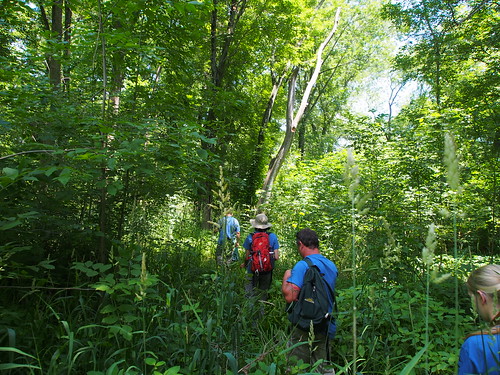
Bioblitzing in wetlands P6280555

We walked into a floodplain forest that often gets flooded during heavy rains.  The grasses and other plants reached our shoulders, and it was moist like the tropics.  Not many new plants, but a lot of animal life.

katydid nymphP6280571

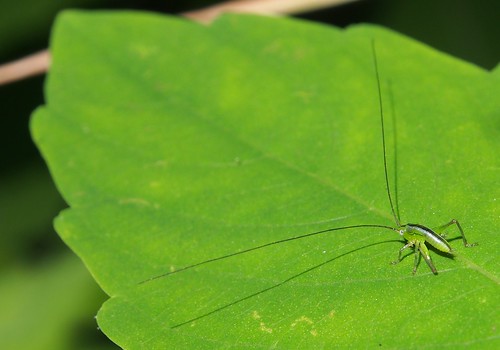
A katydid nymph, very colorful and tiny.  I saw it first because its long antennae sparkled like thin metal wires in the sun. It is some kind of meadow katydid, but too early to tell what species it will become when it grows up.

Carex cf grayi P6280545

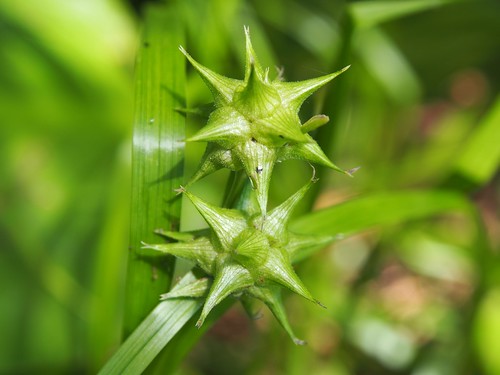
This is a sedge, probably Carex grayi or a closely related species.  The inflated 'bottles' contain the fruit inside.  They look like green stars in the vegetation, and each sedge head is about 2 cm in diameter.

Amber snail maybe, P6280551

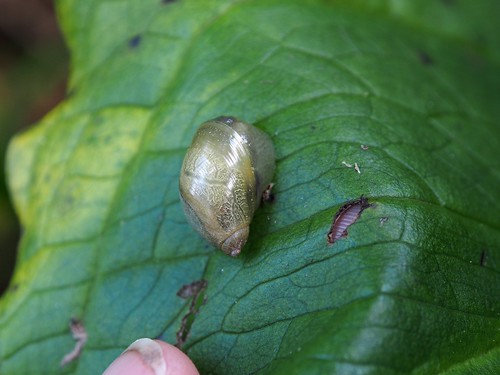
Lots and lots of snails were eating the skunk cabbage, and this one had a translucent shell.  I think it might be an amber snail, but I can't find any good book on land snails for northeastern USA.  Too bad, because that would be fun to learn more about.

Appalachian Brown Satyrodes appalachia

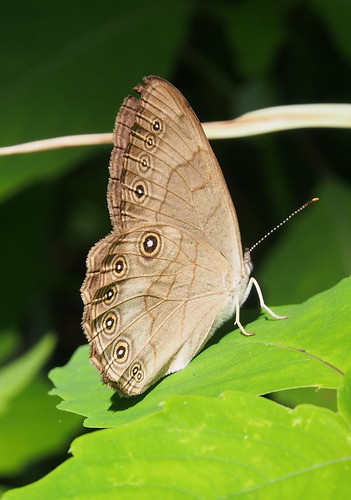
This butterfly has an appropriate name - Appalachian brown (Satyrodes appalachia).  It was sitting on the same plant as the katydid nymph.  I have just started to look at butterflies and they are so different from the Swedish ones.  The names are weird too - like 'brown', 'comma', and 'question mark'.  Very descriptive, but unexpected. Or maybe not :).

Eastern comma Polygonia comma P6280594

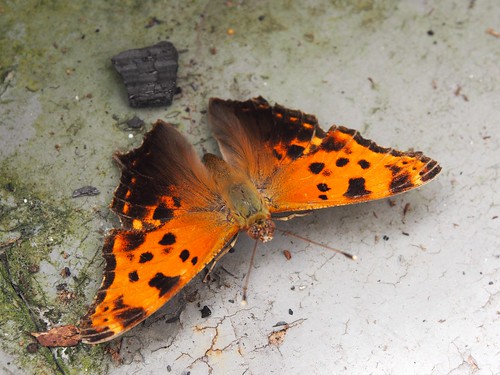
And here, this is an Eastern comma (Polygonia comma), a butterfly.  On its underside of its wings (which you can't see here) it has a white mark that looks like a comma, thereby its name.


Rattlesnake weed, Hieracium venosum_P6280543

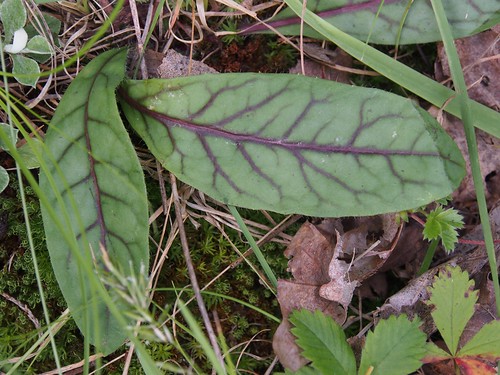
Didn't we see any plants?  Yes we did, but they were less fun to photograph!  Here is one that you can identify by its leaves only, which is always nice... no need to look for hairs on fruits or count petals!  This is rattlesnake weed (Hieracium venosum - those veins sure look like filled with blood!).  It is in the sunflower family and related to dandelions and such. And it is a wildflower, not a weed.

Exomala orientalis (Oriental Beetle) P6280540

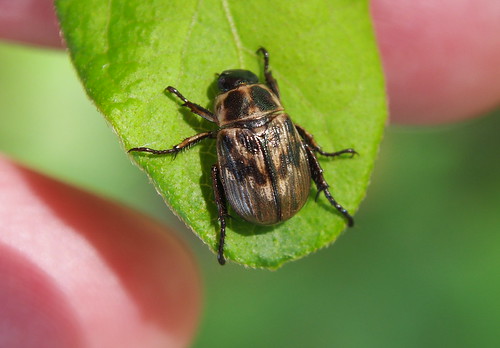
Some species are not native to this area but are very common exotic newcomers.  This is oriental beetle (Anomala orientalis or Exomala orientalis) has its ancestor in Asia, but now is common in this area.  I have seen it on our porch several times, attracted to the porch light in the evenings.  It loves garden plants!

Vanessa virginiensis - American Lady P6280528

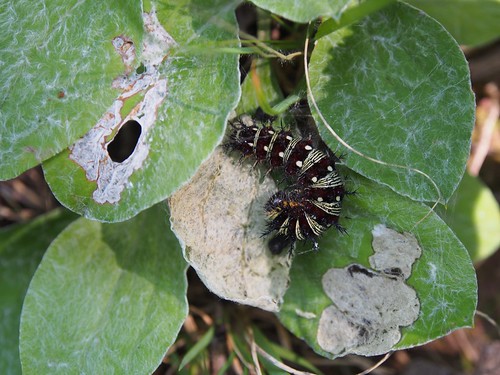
This ferocious-looking butterfly caterpillar will grow up and become an American painted lady (Vanessa virginiensis). It is eating a pussy toe plant (Antennaria) we found in a small area on sandy soil near huckleberry bushes.  I found one ripe huckleberry to taste, and they are very similar to American blueberries in looks and taste.


hardwood forest with storm damage

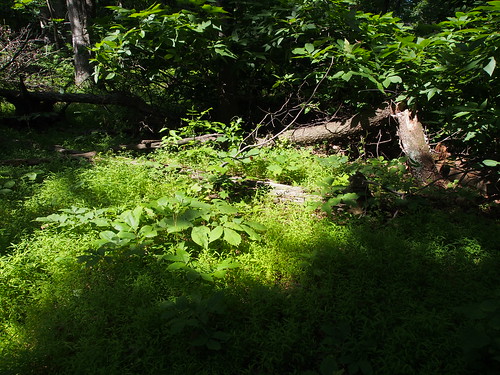
Here is the forest, which after the hurricanes we have had are more open with light gaps from fallen trees, and the invasive Japanese stiltgrass is thriving.  Forests around here have a lot of oaks, maples, and hickories.  Sometimes also tuliptrees.

Lonh-horn beetle, Graphisurus fasciatus P6280515

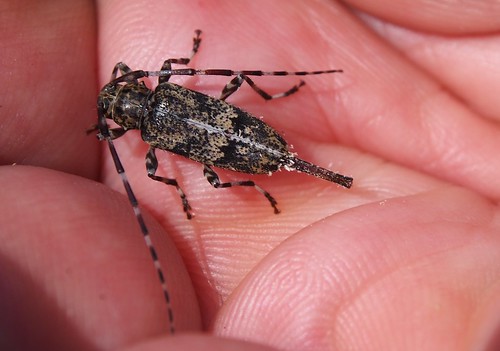
Long-horn beetles are always fun!  This is a female Graphisurus fasciatus, with a egg-laying tube at the back.  In the hand it sat very still, but as soon as we put it back on the tree trunk it scurried off very quickly.

Lucanus capreolus P6280470

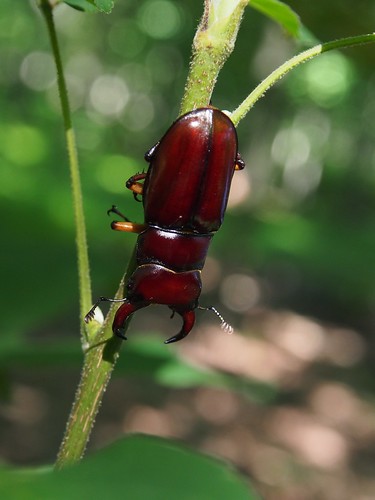
This was probably the coolest animal we saw!  A 4 cm long stag beetle (Lucanus capreolus).  They are said to be very common, but I have never seen one before. 

Hickory gall midge Caryomyia P6280519_closeup

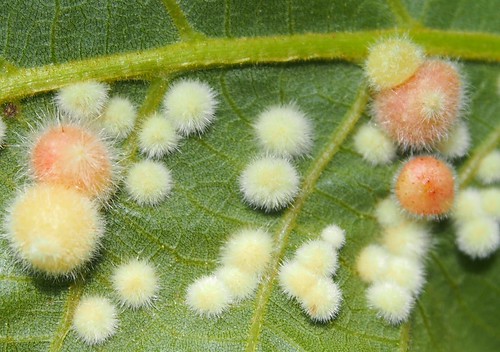
Weird fuzzy golf balls?  No, tiny galls on the underside of a shagbark hickory leaf.  Inside each gall is a tiny developing larvae of a fly or wasp, in this case a small fly.

Winged Euonymus P6280504

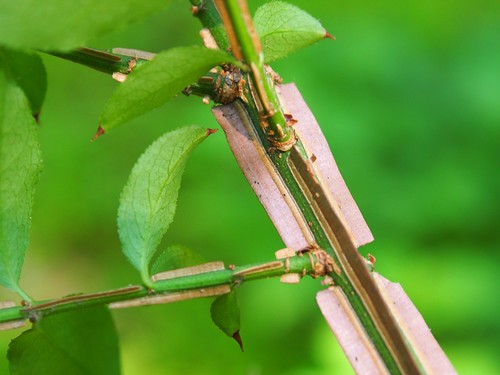
Some invasive plants are really cool, but people don't like them even if they have fascinating characters.  This is burning bush, also called winged euonymus (Euonymus alatus). Look at those cork lists along the stem!  How can you not love that!?

Aralia spinosa P6280500

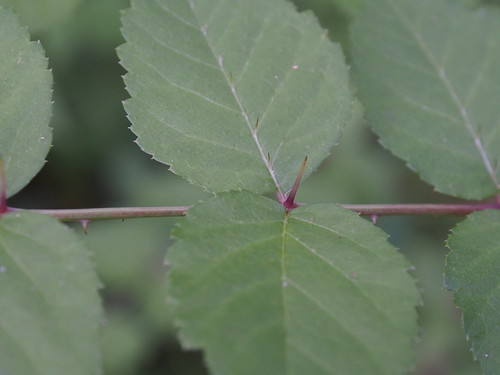
Spiny aralia (Aralia spinosa) has a suitable name.  These spines are on the leaves.  I wonder who it is trying to scare off? 

baby wood frog P6280492

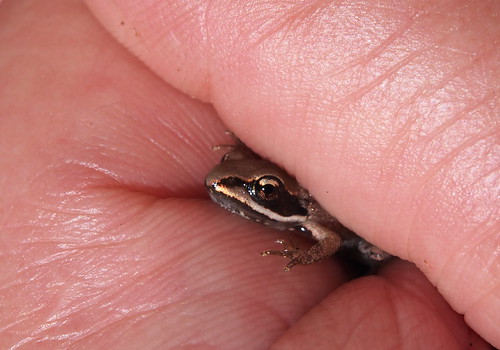
One of several wood frog babies we saw.  Don't worry, it is not getting crushed.

skullcap, Scutellaria integrifolia P6280482

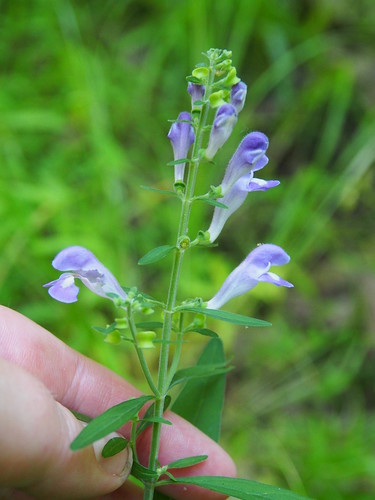
A new species for me, a skullcap (Scutellaria integrifolia).  Look at the flowers, the top part looks like a cap you can put on your head.

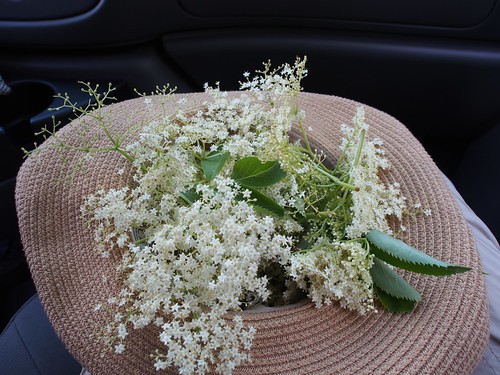
Elderflower collecting P6280582
Towards the end of the bioblitz we saw a big flowering elderflower bush (Sambucus nigra/americana), and I was allowed to pick some of the fragrant flowers in the only thing I had with me, my hat.  The flowers ended up in a jar with lemon peels and vodka and now we have Swedish-style elderflower akvavit in our freezer! Yummy!

Sunday, August 4, 2013

Swamps, wetland, bayou, canal, river, sea, and lake - all in Louisiana

tug boat and barge on the canal
Southern Louisiana is a land on water - thousand miles of waterways through the fresh and brackish delta of the Mississippi, with vast lakes,slow-moving rivers, handmade canals and floating vegetation that creates wetland vegetation over open water.  It is all called the bayou.

pecan swamp forest with saw palmetto
In the higher areas there are pecan forests with saw palmetto understory.

palmetto palm swamp
Sometimes the forest is just water at the bottom.

tree frog on bald cypress
Golden orb spiders, snakes, and frogs are everywhere. Here is a small tree frog that I found along the boardwalk.

 prehistoric midden of shells in the swamp
You can find midden heaps with their thousands and thousands of seas shells collected by prehistoric Native Americans for food.

bald cypress swamps with spanish moss (Tillandsia)
In even more wet areas you get the bald cypress swamps with their long hanging Spanish moss, fluted stems, and roots that come up like knees.  The alligators like to hang out here.  We saw an alligator that was maybe 8 feet, who laid still for 10 min and then suddenly exploded in diving action in a microsecond.

on the canal
Along the canals there are traditional part-time settlements with docks and small cottages that have been in families in generations.  In Jean LaFitte National Park these settlements, often used as vacation houses, are grandfathered in and allowed, but they cannot be sold, only inherited and kept within the same family forever.

 flag house on Rivet Blvd
The only way to reach them are on the water, and everything has to be brought in, including drinking water (unless you have rain tanks).

stoplight deck
During hurricane Katrina these were hit hard with wind, but there was no big flooding - not like in New Orleans where the areas below sea-level flooded catastrophically.

roofless dock
People personalize their docks and houses and live here for months on end.  But some houses have seen better days...

 big storm is coming on over Lake Salvador
During our swamp boat tour we got hit by an amazing rainstorm - 15 minutes of horizontal rain that drenched everything, and then it was over.  The captain of our boat, run by Louisiana Swamp Tours (appropriate name, don't you think), was great, funny, and smiled a little at the poor scientists (not me) that got first muddy up to their knees in the swamp and then drenched to the bone in the rain storm.

 dragonfly
Dragonflies everywhere!  I have no idea of how many species, just many.

 giant grasshopper: devil's horse (Romalea guttata)
And these beasts, called 'devil's horses' in Louisiana are giant black grasshoppers that eat vegetation voraciously.  They come out in swarms in the spring - and you do not want them in your yard or there won't be much left for you. 

blue heron over the canal
This is the land of the movie Beasts of the Southern Wild.  See it if you haven't!  It is an amazing place, not like any other place I have been in the world.  Hot, flat, mosquito-rich, magical, mystical, and rick with life of all sizes.

(More photos from Jean LaFitte National Park here.)

Sunday, July 7, 2013

La Paz Waterfall Gardens

In the rainforest, on a mountain side, down towards some magnificent waterfalls, on the side of an ancient (but active) volcano named Poa, in the central highlands of Costa Rica, on the eastern slope of the Central American mountain ridge, facing the Caribbean, but still miles and miles from the coast, there is a small wonderful place called La Paz Waterfall Gardens. There is a small hotel at this place too,  the Peace Lodge, looking out over the deep valley and the rainforest tree tops.   This is obviously a place designed to pull in ecotourists, but I loved the small scale, down to earth, and simplicity of this place.  I could easily spend a few days here and be happy!

We arrived by bus at the top of the mountain side, where the Peace Lodge is, and started our slow walk on well-maintained steps and paths down towards the aviary and butterfly houses, restaurant, and waterfalls. This is also a wildlife refuge, where animals that have been illegally captured or held as pets can live out their lives, if they can't be released into the wild again.  

La Paz Waterfall Gardens
This is the view from the Peace Lodge, and you can see the aviary to the lower left. The purple flowers are bougainvilleas, with gingers in the foreground and tree ferns lower down.  A short time after we arrived it started to rain, which is very appropriate for the rainy season in a rain forest, and I was very grateful for bringing both a rain jacket AND an umbrella.  Lots of photos could be taken without a wet camera...

wild ginger
This wild ginger has a funny name, Ker-Gawler (Hedychium gardnerianum). It is not from Costa Rica but an import from Himalayas.

in the aviary - a duck
Inside the giant aviary tent where birds flew free and were nearly tame.

toucan
Hello. I am a toucan.

The butterfly house will get its own blog post :)  After checking out the birds, the monkeys, the butterflies, and then passed by the hummingbird feeders in rain (which didn't stop the hummingbirds from visiting the feeders), it was time for lunch. (I bypassed the snake house, I don't care much for those cold blooded animals.) Buffet lunch of traditional Costa Rican food, and it was the best food I have ever had in Costa Rica.  Rice and beans (of course), tortillas, curry beef, chicken in Costa Rican BBQ sauce (not overly sweet), salsa, vegetables, salad, pork chili, mmmm, fresh fruit, and lots of other good stuff... no food in Costa Rica is spicy, but it is tasty!  I forgot to take a photo of the food, sorry!

very fast hummingbirds (sorry about the bad quality, it was dark and rainy)
This place has 24 hummingbird species, the most of any place in the world.  They come right up to you if you stand still by the feeders.  Flying jewels, that is what they are!

view from the restaurant
The view from the restaurant.  I loved it!

epiphytic abundance in the trees
The trees were full of epiphytes. True rainforest style, indeed! It rained too, a lot.

jaguar legsThe 'Big Cat' house was kind of sad.  They can't let these animals out in the wild, but they seem so lonely.  Here are the back feet of the jaguar, which was much lower and stronger than I expected.  I wonder if you hear the cats at night if you stay at the Peace Lodge...

Do you see the ozelot?  It is incredibly quick! Check out the paws!
The ozelot was not a lot bigger than our biggest house cat, but incredibly quick.  No way you could get a good photo of it.  But the paws are in focus, kind of! :)

rain forest in the rain
And then, after passing the frog house, the farmer's house (and tasting fresh cheese), we hiked down towards the waterfalls into the rainforest... in the rain, of course.

the largest waterfall, 120 feet (37 meters) (photoshopped)
The 120 feet (37 meter tall) waterfall, one of at least 4 waterfalls along the trail.  OK, OK, this is a little photoshopped in the colors because the low light in the rain made it an imperfect photo to begin with... please forgive me.

rain forest in the rain
The rainforest in the rain... looking out over the valley.  I really, really want to come back here. And that time, I want to sit and look at hummingbirds for hours. They are truly amazing.

More photos from this place here.