Showing posts with label Cultural History. Show all posts

Tuesday, June 18, 2013

Shaker patterns

In 2011 we visited Hancock Shaker Museum Farm in Massachusetts, and despite it being a somewhat dreary day, we had a great time among the old-fashioned uildings and their tools and utensils.  What striked me was how in the simplicity of all their handmade things was the beauty of patterns, repeats, and just a tiny bit randomness.  Here are some examples (and more photos here):

basket weaving

weaving for the seat of the shaker chairs
shaker chair seat
wooden box workshop
piglets, very young

Sunday, October 14, 2012

Stamp of the day: Muddus National Park, Sweden


Muddus is not a National Park made out of mud, if that is what you think as an English-speaker.  I think it is a Lapponian (Sami) name, and I am not sure what the original meaning is... but it is a land full of bogs, low hills, and waterways and taiga forests in northern Sweden.  Once when we were children our parents took us there, and we kayaked (all five of us, and two Labradors) into the park and into the wilderness for an overnight hike.  It was summer, so the sun barely set at night, and I remember the light at 3 AM in the morning.  It was a magic place, and I remember seeing beavers swimming ahead of the kayaks, unafraid, and a moose or two just glancing at us as we paddled by.  Unusual northern birds, both the singing and the raptor kinds, showed themselves, and we have heard that were was a rare, white falcon ('jaktfalk') at a cliff side nearby but we never saw it.

What we did find though was an abandoned bear winter den, that had been dug out inside an old ant hill (the ant hill are giant in Sweden), with blueberry plants on top.  Near the bear den was a thick stick that stuck out of the ground, and my brother (I think) pulled it out and it turned out to be an ancient ice pick (first we thought it was a bear spear!), with an about a foot long metal pike on a wooden handle over 6 feet long.  The metal was rusted and handsmithed, and the wood was old and grey, but it could still do its job.  Who left it in the forest, hours away from the nearest road?  Who knows.... and we found it.  I wonder where that is now, I don't remember us bringing it.  Or maybe we did, and left it at the local history museum... memories are strange, some things you remember so well, others are in a haze of uncertainty.  But that bear den, that I remember.  It smelled funny and was dark inside...

The stamp shows whooper swans flying over Muddus National Park in Sweden. It was published in 1990 by the Swedish Postal service.

Saturday, April 14, 2012

OK snapshot: Roadtrip 100 years ago

This article is featured in The Swedish Tourist Association's (STF's) 1912 book:

Two Days in An Automobil, on the old royal highway Stockholm-southwards, by Gunnar Anderson.

He describes a roadtrip starting on June 20 (1912, presumably), with not the best weather, "close doors and security hooks, put on rainhats and raincapes, because it is only +9 degrees C, and now we will speed off".

Maybe someone can identify the car on the photo?


{from a book found at a fleamarket in Stockholm}

Thursday, February 2, 2012

Book review: Wildwood Wisdom by Ellsworth Jaeger

This is a most wonderful book.

I have read this book nearly from the first page to the last, and looked at the over 400 handdrawn wonderful illustrations, and contemplated the ways and means that people in the past survived and thrived in the wilderness.  This book has been my late-night companion before my eyes close for sleep for maybe a month or more, and it has been a great read.

Wildwood Wisdom by Ellsworth Jaeger was published in 1945, and has recently been reprinted by First Shelter Publishing, a company that specializes in 'keeping worthy old books in print'.  Jaeger also provide all the amazing and lovely illustrations.

So, what is the book about?  It is about how to survive in the North American wilderness pre-1950s, before nylon, Goretex, GPS, cell phones, and all the fancy equipment we have today.  It builds a lot on Native American tools and techniques, as well as the European trappers and explorers of the 1700s and 1800s.

It is a how-to-book for anything you might need to know while living outdoors.  How to start a fire?  Jaeger presents a dozen ways.  How to skin a skunk? No problem, just be careful and cut off the skunky glands by the tail.  How to make snowshoes?  It is here too.  Food, shelter, bathroom issues, edible and toxic plants, making buckskin and pelts, stalking animals, building shelves out of tree fungi, and how to cook over open fire - just open and read.  And admire the illustrations...

Everything is practial and with exact enough detail that you can copy the methods and sew your own buckskin coat, make a pancake on a hot rock, or built a tepee (see image to the right).  I learned so much from this book; things I might never need to know, but that I love to know.  Today someone at work said - "you are like a sponge soaking up knowledge, and that is so wonderful", and I feel just like that.  THere is so much interesting things out there, from the past, from today, from the future, and real things, hands-on things that exist.  I am not sure things on the internet really exist, but an ax or a pancake, they do really exist.

So, for anybody that goes camping, kayaking, or hiking, this is the book to get them for Christmas.  It works in Europe too, even if you don't have skunks, rattlesnakes, or poison ivy.

The only thing I noticed that was wrong was some of the information about edible fungi.  Some of the mushrooms that were considered edible in the 1940s have now been reevaluated to 'Don't ever think about eating these'.  Otherwise, the book is a true goldmine of great information.  Get it while you can!

Sunday, October 2, 2011

Book review: The Help by Kathryn Stockett

After a long stretch of semi-interesting to really bad books (see this, for example), I opened up this book and just loved it.  I don't want to write a long review, because the book has to be experienced, be loved, and be enjoyed on its own terms, because this is what it deserves.  The Help by Kathryn Stockett is about the black maids in southern US in the 1960s, their lives, loves, and despair, and about the white women that hire them, use them, depend on them, and sometimes, respect them.  I insisted on reading it before I watched the newly made movie based on it, so now I am ready.  If you have read the book, the movie is never better than the book, I think. But this book gets a 9 out of a 10, so I am not worried about the movie being really bad. I heard some had complained that a white woman shouldn't write a book about black women, but come on, that is the stupidiest thing I have heard.  If that is so, then women can't write about men, Swedes can't write about Norwegians, and black men can't write about white men.  We are foremost people, humans, and not our color, citizenship, or gender.  Compassion and understanding is deeper than skin color or culture, at least it ought to be.  So, if you want a great read, a good story, and deep thought mixed with fun stories, this is the book.  It is just like life is. Just read it. A++

Tuesday, May 31, 2011

Checking out Bucks County Art, part 1

The weekend before last, AREA and I participated in Elephant's Eye, a great little event put on by artists in Bucks County, Pennsylvania.  You get a map, some directions and information, and then it is up to you to find the home studios of the sculptures, painters, and other artists that are part of this.  We spent 5 hours driving around in this rural, but rather upscale, part of Pennsylvania, across the Delaware River from Lambertville, NJ, and saw some really great art, some really interesting art, and some that didn't move me much.  Just like art should be.  Here is our story (part 1).

King’s Oaks Farm, Newton, PA, 
USA 

The first artist and studio we visited was Alex Cohen at King Oaks Farm in Newton.  This turned out to be the highlight of all the studio visits, not only because of the art, but also because Alex is funny, interesting, and likes to talk.

King’s Oaks Farm, Newton, PA, USA

His studio (and apartment) is in the old carriage house (photo above) of this big estate which was owned by his grandparents.  They used to cut a meadow into a landing strip for planes in the early 1900s, and some of Alex' art is inspired by this.  What I really loved about his art was the diversity in the paintings, and they were happy (or less so, but not just depressing), interesting, alive, and varied in method, colors, and themes.  Some looked like colored-in black and white movie scenes from 1940s gangster flicks, others were more abstract and showed swaths of green in a spring forest.  Wonderful versatility, and lots of art.  Some of the studios we visited later had much less art and things around, and were therefore less interesting.  And many of the older artists seemed to have gotten stuck in a rut and only did one particular thing.  I won't mention their names here, because this is just a personal opinion, and others might love their work.

Old Dining Room sign

After a while, we got hungry. AREAs comment to this was: "Mom, you always know where the good places are, can't you take me to some little inn or something?". Well, I was in uncharted territory.  We drove and looked, drove and looked, but nothing looked good (just fast food or junk food or greasy pizza). Eventually we came to Gardenville, a tiny crossroads with a few houses with a sense of times past (the post office address is Pipersville).  A general store served sandwiches and we went in to ask if there was a place around that served sit-down food.
"Yes, you can sit outside at the garden tables," the young clerk said.
"No, like a place that serves warm food," I clarified.
"Oh, I guess the bar is open across the street," she said, "it is after noon.  Yep, it is open!"

We looked across the street, catty-corner to the general store was the Gardenville Hotel and Bar, of obvious ancient prestige (and I mean ancient here).  We weren't really sure about the whole bar-thing, but it said Dining Room on the sign too, so we crossed the street between giant GMC trucks and horse trailers.

 stuck in time, a long time ago

We went inside, and after the dark hallway with wallpaper anno 1924 or so, came into a very dark dining room of similar decor.

 lamp in the dining room of Gardenville Hotel

Tiffany-lookalike lamps in the ceiling, metal chairs with red 'galon' (the kind that sticks to your skin through your pants on a hot summer evening), and an unmistakable smell.

stuck in time, a long time ago

"This smells like a hotel in Uzbekistan", I told AREA.  That musky, moldy, and old smell brought me back to some memorable times in the old Communist Party's summer vacation places (I wasn't making that up, it was from personal experience). Nobody was around, no waiter, no guests.  We made our way around the corner and found the bar, which actually was populated and didn't smell.  Nice waitress too, extremely nice and funny.

reindeers (caribou) are allowed in the bar

We sat down, by this time weak from hunger and thirst, at the table under the reindeer (they say caribou here, but they look the same).

 IMG_4509

A couple of regulars were sitting at the bar, one watching an old movie on the TV, and everybody was eating or ordering food.  Well, the food can't be that bad I thought, not if the regulars that know the waitress eat here.  (I don't really take photos of nice people I don't know, so the photo of the bar shows it empty)

So we ordered - grilled veggie wrap for the herbivore and Corona with lime and a Gardenville burger for me.  With SPECIAL potato salad, that all the regulars told me to get because I would love it (I did, it was fantastic). The food was really, really good, and it was not just because we were hungry.  We had happened to find a food oasis in the hybrid zone between rich people's suburbia and farming play country, and old real rural communities.  It was such a great experience.  So all of you readers on this blog, go and visit Gardenville Hotel and Bar in Gardenville, PA.  Oh, I didn't tell you, there is a real modern hotel in the back of the building, without Central Asian smells :)

The waitress told everybody a story about a man who had come in the weekend before and eaten 2 dozen oysters, 1 plate of steamed clams, one Gardenville burger, and two more big dishes. How did he fit it all?  Just the burger was giant.

OK, that was half the day - the rest will be in part 2.

(And a side note - AREA passed her drivers test and got her drivers license a few days earlier, so she drove the whole day, excellent job, kiddo!)

Thursday, May 19, 2011

Spring Sky in New Jersey


Can you see the turkey vulture in the sky? It is there! Actually it is two.

This photo is from Locktown, a tiny village with a very old (with American standards) church and cemetery with grave stones leaning in all directions, and some so old that they are just made from plain flat stones from the nearby Wickecheoke Creek (yep, that is an old Indian name). More photos of this nice place on Flickr.

Wednesday, March 30, 2011

Hairy heads on the railroad


It is amazing what you can find accidentally on the internet. This photo is from the archives at a university and shows the taxidermy department at Kansas Pacific Railway. The stuffed buffalo heads where apparently used for advertising. Times were different back then. I wonder if this was the only railroad that had a taxidermy department. (I better ask PP and BV, they know everything important about railroads, or they can find out if they don't know.)

Friday, March 18, 2011

Knappar, märken och medaljer

Varje barn i Sverige har nog minst ett simmärke och det verkar som även vuxna sparar sina.
Att ta ett märke är förknippat med en prestation och att ta simborgarmärket är något alla barn i Sverige vill klara. För att ta det ska man simma 200 m, i bassäng eller i fritt vatten och detta märke har funnits sedan 1934. Det har nyligen MH 8 år gjort, till sin och min förtjusning. Att kunna simma är en livförsäkring. Många barn får flera märken, både vid simning och andra sporter.


I Sverige finns en lång tradition att visa sin sympati för något med ett nålmärke på kavajslaget. Därför finns många märken för politiska partier, företag, föreningar mm. Att ge ut ett borgarmärke var ett sätt att främja folkets kunnande vilket ansåg i många föreningar vara en huvuduppgift. Genom att göra ett prov kunde man ta sitt märke, traditionen finns ännu. Därför finns (eller fanns) både hundborgarmärke, skidborgarmärke, ridborgarmärke (tv) simborgarmärke och bilkunskapsmärke. Livräddarmärke och samaritmärken visar att man är utbildad. Troligen får fortfarande sjuksköterskor ett märke vid examen.


Det företag som oftast står bakom de mångformiga märkena är Sporrong. Jag blev nyfiken och det visar sig att Sporrong är ett av Sveriges äldsta företag, verksamheten startade redan 1666 i Stockholm med en Mäster Grau. Då hette inte företaget Sporrong ännu, det kommer först 1842. Mellan tiden 1842 och 1875 heter företaget Sporrong för att därefter heta CC Sporrong & Co. Ofta tillverkades även uniformsknappar, t.ex till militären.
Tillverkningen skedde i flera verkstäder runtom i Stockholm men bedrivs idag i Estland och Finland. Mer om Sporrongs historia här .


Metal buttons, pins and medallions

First picture is a swimming test pin, which many children in Sweden get after they succeed to swim 200 m in a pool or outdoor lake
. There are many pins in Sweden that are linked to a personal achievement like riding, dog leading, car driving and skiing. Many are also worn to show support for a specific political party, sports club or hobby club. The company which makes many of these is Sporrong, one of the oldest companies in Sweden, dating back to 1666. For a long time the production was sited in Stockholm but is has now moved to Finland and Estonia.

Monday, March 7, 2011

Book review: Hundraåringen som klev ut genom fönstret och försvann av Jonas Jonasson

One more book review of a Swedish book in Swedish on this blog, but this one it on its way to be translated into English and a multitude of other languages.  It was a long time ago I read such a hilarious book.  It helps that the long beginning takes place in a small village not far from where I grew up, and that the author successfully makes fun of Swedish society, world history, politicians and incompetent bureaucrats, and puts together an obviously too-incredible story, but it is fun!  Just like crazy movies like Young Frankenstein is fun.  It is not because the story is believable, but because the book (or movie) creates laugh-out-loud moments in your life. 

In Swedish this book by Jonas Jonasson is called 'Hundraåringen som klev ut genom fönstret och försvann', which means The 100-year old who stepped out the window and disappeared. It will be made into a Swedish movie in 2012.  Jonas Jonasson is a former Swedish journalist who had the first draft of this book in his drawer for over 20 years or so.  The story seems simple, but it is not.  An old man turns 100 (named Allan) and decides to escape before his birthday party at the old-people home, and steps out the window.  And then the story starts, which includes murders, elephants, police, journalists, mafia, drug dealers, akvavit, swedish summer, swedish women, and much more... all written in a hilarious Swedish based on 1940-1950s intricate and sometimes stilted grammar with words of today thrown in. Throughout the book the 100-year old reminisces about his colorful life, where he has traveled the world, and in fact, helped (or not) world history personalities such as Franco, Roosevelt, Mao, Einstein's brother, Stalin, and he visits and deals with the associated gulag camps, atom bomb makings, secret submarines, and Iranian revolutions.  The book gives a great work-through of 20th century history, but of course it is all wrong because Allan is inserted in it.  But hilarious! I won't tell you the ending of the story, but it is good to the end.

I loved this book.  Apparently many (snobbish?) book critics in Sweden didn't like it at all, and thought it was silly, overwrought, or just plain dumb.  Well, dumb, that is Danielle Steele.  Overwrought, sure, but that is the point!  Just like a Mel Brooks movie, get it!?  Remember Springtime for Hitler - just the same thing, but this is nearly better, I think.  Silly - come on, good culture can be FUN. One critic complained that the book wasn't believable (hello, it wasn't meant to be!). This is pure entertainment, not serious literature... I am keeping this book so I can read it again next time I get the flu and have to lay in bed for a day or two. It will make me laugh many times again.  (And thanks to BOS for sending it to me!)

So, English-speaking readers, keep your eyes open and get it when it comes out in your country in the translated form.

Saturday, February 19, 2011

Gorgeous: Tiles in Samarkand

Samarkand is a magical place, an old market city on the old Silk Road and home to ancient scientists and poets. The old mosques are still there, and with detailed and large mosaic patterns, often in turqoise. Here is a tiny detail of a regular wall in one of the historic compounds. Each brick is painted, glazed and burned before you make the wall, so these colors are hundreds if not a thousand years old.

Friday, December 3, 2010

Some thoughts on books (for those that say they are dead)

"Good as it is to inherit a library, it is better to collect one" -Augustine Birrell
"Outside of a dog, a book is man's best friend. Inside of a dog it's too dark to read" -Groucho Marx
"The man who does not read good books has no advantage over the man who can't read them." -Mark Twain
"The smallest bookstore still contains more ideas of worth than have been presented in the entire history of television" -Andrew Ross
"Never lend books, for no one ever returns them; the only books I have in my library are books that other folks have lent me" -Anatole France
"No entertainment is so cheap as reading, nor any pleasure so lasting" -Mary Wortley Montague

Friday, November 26, 2010

Book review: American Terroir by Rowan Jacobsen


This is one great book: American Terroir by Rowan Jacobsen.  One not too thick, not too dense, not too preachy, not too boring, not too silly, not too detailed, not too American book.  American terroir (not terror, not terrier, but terroir – as in the land and microclimate that give wines special flavors, "the taste of place") is a book that takes us on a tour around North America to ten great food products, and their greatness are because of where they are grown and the history and climate of the place.

Rowan Jacobsen writes in a funny but detailed way, giving you an abundance of history, science, and culture in short but dense sentences that never become a chore to read.  In fact, when I fell asleep reading this at night I was unhappy because I wanted to continue reading it, not go to sleep. This is in stark opposition to Michael Pollan’s The Omnivore’s Dilemma (TOD), which I am struggling to finish after a year of trying to get into it.  I ought to like TOD, because I ought to like Michael Pollan and his work for better food and agriculture in America, but I just don’t like it that much.  This book, this little gem of red rowanberries, this I LOVE! 

The chapters deal with the following ingredients and food products: maple syrup from Vermont, coffee from Panama, apple cider from New England and apples from Washington State, honeys from everywhere, potatoes from Prince Edward Island, wild mushrooms and native plants in southeastern Canada, oysters from Puget Sound in the Pacific Northwest, avocados from Mexico, Yukon River King Salmon, unusual wines from California, cheese from Vermont, and chocolate from Chiapas in Mexico. 

While reading this book my brain kept constant notes on which people I would recommend each chapter to (coffee to my brother, salmon to my husband, etc.) but in the end, I will have to recommend the whole book to everybody.  There is no best chapter, they are all great.  It is easy reading, but chock-full of great facts and stories. Each chapter ends with a few recipes and a list of suppliers and websites for more information.

Rowan Jacobsen manages to teach the reader a lot of plant genetics, breeding history, soil science, and microbiology without the reader even noticing – we are too busy just enjoying the story.  By highlighting not just the local food and sustainability, but the connection of these foods to the natural places, history of its people, and personal stories, Jacobsen made me want to know more and more about our little corner on this Earth and its connections to the past.

This book was a great surprise and a great find, and I recommend it to anybody – chocolate fanatics, oyster nerds, historians, and food people, grandmothers, teenagers, and husbands, Swedes, and Americans, and any mycologists and farmers out there.  It is just a GREAT book, probably one of the best non-fiction books I have read in 5 years.  (Catching Fire by Richard Wrangham was also great, but this is more mainstream). It seems like many people like this book - I just found some of the reviews here. A new classic, indeed. 

The only thing I missed was a detailed index, please, publishers, don't skip on this.  We need indices! Books on paper don't have Google attached to them.

 Here are some excerpts to give you a feel for the writing style:

(on maple syrup):
"Caramelization is one of those unlikely tricks that reminds you that the world is magical and mysterious. It's the flavor equivalent of using a prism to transform white light into a rainbow. In this case, the prism is heat, which breaks and odorless sugar molecule (sucrose) into a rainbow of delightful aroma compounds."

(on cheese):
"Cheese used to be something that nature did spontaneously, We didn't design the cheese so much as guide it, like an equestrian riding a horse. The cheese powered itself and the cheesemaker gave it some direction."

(on oysters):
"A geoduck looks like something that might owe a lot of money to Jabba the Hutt. A giant clam that burrows so deep that armor becomes superfluous, it maintains a vestigial shell that sticks to its backside like a G-string on a sumo wrestler."

(on apples):
It turns out that, given a choice, people overwhelmingly go for the reddest apple. So growers kept selecting for the reddest. They were not, however, selecting for the tastiest. Eventually, Red Delicious apples eclipsed fire-engine red and reached a color imaginatively described as 'midnight-red'. And most are virtually inedible, with dry flesh and thick skin.  Good-tasting apples have small, tightly packed cells that break apart at first bite, spilling their juice in all directions.  Red Delicious have cottony, dry cells with too much air in between."

Tuesday, November 23, 2010

OK snapshot: Stockholm sunset

Denna över Marieberg. Kan väl symbolisera kulturskymningen i svensk dagspress...
(This one over Marieberg. It can symbolize the cultural dawn that is sinking down over daily Swedish newspapers. [Marieberg is the little mountain on Kungsholmen where Dagens Nyheter and Expressen have their offices - those tall buildings in the distance.])

LS comments:
Swedish newspapers are struggling just as American ones, and what sells the most (crime, drama, entertainment, and other mayhem) is not really what can be considered high culture...(which some think is just snobbish intellectualism... but I don't agree 100%). Fewer and fewer pages are printed in the morning papers, and the giant online dragon is Aftonbladet (also in print), who mostly has sold out to the mayhem-addicted. I read Aftonbladet all the time online, but half the time it makes me sick. But it still has lots of currently updated news from around the world, mixed in with the latest in plastic surgery, weather chaos, grisly murders, and recent school bullyings.

Currently the top headline in the online edition of Aftonbladet is "Obama furious at North Korea" (something serious to look like a serious paper), but this is followed below by "Hand was stitched on the foot -9-year old girl had miraculous operation" (gross me out and make me in awe thing), "Several trucks blowed off road" (the usual weather chaos thing), "Your child will become obese due to bad sleep" (scare me in the everyday life thing).

Dagens Nyheter and Svenska Dagbladet are the two old morning papers in Stockholm, fierce competitors, and both try to be very serious until they too dip their feet into the reality TV shows and Zlatans latest outburst. Then there is Expressen, Aftonbladets competitor, an evening newspaper also online and in print - but not at all as big as 'aftonslasken' ('the evening garbage'). These are all in Stockholm, and on the West Coast there are a few more papers.

Aftonbladet was in deep dodo about 20 years ago but managed to turn a bad situation around by focusing more on the 'soft issues', i.e., home, women, food, health, parenting... and becoming less macho (=sports, economy). There is a great documentary radio program in Swedish about the macho culture on Aftonbladet back then, when a few women who wrote a report about it which became rather infamous (and important) and how their newspaper office is today. Yrsa Stenius has also written about the culture at newspapers in Sweden in her great book Makten och kvinnligheten (The Power and The Feminitity), which I will review here at some point.

But the point here is that there used to be a lot of culture, analysis, deep thought, and funky stuff in these newspapers (like New York Times still has), but it is largely gone or at least minimized. There is still reviews and important articles about art, theater, books, philosophy, movies of course, but it has become much more shallow, especially in Aftonbladet, I think. So, the sun is setting over the cultural departments at the
Swedish newspapers.... I am sure there is lots of interesting things to read in other media forms, such as magazines and blogs... but an old tradition is fading. The times they are a'changin'.

Monday, October 11, 2010

Maybe the best sandwiches in the world?

Sometimes I get really homesick for Swedish food.  I was just downstairs in the kitchen and opened the fridge and thought about the Swedish things that are great but hard to get here in the US.  So here you go, my list of the best traditional Swedish sandwich toppings (smörgåspålägg [ha, there is a Swedish word for you Americans to master!]), in no particular order (they are all amazing).  I know, some of you will not agree, feel free to comment. :)

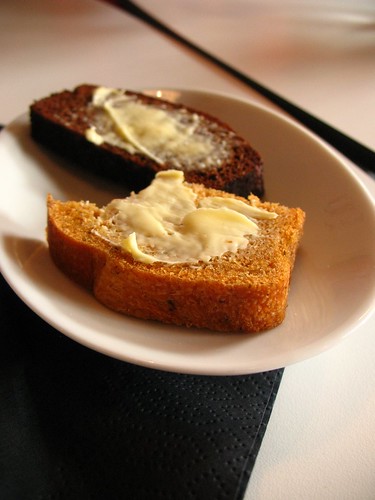
    bread at restaurant P2
- Arboga leverpastej med inlagd gurka (Arboga liverwurst with sliced dill pickles) (photo)

- Skivat hårdkokt ägg med Kalles kaviar (Sliced hardboiled egg with smoked creamed fish roe) (photo)

- Skivat hårdkokt ägg med ansjovis (Sliced hardboiled egg with anchovy-pickled herring sprats [these are not real anchovies]) (photo)

- Skivad kall kokt potatis med kaviar (Sliced boiled cold potatoes with smoked creamed fish roe) (photo)

- Smörstekta kantareller (Wild-collected yellow chanterelles fried in butter) (photo)

- Räksmörgås (Shrimp sandwich, with little tiny pink shrimp, mayo, sliced boiled egg, lettuce, thinsliced lemon) (photo)

- Rökt renkött med pepparrotsvisp i tunnbröd, renklämma (Smoked reindeer meat with creamed horseradish in thin bread) (photo)

- Greveost och rökt skinka med färsk röd paprika  (Greve cheese and smoked ham with fresh sliced red pepper)

- Gravad lax med senapssås och dill (Gravlax/Brined salmon with mustard sauce and dill) (photo)

- Köttbullar (kalla) med rödbetssallad och sallad (Cold meatballs with beet salad (with youghurt or sour creme) and lettuce) (photo)

- Gratinerad varm smörgås med allt möjligt, kantareller, ost, tomater, osv. (Oven-broiled sandwiches with different toppings, such as chanterelles, cheese, tomatoes...) (photo)
    Swedish sandwiches are always open-faced (no bread on top), with things falling off them when you eat them.  That is just the way it is.  The bread can be any kind. You can make a double sandwich if you have to transport it somewhere and eat it for lunch but otherwise it is not common.

    We Swedes have much less toppings on a sandwich than Americans (well, we used to, I think Swedes are becoming richer and add more nowadays).  I only think Dutch people have less. And they put butter, chocolate sauce and chocolate sprinkles on their breakfast sandwiches.

    We don't cut off the crust and make little triangular double sandwiches with white mush in them like the Brits (I do like these too, but they are for people that are afraid of getting messy).

    We don't overload giant subs and heros with salamis and other meats like American-Italians (which can be great to eat, but isn't Swedish). Ever heard of a muffaletta?  They are giant. Giantly tasty too.

    We don't make peanut butter and jelly sandwiches, a combination I personally think is kind of... disgusting.  Each one by itself is quite fine.

    We don't make smörrebröd, that is the Danes specialty (overloaded warm or cold sandwiches you have to eat with a knife and fork - also delicious).

    Sometimes Swedes invent crazy sandwich topping combinations.  I have a vivid memory of a cousin, who will rename unnamed, who ate a sandwich with cheese, kaviar, and orange marmalade. And here is a crazy one too!

    So, what is my favorite breakfast sandwiches here in the US?  Well, since there aren't some of the Swedish things...  smoked ham, cheese and Frank's Hot Sauce...  cottage cheese and fox point seasoning...   hummus....  goat cheese...  sliced cold potatoes and kaviar (everybody else in the house thinks I am crazy to eat that)...  sliced egg and real anchovy...  marmalade....  blueberry jam (homemade, more about that later)...  cheese and pickles, or cheese and sundried tomato tapenade...

    Wednesday, September 29, 2010

    Old and real things last longer

    In the small, semi-northern Swedish province of Gästrikland, there is an old village mainly consisting of a 1600s iron foundry with worker's baracks, mansion, farm buildings, storage cellars, and so on.  This is Gysinge Bruk, which has recently been restored and is now used as a conference center.  These rural places have a hard time to survive financially, but Gysinge has found its niche in the Swedish economy.

    examples of outside historic paints for sale


    Some passionate people founded the Centrum for Byggnadsvård (approximately the Center for the Care and Restoration of Historic Houses, website is unfortunately mostly only in Swedish) here, and this has become a pilgrimage place for many Swedes who have old houses they want to care for using old practices.  Paints are sold using old recipes using either oil or flaxseed oil (no acrylic here), and copies of old electrical, lightning, or metal parts are sold for replacement of broken old parts.  They have courses and workshops in careful and thoughtful renovation of these soulful houses, and there are many, many historic houses in Sweden, so the interest from the public is huge.

    partially renovated kitchen


    Part of their center is a hands-on demonstration of a work-in-progress where 1700s farmhouse is being restored and simultaneously converted into a suitable and efficient house for a modern family.  Nowhere do you see chrome, plastic molding, and other modern materials, even if the tools they use are sometimes high-efficient and modern. This creates a unique atmosphere in these houses, a warm welcoming feeling of memories and recognition, at least for me who has lived in several old houses and seen many more in Sweden.

    window detail
     
    old electric style - and approved for useThe appreciation for the natural materials, the simplicity of lines and designs (even when elaborate), and the history of craftsmanships are all things that form the foundation for this amazing place.  What this center provides is incredibly important for Swedish culture and history, and they really create new life in old buildings. Of course many people use these designs in their modern houses as well, inspired as they are of seeing the shapes, colors, and lines of times past.


    On the website the founders of this center asks us the question: "Who would cut up the side of an old T-Ford to press in the door to a new Toyota Corolla?"  Still, this is what many people do when they own an old historic house.  Then they point out that many times this is done because people don't know they can replace old with old, because they don't know about the center in Gysinge where you can buy parts and products. They sell not only paints and parts, but also moldings, wall paper, brooms, windows, flower pots, kerosene lamps, signage, railings, electric switches, tiles and chairs.

    More photos from Gysinge here. Click on the photos above if you want to read more about them,

    Sunday, September 26, 2010

    Swedish food, now and then

    While in Sweden recently I had many memorable meals, in very different settings, and from the fancy to the everyday, from the modern to the traditional or even ancient, and from pure Swedish to authentic Italian via swedish-inspired Thai and swedish-style pizza.  During our trip north to the province of Gästrikland we stopped in at the restaurant Furuviks Brygga (Furuvik's Pier), which is a fancy and rather new restaurant located on the Baltic seashore near the town of Gävle (a word that is not related to jävlar) of Botnia, or literally translated 'the bottom sea".  Furuviks Brygga is quite isolated and was very hard to find - they certainly need some help with their way-finding signage. 

    Furuviks Brygga restaurant
    But we found it and despite it being a cloudy, semi-chilly September day in the beginning of the off season (= very few guests at the restaurant), we loved the setting and atmosphere of the building, which was architecturally inspired by old Falu red fishing huts along the coast. We stared out at the horizon and looked for eagles and seals, but only a cormorant and a heron showed up.

    fish dish
    The food was excellent, focused on Swedish delicacies in the nouveau way of cooking them, but the service could have been a lot better. Above is hälleflundra (halibut).

    Furuviks Brygga restaurant and the ocean
    For a near empty restaurant you think you could have gotten your check in a timely manner, and that they could have made sure the glasses on the table were clean. "Oh, our dishwashing machine is having a problem", is not an acceptable excuse.

    reindeer carpaccio - the best!
    But the reindeer carpaccio (above) and the fish dishes were amazingly good, and fed both the stomach, eye, and soul. I would definitely visit this place again.

    A very different place was Sjätte Tunnan (The Sixth Barrel), a medieval-themed restaurant in a medieval cellar in the Old Town (Gamla Stan) of Stockholm. My cousin AI (thanks!) had recommended it as a fun place to take some non-Swedes, so I ended up here with eight non-Swedish friends from all over the world (Belgium, Mexico, Colombia, USA, UK...) during one of the evenings of the scientific conference I attended. 

    medieval cellar, where you eat at Sjätte Tunnan, medeltidsrestaurang
    From the street in this old cobble-stone part of Sweden's capital you sneaked down a deep and steep stone stairway and found yourself in a cellar of small interconnected vaulted rooms with thick stone-walls.  You could nearly hear the walls talking about times past, from the Hanseatic trading times to the Stockholm bloodbath when the Danish King cut the heads of Swedish noblemen and bishops. That was a long time ago, but it had an enormous influence on Swedish history.  The son, Gustaf Eriksson, of one of the killed, got mightily pissed off and went north to Dalarna to engage the grassroots (farmers mostly), and he later became the king Gustav Vasa (famous as Wasa crispbread these days).  Gustav Vasa started out as a revolutionary but after getting royal powers, he as many others around the world, turned into a megalomaniac, selfish, and power-hungry dictator (I think).

    menu at Sjätte Tunnan, medeltidsrestaurang
    The menu was long, long, long, but with rather few items, since all items were described in detail and there were also introductions and explanations to the purpose of the restaurant - authenticity.  They had an English version of the menu too, so I didn't have to translate it all... For many dishes the original publication of the recipe was cited, such as "Le Viander from the 14th century".
          The drink menu was regular beer and wine, but they had many special and home-made meads (mjöd) as well (mead is beer made with honey, famously drunk by the vikings), and hard cider from local Swedish apple orchards and breweries.  And then the food - only ingredients present at medieval times... so no potatoes, tomatoes orchards and chili peppers (all from the New World and absent from Europe before 1492).  Lots of game and wild meat and fish - chicken, wild boar, beef, lamb, trout, and even beaver (when available).

    medieval cellar, where you eat at Sjätte Tunnan, medeltidsrestaurang
    We were sitting along a long rough-hewn table in candle-light on long plank benches - all to create the right atmosphere.  On the table were knives and spoons, a rock, and candles.  The rock was the salt - if you needed some you just scraped some off with your knife.  Forks were not around in medieval times, but you could get one here if you asked, and we did.  The waiter was dressed in coarse fabric, maybe linen, and in clothes that looked homemade and were rather holy (as in holes, not religious).

    medieval mooseballs at Sjätte Tunnan, medeltidsrestaurang
    I went for the moose meatballs ('älgbullar') with mashed rutabagas ('rotmos') and lingonberry jam ('lingonsylt').  There were very few greens available with the dishes, because medieval people were very suspicious of greens - they were meat-and-potatoes kind of people (except the potatoes were turnip, cabbage, rutabaga, etc.).  The food at this place was great, but not exceptional, and in fact one of my meatballs had so much salt in it it wasn't really edible, but everybody else's food was great and the atmosphere was fascinating.  Experiences like this are so much better than reading about history in some old boring schoolbook.  I really recommend this restaurant, and especially to Americans that need a dose of hands-on history, since there are no medieval buildings in most of the USA.

    Thursday, September 16, 2010

    When food gets scarce...

    ... reach upwards.

    This is an old heritage breed cow from southern Sweden from an isolated farm who kept the same group of cows (and their calves) over nearly 50 years, thereby preserving their genetics and not replacing them with the high-yielding superbred cow breeds that are common today. So kind of a living fossil. This is the kind of cow that was common in the early 1900s and is shown in the books by Astrid Lindgren. And now this cow is in a living farm museum in Södertälje, Sweden.

    Monday, May 24, 2010

    A Swedish classic on the likelihood of nuclear power disasters


    This video of Tage Danielsson shows one of his most classic dark-comedy monologues which he made right after the nuclear failure at Three Mile Island in Harrisburg, USA in 1979. This was in the middle of the campaigning in Sweden before the national referendum if Sweden should develop or undevelop their three nuclear power stations. It is too bad this is non-translatable, it is a fantastic linguistic peace of work. The main point is that the accident at Three Mile Island was so unlikely that it really couldn't have happened, or... It is a big play on words, and the victims of his jokes are mainly the Social Democrats who led Sweden at the time. So this is for you Swedes that read this blog! Enjoy! (Swedish blog about Tage)

    "Utan tvivel är man inte klok" = "Without doubt you are not intelligent" (quote from Tage Danielsson)

    Sunday, April 18, 2010

    Ice and fire in the time of volcanism

    When you have gotten tired of your too colorful and contrasty screen background and need something black to rest your eyes on, try one of these.  I love the one with the black labrador and the waterdrop on the chrysantemum petal. I know some readers of this blog probably would pick the black LEGOs :)
    This one called leafage is by (matt) on Flickr (creative commons license).


     The volcano on Iceland is still spewing out ash and probably soon more lava, they say.  Can you imagine the first vikings that settled Iceland from Norway over a thousand years ago.  They came from a solid-rock country of granite and gneiss and limestone, billion year old rocks carved by ice ages, and were faced with a living breathing geologic living thing.  The earth moved and trembled, spewed out lava, ash, and rocks, sulfuric water boiled in hot pools, and whole mountains exploded and cracked open.  If you were a viking that had never heard of such things, what would you have thought?  I wonder how much of these experiences influenced the old Norse mythology and especially Ragnarök, their Doomsday.  I am sure it provided vivid imaginary of hell, except Old Norse didn't have hell and heaven (well, they did have hel, but that had a slightly different meaning than the home of the devil), they had Muspelheim and Valhalla. I find it kind of ironic that a hot place like this island was named Iceland ("Island"), and not Fireland ("Eldslandet").  (In 1947 Hekla, another one of the larger volcanoes erupted, see today's stamp from Iceland). Was it just wishful thinking from the vikings?