Showing posts with label United Kingdom. Show all posts

Wednesday, June 6, 2012

A bunch of books...

Do books come in bunches?  Or are they in piles?  Groups?  Heaps?  Anyway, here is a couple of short reviews of books I have read in the last couple of months, from the great to the not so great.  So, the best first.

Tracy Chevalier: Remarkable Creatures.  What a great novel!  It is in the early half of the 1800s and a poor girl gets her living from discovering and selling fossils from the beach by her home village along England's southern coast.  An unmarried woman and her sisters move to town, mostly because it is a cheaper place to live than London, and she befriends the girl and learns about and collects fossil.

They discovered the most amazing fossils of the time, fossils that were bought and transported to natural history museums in London, Paris, Oxford, and so on.  These fossils were fodder for a lot of discussion in this pre-Darwin era, and fueled scientific thinking.  Plesiosaurs, ichtyosaurs...  However, the women didn't get proper credit, since they were women and fossil collecting and science were unwomanly activities. A few of the contemporary paleontologists gave them proper respect and credit, but the divide was enourmous, especially for Mary who started out illiterate and extremely poor.  For example, women were not allowed even into the meetings of the British Geological Society.

The young woman's name was Mary Anning, and her older friend was Elizabeth Philpot, who specialized in fish fossils.  This book tells the story from their viewpoint.  The general story is true, but it is a novel so gaps have been filled in with possible scenarios.  It is a great book that not only describes natural history and its discoveries in historical context, but also highlights and make the inequality come to life. And that inequality is not just between genders but also between classes and religious groups. I highly recommend this book. So, 5 stars.
Sandra Newman: The Western Lit Survival Kit.  This book is fantastic! Well, near fantastic, because sometimes she goes overboard. I read the whole thing straight through, laughed, smiled and took note on which classics that I wanted to read and which ones I never need to open. Actually, I don't feel the need to read any of the classics after reading this book, I have too many books already here at home waiting to be opened.  Probably around a 100 unread books... and only a few of them are classics.  Like Marco Polo... I want to read that one, but I digress. 

Her style is out of this world funny and knowledgeable. Ah, we need to let high school students have a look in this book! The book is exactly what the subtitle says "An irreverent guide to the classics, from Homer to Faulkner". Each classic book is graded on Importance, Difficulty, and Fun, and she of course admits that that is a very subjective scale she has graded these on. She is not always trying to be dead serious, which is what I like, but some other bibliophiles that have reviewed this book have a problem with that. 4 stars.

Jill Ker Conway has written three memoirs about her life as a child in Australia, student, emigrant to the US to study history at Harvard, her scholarly work on women in history, her years as a Dean at a Canadian university, and then as the President of the small all-female Smith College in Massachusetts.  I reviewed the two first books here on this blog, and they are fantastic and refreshing. 

The writing is exquisite, intellectually so rewarding, and she makes you think.  There was much more anti-woman stuff going on in academia going on back then, but some things are still the same.  And many things that we struggle with today have not changed at all, and they are not based on gender.  People unwilling to change, people that want too much change, the will to look beyond what you have learned in the class, the willingness to discuss without arguing, and so on.

I read her third book recently, A Woman's Education, which is smaller and less strictly a memoir in a way.  It describes her years at Smith College, and goes in depth into how it was to administer a small independent school.  It wasn't all easy, not at all.  What infuses the book is her caring about students and their education, on a very deep, serious level. 

I admire her, she has been a big inspiration in my recent work.  She tries to change the view of some older professors, make reformations in educational thinking, and is seen as a rebellion, but it is how things have to be done.  The world changes and so do we and so do how we do things.  This book I am keeping! 5 stars.

Last book in the pile.... Daniel Beard's The Field and Forest Handy Book. This is a reprint of a 1912 book about camping, scouting, outdoor recreation, hiking, etc., and includes great illustrations, which I think were made by the author as well. Daniel Beard was a co-founder of the Boy Scouts of America, and boy, is this a boyish book.  Girls do not exist.  At least not outside any house.  The book is really a time capsule of how things were back then.

There are many useful skills described in here, how to make a raised platform for a place to sleep in a swamp, how to make a logomaran so you can drift down a river (never ever use fresh wood, or you might sink), how to make fire without matches, how to make a play house, what to eat in camp, and that you should bring a flour sack to make into a pillow case.  He even have instructions on how to build a fire engine. Oh, and even how to make a herbarium is in here.

This book is not really about true survival based on old traditional knowledge like the book Wildwood Wisdom (reviewed on this blog), but about fun wild stuff boys can do outside.  Some certainly has survival tones to it, but some is more silly, like How to Play Pirate and How to Make an Aquarium.  Under Novel Food Used in Camp, he writes: "...Wolf meat is said to be sticky and disagreeable.".  Times were different back then.

Grade?  I am not sure.  Maybe 2-3 stars, but it has certainly historic interest and I would have loved this book when I was 12-14 years old. I learned a lot of useful information that I probably won't have much use for in my life, but that is OK. One day it might come in very handy.

OK, that is it for this batch.  If you read all the way to down here, good for you!  Now you know more than before :)

Tuesday, November 9, 2010

Danger on the rail

Back in the late 1880s, railroading was a dangerous business. This map from the Spatial History Lab at Stanford University shows the number of accidents in Colorado during just 12 months in 1883-1884, with at least 100 accidents. It seems like most accidents happened at the Division Points (Denver, Pueblo, La Junta, and Salida), where there were large stations, with extensive railyards and a lot of switching trains back and forth.  Maybe those accidents weren't as bad as those happening out in the high mountain passes (such as Marshall Pass, up at 11 000 feet (over 3300 m) or so). Check out this amazing map of the Denver & Rio Grande Railroad's route up and through the Marshall Pass. The Marshall Pass is the home of the story about the famous phantom train, and has had many accidents over the years, like this one:

"Salida Record, Sept. 30, 1904: Yesterday evening train number 69 which leaves Salida at noon ran away down the western slope of Marshall Pass and as a result fourteen coal cars and the engine are a pile of wreckage at the bottom of the embankment. That no lives were lost is remarkable considering that this is as bad as any of the previous wrecks that have occurred at this exact spot, the last one having occurred about a year and a half ago when Harry Goldwater and Nelson Van Pelt lost their lives." (link)
  
Don't you find it remarkable that this text from over 100 years ago is using exactly the same grammar and words you might find in a newspaper today?  Or maybe, the person typing this in modified the text?  I don't think so though. This would not be true for Sweden, where the language was much more old-fashioned a hundred years ago, and quite different in both grammar and word choices. I wonder if this had to do with that the people that moved out west generally had less education and/or often immigrants and therefore needed 'simpler' grammar in their newspapers to understand better.  There is a nice absence of snobbishness and pretentiousness in these newspaper paragraphs.  Just the news, please. 

Just because of my thoughts above I had to look up a British newspaper from 1904 (Suffolk Free Press), and the grammar is more elaborate, just like I thought (I know, this is just one of hundreds of articles that day, so my statistical sampling is very poor...):
"On Wednesday afternoon a sad and terrible accident occurred to a little boy near Pentlow Mill. The little lad's name was Samuel Clarry aged 6 years, he was crossing the railway line opposite the flood gates near the Mill. His companions were on the other side of the metals and Clarry in his eagerness to join them did not notice the approaching train and essayed on to the line. In an instant the engine was upon him, the buffer knocking him down. The poor lad's right arm being completely severed from his body and his head frightfully mangled.  There have been many narrow squeaks at this place but this is the first fatality. P.C.Kent said the path over the railway was used a great deal during the summer as it led to the flour mill and to the overflow from the mill where children went to paddle." (link)

Of the places marked on this accident map, we visited Denver, Golden, Georgetown, Salida, Otto (which doesn't exist anymore, not even on Google Maps), Gunnison, Black Canyon, Montrose, Silverton, and Pueblo (now a horrific, run-down urban place).  Railroads, past and present, are really engraved into the Colorado landscape and history, and I don't seem to be able to stop writing about them.  Imagining the old times and tracing the steps of history fascinates me, and even more so in places where you can really see the old.  You can't really imagine steam trains in New York City anymore.

Antonito station, high altitude
 
I think it is interesting to note that there wasn't one single accident on the southernmost route from Silverton to Pueblo on this map (this is the line going through Durango, Chama, Antonito, and Alamosa).  Either they 'forgot' to report accidents, the mapmaker didn't have any data, there weren't any trains that year (I doubt that), or the southern engineers were masters at running trains.  That accident free route is the Denver & Rio Grande Railroad narrow gauge line that we rode, both from Durango to Silverton (will be posted here later), and from Antonito to Chama (see here). There weren't any accidents on this line in 2010 either, that I know of.

Monday, October 11, 2010

Maybe the best sandwiches in the world?

Sometimes I get really homesick for Swedish food.  I was just downstairs in the kitchen and opened the fridge and thought about the Swedish things that are great but hard to get here in the US.  So here you go, my list of the best traditional Swedish sandwich toppings (smörgåspålägg [ha, there is a Swedish word for you Americans to master!]), in no particular order (they are all amazing).  I know, some of you will not agree, feel free to comment. :)

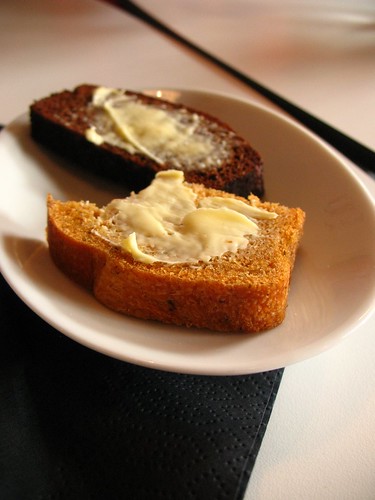
    bread at restaurant P2
- Arboga leverpastej med inlagd gurka (Arboga liverwurst with sliced dill pickles) (photo)

- Skivat hårdkokt ägg med Kalles kaviar (Sliced hardboiled egg with smoked creamed fish roe) (photo)

- Skivat hårdkokt ägg med ansjovis (Sliced hardboiled egg with anchovy-pickled herring sprats [these are not real anchovies]) (photo)

- Skivad kall kokt potatis med kaviar (Sliced boiled cold potatoes with smoked creamed fish roe) (photo)

- Smörstekta kantareller (Wild-collected yellow chanterelles fried in butter) (photo)

- Räksmörgås (Shrimp sandwich, with little tiny pink shrimp, mayo, sliced boiled egg, lettuce, thinsliced lemon) (photo)

- Rökt renkött med pepparrotsvisp i tunnbröd, renklämma (Smoked reindeer meat with creamed horseradish in thin bread) (photo)

- Greveost och rökt skinka med färsk röd paprika  (Greve cheese and smoked ham with fresh sliced red pepper)

- Gravad lax med senapssås och dill (Gravlax/Brined salmon with mustard sauce and dill) (photo)

- Köttbullar (kalla) med rödbetssallad och sallad (Cold meatballs with beet salad (with youghurt or sour creme) and lettuce) (photo)

- Gratinerad varm smörgås med allt möjligt, kantareller, ost, tomater, osv. (Oven-broiled sandwiches with different toppings, such as chanterelles, cheese, tomatoes...) (photo)
    Swedish sandwiches are always open-faced (no bread on top), with things falling off them when you eat them.  That is just the way it is.  The bread can be any kind. You can make a double sandwich if you have to transport it somewhere and eat it for lunch but otherwise it is not common.

    We Swedes have much less toppings on a sandwich than Americans (well, we used to, I think Swedes are becoming richer and add more nowadays).  I only think Dutch people have less. And they put butter, chocolate sauce and chocolate sprinkles on their breakfast sandwiches.

    We don't cut off the crust and make little triangular double sandwiches with white mush in them like the Brits (I do like these too, but they are for people that are afraid of getting messy).

    We don't overload giant subs and heros with salamis and other meats like American-Italians (which can be great to eat, but isn't Swedish). Ever heard of a muffaletta?  They are giant. Giantly tasty too.

    We don't make peanut butter and jelly sandwiches, a combination I personally think is kind of... disgusting.  Each one by itself is quite fine.

    We don't make smörrebröd, that is the Danes specialty (overloaded warm or cold sandwiches you have to eat with a knife and fork - also delicious).

    Sometimes Swedes invent crazy sandwich topping combinations.  I have a vivid memory of a cousin, who will rename unnamed, who ate a sandwich with cheese, kaviar, and orange marmalade. And here is a crazy one too!

    So, what is my favorite breakfast sandwiches here in the US?  Well, since there aren't some of the Swedish things...  smoked ham, cheese and Frank's Hot Sauce...  cottage cheese and fox point seasoning...   hummus....  goat cheese...  sliced cold potatoes and kaviar (everybody else in the house thinks I am crazy to eat that)...  sliced egg and real anchovy...  marmalade....  blueberry jam (homemade, more about that later)...  cheese and pickles, or cheese and sundried tomato tapenade...

    Friday, October 1, 2010

    Stamps of the day: Locomotive stamps from Royal mail


    Royal Mail in Britain have invented the "intelligent stamp". Together with an Iphone and an App it´s the ticket to exclusive material on Royal Mail Channel. Read more here. And if you don´t have an Iphone the stamps are pretty to look at anyway!

    Monday, October 19, 2009

    Stamp of the Day: Mr Frost has arrived

    The first frost was last night, so know summer is absolutely over, and winter is near... Here are some ice sculptures on stamps from the United Kingdom to celebrate the change of seasons. Don't you think the Queen of England looks a little cold there in the corner of each stamp?

    For those of you in tropical Madagascar, hail will have to do. (see recent post on the Don't Feed the Lemur blog)

    Wednesday, July 1, 2009

    A shirt not suitable for airports...

    But that is where he wore it, my son (LA). We did get some strange looks...

    The shirt design is a spoof on a WWII era government poster from the UK, with the original stating: KEEP CALM and CARRY ON! Now Panic and Freak Out seems to be more suitable for our times...

    The story of the poster is interesting:
    "Back in the spring of 1939, it was an anonymous civil servant who was entrusted with finding the slogan for a propaganda poster intended to comfort and inspire the populace should, heaven forbid, the massed armies of Nazi Germany ever cross the Channel.

    This was the third in a series. The first, designed to stiffen public resolve ahead of likely gas attacks and bombing raids, was printed in a run of more than a million and read: Your Courage, Your Cheerfulness, Your Resolution Will Bring Us Victory. The second, identically styled, stated: Freedom Is In Peril.

    From August 1939, both posters began appearing all over the country, on billboards, in shops, on railway platforms. The third, though, was held back. This one was for the real crisis: invasion.

    ... For 60 years, the poster had been forgotten. Then, one day in 2000, Stuart Manley, co-owner with his wife Mary of Barter Books in Alnwick, Northumberland, was sifting through a box of hardbacks he had bought at auction when he saw "A big piece of paper folded up at the bottom. I opened it out, and I thought, wow. That's quite something. I showed it to Mary, and she agreed. So we framed it and put it up on the bookshop wall. And that's where it all started." (link to full story)

    The reprinted poster is now everywhere, and tens of thousands of copies of it has been sold.

    Thursday, May 28, 2009

    Stamp of the Day: Toad

    There has been a lot of talk about frogs here, but who cares about the toads? I would like to know what a natterjack is....


    Thursday, January 22, 2009

    Single marm?

    Now THIS is what I would like to have on my breakfast scones! View the photo larger, and you will see. OK took the photo, I bet he likes it. Yummy, or as we say in Sweden, 'Gottigotti!'.

    Sunday, December 7, 2008

    Stamp of the Day: I found one! (two actually)

    I found a stamp! Here is Lord Bacon from UK! The stamp is 6 cents from Newfoundland, commemorating Francis Bacon. He seems to have lived a very interesting life. Lord Bacon wrote the novel The New Atlantis about an utopian place, and some think this was meant to be North America.

    It seems like bacon is not named after Lord Bacon, and he wasn't named after the meat either. Bacon might come from a german word. Now, what is bacon in Swedish? Sidfläsk? That means 'side flesh'. As usual, the swedes just say it straight out, no fancy words there.


    While looking for the bacon stamp I also found another pig stamp. I think this speaks for itself. ("Grymt, sa grisen.")

    By the way, "the USDA defines bacon as "the cured belly of a swine carcass", according to Wikipedia. It tastes better than it sounds.

    Wednesday, September 10, 2008

    Stamps of the Day: Slow motion photography

    For the birders on this blog, dinner is served! Kestrel and barn owl in flight on British postage stamps from 2003, after photos by Stephen Dalton. I think these are amazing. It reminds me of old David Attenborough's nature movies.

    And right now the screech owl is going crazy howling outside our window. EH, I bet you will hear it a lot from the guest bedroom window. It is great. A few nights we had two of them, one on each side of the house.

    Wednesday, June 25, 2008

    Darwin's garden

    There was an exhibit recently at The New York Botanical Garden, where they had recreated Charles Darwin's garden at his home Down House in Kent, England. As a European, it was a familiar view with all kinds of old-fashioned northern European garden plants, many of which that grow in Swedish gardens too, but are not so common here. There were giant foxgloves (Digitalis), poppies (Papaver), lark spurs (Delphinium), monkshood (Aconitum), and much, much more. They also had built up one wall of Darwin's house and you could go inside and look out the window over his desk to see the abundant plant life. What was missing was the bees, bumblebees, and butterflies. Since this was inside a greenhouse, pollinating insect life was unfortunately absent and made the garden feel sterile. But the exhibit reminded me of Sweden, and it was lovely.


    Tuesday, May 27, 2008

    English food

    Another quote from my little book:

    The English have the undeserved reputation of ruining all the vegetables they can lay their hands on. - Frank Oliver (an Englishman)

    I still remember the first time I was in London, around 1991, and the two memorable meals I had there. The first was greasy fries and some beef pie at a pub for lunch - all I remember is the grease and the lack of anything vegetable-like except the fried potatoes. The second was an evening when I for the first time in my life went to an Indian restaurant and I had chicken tandoori, and it was great. I didn't understand anything the waiters said, and thought it was strange that you ordered bread and side dishes separately. But since then I have loved Indian food.

    Monday, March 31, 2008

    Right of way

    The following is the transcript of an actual radio conversation in October 1995, between a US Navy ship and the British authorities off the north coast of Scotland. The transcript was released by the MoD on the 10/10/95.

    BRITISH: Please divert your course 15 degrees to the South to avoid collision.

    US Navy : Recommend you divert YOUR course 15 degrees to the North to avoid collision.

    BRITISH: Negative. You will have to divert your course 15 degrees to the South to avoid collision.

    US Navy: This is the Captain of US Navy ship. I say again, divert YOUR course.

    BRITISH: Negative I say again divert your course.

    US Navy : THIS IS THE AIRCRAFT CARRIER 'USS LINCOLN' THE SECOND LARGEST SHIP IN THE UNITED STATES' ATLANTIC FLEET. WE ARE ACCOMPANIED BY THREE DESTROYERS, THREE CRUISERS AND NUMEROUS SUPPORT VESSELS. DEMAND THAT YOU CHANGE YOUR COURSE 15 DEGREES NORTH, THAT'S 15 DEGREES NORTH, OR COUNTER MEASURES WILL BE UNDERTAKEN TO ENSURE THE SAFETY OF THIS SHIP.

    BRITISH: We are a lighthouse. Buzz Off!!!

    (found here, but the story is false, even if funny and maybe even possible)

    Tuesday, November 20, 2007

    Book review: Three food books you don't have to bother with

    eat pray love by Elisabeth Gilbert
    This is an interesting book, and the only reason it is in this category is that I don't think it is for everyone. It is a autobiography, telling the true story of a woman who leaves an unhappy marriage and lives 4 months in Italy to eat and promote decadence, 4 months in India to learn how to get closer to God at a Hindu center called Ashram, and then 4 months in Bali to find herself with a native healer. She also finds love again in Bali. The writing is excellent, a real delight, and she is especially good at writing about humorous situations as well as her own anxiety and impatience. I loved that. However, it is kind of a strange book, because the only person that feels real in the book is herself, none of the other characters. They are more like shadows. But her descriptions of eating pasta, pizza, and gelato in Italy wants me to go there NOW. So if you don't mind some God praying stuff, read it, otherwise read only part one and then go on to another book.

    The year of eating dangerously by Tom Parker Bowles
    This is the book I only read to chapter 2, then gave up on. If you think the author's last name is familiar, it is because 1) he is a famous British food writer, and 2) he is the son of Camilla Parker Bowles, now married to Prince Charles of the British royal family. No, Charles is not in the book, but his mom is, mentioned as someone that can cook, hates spicy food, and like good ingredients. The author writes a lot, far too much. It is like he thinks every little word and thought is of interest, but there really isn't any depth to anything. The first chapter is about baby eels, but he ends the chapter without eating one molecule from the eel, and the second chapter is about chilis in New Mexico, but you don't really learn anything about chili or find out what he thinks about them. It is just one long diatribe about being to a Fiery Food Festival eating too hot sauces, seeing people puke and say the f-word (lots of that in the book), and then just want to go home. Boring. Superficial. I gave up. If I writer can't even excite me about hot chilies and Santa Fe, the book is lost. I really tried to like it, but I couldn't.

    Remembrance of things Paris, sixty years of writing from Gourmet, edited by Ruth Reichl
    If you have been to Paris sometime in the 20s to 50s, maybe this book is fun for you. I wasn't even born then. The best essay in the whole book is the one by Ruth Reichl, about trying on a black dress! It is outstanding, but the rest is about as boring as Marcel Proust. But I read nearly all of it while I was stuck on an airplane. If you want to read about French food there are a lot better books. Too much is snotty, snobbish, and only the insiders would know what you mean. More Ruth Reichl, less old dusty stuff.
    On a scale from one to 100, this book is a 5 and Comfort me with Apples by Ruth Reichl is a 99.