Saturday, March 1, 2014
Sunday, May 19, 2013
Up and coming plants and botanicals
A few days ago I attended a big commercial fair about cosmetics and botanicals, where the suppliers to the cosmetics companies showed of the newest, bestest, cheapest and, of course, the most 'naturalests'.
I can't even count how many times I saw '100% natural' on signs there. The strangest was the sign that said 'Ultra-organic', I wonder what that is. Pure carbon? Another sign said '100% botanical'. Hmm, no water in that product? All marketing, of course.
Anyway, here is my report:
Up and coming botanical products, soon in a store near you (if not already):
Meadowfoam seed oil (from Limnanthes alba, a springflower native to NW USA).
Camelina sativa oil (camelina was grown in ancient agricultural societies in Europe, and now it is back!)
Borage seed oil (Borago officinalis - this wonderful blue-flowered plant with edible flowers that look like they can sting you with their black anther-pistil shaft. The leaves look like hairy tongues. )
Echium seed oil (from the European species Echium plantagineum, now an invasive species in North America - yes, let's use up the invasive species, I love it! I mean it, I am not joking... It is also toxic in large doses.)
Argan oil (from Argania spinosa, an ancient crop tree of the berbers of Morocco, and the new natural product darling of the upscale cosmetics companies)
Can you imagine a field of these plants grown as crops? That would be a bit different than a field of beets or lettuce...
From the non-botanical end of things, there are now crushed garnet included in some skin exfoliator products. Talk about wasting a beautiful gemstone!
Posted by
LS
at
4:45 PM
0
comments
Labels: botany, chemistry, commercialism, ethnobotany, flowers, marketing, plants
Friday, January 4, 2013
Stamp of the Day: tulip tree
Posted by
LS
at
9:11 AM
0
comments
Labels: ethnobotany, forest, gardens, medicine, stamps, Sweden, tree, USA
Friday, November 26, 2010
Book review: American Terroir by Rowan Jacobsen
Posted by
LS
at
2:35 PM
0
comments
Labels: agriculture, book review, Canada, chocolate, coffee, Cultural History, ethnobotany, fish, food, Mexico, mushrooms, plants, USA, Vermont
Sunday, October 3, 2010
Book review: In case of survival food, do not consult the US Army
I recently picked up a book from the library called The Complete Guide to Edible Wild Plants by the Department of the Army. Yes, that Army, the US Army and Pentagon are listed on the back page. This is a 'no-nonsense survival aid, {...} an essential guide for serious adventurers and the armchair botanist alike." I thought I would get some interesting information about locally edible and poisonous plants, but the book provided something else, a serious scare.
First, the book covers the tropics, subtropics, and temperate zones, but covers very few edible plants from each region. That is OK, even if not great. In the beginning of the book it is stated that you should never eat any plants you can't securely identify to the correct species. Well, well - I would like to see the person that can identify any plant to the correct species based on the photos and descriptions in this book. I can't even see some of the plants in some of the photos. Many of photos are grainy, too dark, and over-tinted in green. And when they couldn't find good photos they resorted to stick figures of the plants, also badly pixelated.
The photos of sorghum grains, the only photo used to illustrate this plant, looks like a large bunch of small cockroaches on a tabletop. The description of sorghum, which supposedly is there to help you identify the plant, follows: "There are many different kinds of sorghum, all of which bear grains in heads at the top of the plants. The grains are brown, white, red, or black. Sorghum is the main food crop in many parts of the world." Would you be comfortable with identify a wild plant as sorghum after reading this? I mean, the only real description here is that the seed color can vary and that the seeds are in heads on the top of the plant. It doesn't even say it is a grass! Plant families are only listed for poisonous plants, I wonder why? If you get sick, only then you need to know the family?
The mixture of tropical with temperate plants provides some interesting contrasts. Sago palm (with a horrible photo), and sassafras (with a great photo, from the season when the plants have leaves) share one page. Same with prickly pear cactus (Opuntia) and pokeweed (Phytolacca, a plant which actually is very poisonous if raw or taller than 25 cm.)
Some information is dangerously wrong. The fish tail palm, which I recently saw in the botanical garden in Stockholm, is edible, but the fruits are toxic and the leaves can give you dermatitis (link)." In this manual, this is a perfectly fine plant without any warning signs at all. Only 17 poisonous plants are listed, and this book is supposedly covering the whole world.
Looking through this book I am starting to think it is a joke. Either that, or the American soldiers are much dumber than I thought. The text reads often like an essay by a 4th grader, for example:
"Look for sugarcane in fields. It grows only in the tropics (throughout the world). Because it is a crop, it is often found in large numbers."
This book is an embarrassment to the US government, US publishers, and botany. The book was published in 2009, and even if it was printed in China (true), I bet the material was provided from the US.
Remember that this book is called the "Complete guide..."? It is as complete and useful as the human anatomy chapter of a high school biology book is to a neurosurgeon. As a survival aid, this book is not very helpful, and could even be risky to use for the serious outdoorsman. I also really doubt there are any armchair botanists out there that would enjoy a book with so many botanical faults. I really hope the US Army provides their soldiers with better field manuals than this. There are many more and better books on this subject for those that really are interested in wild edible plants and wilderness survival.
Posted by
LS
at
10:20 PM
2
comments
Labels: book review, ethnobotany, military, plants, USA, war
Friday, September 3, 2010
Old Sweden...
From Colorado to Sweden in three days - talk about contrast. Language, flora, history, and weather is all very different, and also very different from New Jersey. 100 degrees Fahrenheit in NJ, and then 50 degrees in Sweden. Two days ago we visited a living outdoor museum on a mountain (Torekällberget) in the city of Södertälje, south of Stockholm. It has old historical buildings (the typical Falu red paint is on them of course), and also exhibits a living farm with heritage breeds that are endangered now. In the part that mimics a little old cobblestone town you can find real stores with craftsmen making pottery, printing (with old presses), weaving (mostly linen from flax), baking, and blacksmithing. I bought two really nice kitchen towels, and took lots of photos, which you can see here. Here are some:
An 200-300 year old Swedish kitchen. Note the crispbread on the poles in the ceiling, and also the two large painted boxes, those contains two beds. This building was built in 1775-1776 and was moved to this museum much later.
An old-fashioned Swedish round pole fence, made from all plant materials and no nails or strings. People still maintain these around Sweden.
I bought the green ones of these kitchen towels locally out of linen. The store is called Axlings Linne.
Swedish cinnamon buns (kanelbullar) is a really Swedish thing. At the bakery they come in many innovative varieties, not just cinnamon.
Posted by
LS
at
4:58 PM
4
comments
Labels: agriculture, cooking, crafts, ethnobotany, food, history, museum, Sweden, travel
Thursday, October 8, 2009
Visste du att... (Did you know that..)
Vattenkastanjer är rotknölarna av starrgräs som odlas på vattendränkta fält runt om i Sydostasien. De har neutral smak och har för växter den ovanliga egenskapen att vara krispig i konsistensen även efter konservering och tillagning. Detta beror på att cellväggarna är korskopplade och förstärkta av vissa fenolföreningar, egenskaper som vattenkastanjer delar med bland annat lotusroten.
Läst i ett matmagasin på en hemsida från Martin Olsson, grossistföretag i Sverige.
LS, please translate if you like.
Translation by LS (and I added a photo too):
"Water chestnuts are the tubers of a sedge that is grown in wetland fields in Southeast Asia. Their taste is neutral and are unusual among plants that their consistency is crunchy even after preserving and cooking. That is because their cell walls are cross-linked and enhanced by phenolic compounds, which is also found in the lotus."
Posted by
EH
at
2:56 AM
2
comments
Labels: agriculture, Asia, China, ethnobotany, food, plants
Tuesday, June 17, 2008
Quote - beans
Ecuadorian pink beans. Aren't they pretty? My bush beans are growing like crazy here in New Jersey and started flowering today.Quote of the day:
“Weather means more when you have a garden. There's nothing like listening to a shower and thinking how it is soaking in around your green beans.” Marcelene Cox
Posted by
LS
at
10:21 PM
1 comments
Labels: Ecuador, ethnobotany, food, photo, quotes
Thursday, February 14, 2008
Happy Valentine's Day!
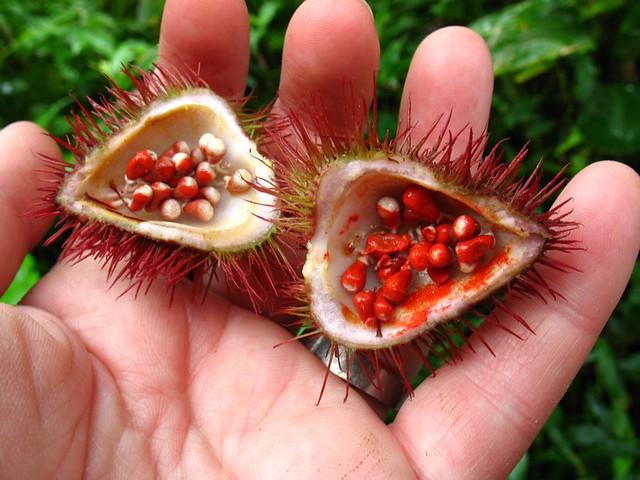
With some Bixa orellana, also known as achiote or annato, heartshaped spiny fruit with seeds surrounded by red juice that is used for hair coloring and lipstick. This photo is from Ecuador, where we saw this tree in the rain forest. I read somewhere that women that wear lipstick actually 'eat' more than several pounds of lipstick over their lifetime.
Happy Valentine's Day everybody - we love you all!
Posted by
LS
at
6:57 AM
1 comments
Labels: Ecuador, ethnobotany, holidays, photo, plants