Showing posts with label Denmark. Show all posts

Saturday, March 17, 2012

OK snapshot: Skandinaviska (Scandinavian)

Nu med egna vokaler...
a new language, Scandinavian, now with its own vowels? The umlaut o got
both dots (from Swedish and Finnish), and a slash (from Danish and
Norwegian). Well, whatever works, right?
What is in the bag? Strawberry-flavored candy that looks like long string.

Saturday, November 6, 2010

Saturday thoughts on wool, pancakes, and frost

Things I have learned today (and yesterday):

"One surefire method to tell the difference between wool (and cotton) and synthetic fabrics is to test them against an open flame. Wool will burn to ash, while synthetics will melt." (link) Wool smells like burning hair, cotton like burning leaves... Now I can sort my yarn better, if I spend some time tomorrow outside over a bucket of water burning little things up! Here is the whole story on burning fibers.

If you first fry up some portobella mushrooms in olive oil, then add a little balsamic vinegar, then put it on buttered bread, with some fried up thinly sliced onion with thyme and parmesan cheese on top, and then have Jarlsberg cheese on top of that and then put it under the broiler in the oven for 5 min, you have the best smorrebrod sandwich in the world for breakfast.

A Skeppshult pancake frying pan will work the best if you soak the top with canola oil before you try to use it. The last couple of times my pancakes got stuck.  This time, not one pancake got stuck and they tasted fantastic. I made a large batch yesterday morning, and many are now in the freezer for mornings to come.  When I was a kid, my grandparents (KE and RE) used to make pancaked, freeze them, and then refry them up in little pieces when we came and visited.  Served with their homemade rhubarb and strawberry jam it was one of my favorite foods in the world. (Thanks for the pancake pan, EH!)

And, a frosty night will not kill off the habanero chili peppers.  Maybe the capsaicin is some kind of anti-freeze too? But now all tomates, carrots, and peppers are inside. I also harvested tarragon branches, but we still have lots of colorful swiss chard outside.

Monday, October 11, 2010

Maybe the best sandwiches in the world?

Sometimes I get really homesick for Swedish food.  I was just downstairs in the kitchen and opened the fridge and thought about the Swedish things that are great but hard to get here in the US.  So here you go, my list of the best traditional Swedish sandwich toppings (smörgåspålägg [ha, there is a Swedish word for you Americans to master!]), in no particular order (they are all amazing).  I know, some of you will not agree, feel free to comment. :)

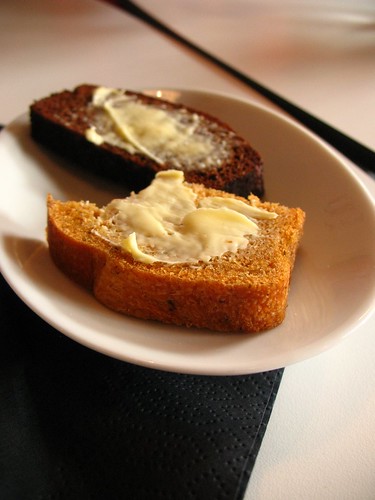
    bread at restaurant P2
- Arboga leverpastej med inlagd gurka (Arboga liverwurst with sliced dill pickles) (photo)

- Skivat hårdkokt ägg med Kalles kaviar (Sliced hardboiled egg with smoked creamed fish roe) (photo)

- Skivat hårdkokt ägg med ansjovis (Sliced hardboiled egg with anchovy-pickled herring sprats [these are not real anchovies]) (photo)

- Skivad kall kokt potatis med kaviar (Sliced boiled cold potatoes with smoked creamed fish roe) (photo)

- Smörstekta kantareller (Wild-collected yellow chanterelles fried in butter) (photo)

- Räksmörgås (Shrimp sandwich, with little tiny pink shrimp, mayo, sliced boiled egg, lettuce, thinsliced lemon) (photo)

- Rökt renkött med pepparrotsvisp i tunnbröd, renklämma (Smoked reindeer meat with creamed horseradish in thin bread) (photo)

- Greveost och rökt skinka med färsk röd paprika  (Greve cheese and smoked ham with fresh sliced red pepper)

- Gravad lax med senapssås och dill (Gravlax/Brined salmon with mustard sauce and dill) (photo)

- Köttbullar (kalla) med rödbetssallad och sallad (Cold meatballs with beet salad (with youghurt or sour creme) and lettuce) (photo)

- Gratinerad varm smörgås med allt möjligt, kantareller, ost, tomater, osv. (Oven-broiled sandwiches with different toppings, such as chanterelles, cheese, tomatoes...) (photo)
    Swedish sandwiches are always open-faced (no bread on top), with things falling off them when you eat them.  That is just the way it is.  The bread can be any kind. You can make a double sandwich if you have to transport it somewhere and eat it for lunch but otherwise it is not common.

    We Swedes have much less toppings on a sandwich than Americans (well, we used to, I think Swedes are becoming richer and add more nowadays).  I only think Dutch people have less. And they put butter, chocolate sauce and chocolate sprinkles on their breakfast sandwiches.

    We don't cut off the crust and make little triangular double sandwiches with white mush in them like the Brits (I do like these too, but they are for people that are afraid of getting messy).

    We don't overload giant subs and heros with salamis and other meats like American-Italians (which can be great to eat, but isn't Swedish). Ever heard of a muffaletta?  They are giant. Giantly tasty too.

    We don't make peanut butter and jelly sandwiches, a combination I personally think is kind of... disgusting.  Each one by itself is quite fine.

    We don't make smörrebröd, that is the Danes specialty (overloaded warm or cold sandwiches you have to eat with a knife and fork - also delicious).

    Sometimes Swedes invent crazy sandwich topping combinations.  I have a vivid memory of a cousin, who will rename unnamed, who ate a sandwich with cheese, kaviar, and orange marmalade. And here is a crazy one too!

    So, what is my favorite breakfast sandwiches here in the US?  Well, since there aren't some of the Swedish things...  smoked ham, cheese and Frank's Hot Sauce...  cottage cheese and fox point seasoning...   hummus....  goat cheese...  sliced cold potatoes and kaviar (everybody else in the house thinks I am crazy to eat that)...  sliced egg and real anchovy...  marmalade....  blueberry jam (homemade, more about that later)...  cheese and pickles, or cheese and sundried tomato tapenade...

    Sunday, September 26, 2010

    Swedish food, now and then

    While in Sweden recently I had many memorable meals, in very different settings, and from the fancy to the everyday, from the modern to the traditional or even ancient, and from pure Swedish to authentic Italian via swedish-inspired Thai and swedish-style pizza.  During our trip north to the province of Gästrikland we stopped in at the restaurant Furuviks Brygga (Furuvik's Pier), which is a fancy and rather new restaurant located on the Baltic seashore near the town of Gävle (a word that is not related to jävlar) of Botnia, or literally translated 'the bottom sea".  Furuviks Brygga is quite isolated and was very hard to find - they certainly need some help with their way-finding signage. 

    Furuviks Brygga restaurant
    But we found it and despite it being a cloudy, semi-chilly September day in the beginning of the off season (= very few guests at the restaurant), we loved the setting and atmosphere of the building, which was architecturally inspired by old Falu red fishing huts along the coast. We stared out at the horizon and looked for eagles and seals, but only a cormorant and a heron showed up.

    fish dish
    The food was excellent, focused on Swedish delicacies in the nouveau way of cooking them, but the service could have been a lot better. Above is hälleflundra (halibut).

    Furuviks Brygga restaurant and the ocean
    For a near empty restaurant you think you could have gotten your check in a timely manner, and that they could have made sure the glasses on the table were clean. "Oh, our dishwashing machine is having a problem", is not an acceptable excuse.

    reindeer carpaccio - the best!
    But the reindeer carpaccio (above) and the fish dishes were amazingly good, and fed both the stomach, eye, and soul. I would definitely visit this place again.

    A very different place was Sjätte Tunnan (The Sixth Barrel), a medieval-themed restaurant in a medieval cellar in the Old Town (Gamla Stan) of Stockholm. My cousin AI (thanks!) had recommended it as a fun place to take some non-Swedes, so I ended up here with eight non-Swedish friends from all over the world (Belgium, Mexico, Colombia, USA, UK...) during one of the evenings of the scientific conference I attended. 

    medieval cellar, where you eat at Sjätte Tunnan, medeltidsrestaurang
    From the street in this old cobble-stone part of Sweden's capital you sneaked down a deep and steep stone stairway and found yourself in a cellar of small interconnected vaulted rooms with thick stone-walls.  You could nearly hear the walls talking about times past, from the Hanseatic trading times to the Stockholm bloodbath when the Danish King cut the heads of Swedish noblemen and bishops. That was a long time ago, but it had an enormous influence on Swedish history.  The son, Gustaf Eriksson, of one of the killed, got mightily pissed off and went north to Dalarna to engage the grassroots (farmers mostly), and he later became the king Gustav Vasa (famous as Wasa crispbread these days).  Gustav Vasa started out as a revolutionary but after getting royal powers, he as many others around the world, turned into a megalomaniac, selfish, and power-hungry dictator (I think).

    menu at Sjätte Tunnan, medeltidsrestaurang
    The menu was long, long, long, but with rather few items, since all items were described in detail and there were also introductions and explanations to the purpose of the restaurant - authenticity.  They had an English version of the menu too, so I didn't have to translate it all... For many dishes the original publication of the recipe was cited, such as "Le Viander from the 14th century".
          The drink menu was regular beer and wine, but they had many special and home-made meads (mjöd) as well (mead is beer made with honey, famously drunk by the vikings), and hard cider from local Swedish apple orchards and breweries.  And then the food - only ingredients present at medieval times... so no potatoes, tomatoes orchards and chili peppers (all from the New World and absent from Europe before 1492).  Lots of game and wild meat and fish - chicken, wild boar, beef, lamb, trout, and even beaver (when available).

    medieval cellar, where you eat at Sjätte Tunnan, medeltidsrestaurang
    We were sitting along a long rough-hewn table in candle-light on long plank benches - all to create the right atmosphere.  On the table were knives and spoons, a rock, and candles.  The rock was the salt - if you needed some you just scraped some off with your knife.  Forks were not around in medieval times, but you could get one here if you asked, and we did.  The waiter was dressed in coarse fabric, maybe linen, and in clothes that looked homemade and were rather holy (as in holes, not religious).

    medieval mooseballs at Sjätte Tunnan, medeltidsrestaurang
    I went for the moose meatballs ('älgbullar') with mashed rutabagas ('rotmos') and lingonberry jam ('lingonsylt').  There were very few greens available with the dishes, because medieval people were very suspicious of greens - they were meat-and-potatoes kind of people (except the potatoes were turnip, cabbage, rutabaga, etc.).  The food at this place was great, but not exceptional, and in fact one of my meatballs had so much salt in it it wasn't really edible, but everybody else's food was great and the atmosphere was fascinating.  Experiences like this are so much better than reading about history in some old boring schoolbook.  I really recommend this restaurant, and especially to Americans that need a dose of hands-on history, since there are no medieval buildings in most of the USA.

    Saturday, July 24, 2010

    Taxonomic inaccuracies in the food world

    Most times I don't care if people can tell the difference between a cow and a deer, a bee or a wasp, or a crow and a turkey vulture, but when authors and publications that are very particular on being accurate in one area don't even bother to check the ID on other things they write or talk about, it really bothers me.  Such as food magazines that proudly distinguishes with fancy words between the top and bottom of a pig, different varieties of kale ('grönkål'), and have different words for types of Italian vinegars depending on the region they come from.  If you are that picky, and pride yourself on it, as a publisher you should check everything and ask the experts when you enter new zoological and botanical territory.

    Here are two recent examples:
    On Bon Appetit's website there is a blogpost about what to do when you get a fly in your soup at a restaurant.  Good post, interesting comments, however...  the accompanying photo is of a soup bowl with a... guess.... a CIKADA (they are also called locust).  A giant cikada, obviously dead and spread out with its wings in a very unnatural position to resemble a monster fly. I have to ask my family dipterist (that is fly guy) if there even are that big flies in the real world.  But still, why not just say it is a cikada in the soup? The photo is from istockphoto and the photographer said it wasn't a fly, but that wasn't clarified by Bon Appetit, who bought the right to use the photo.  It is like saying you are looking at a pork chop when in fact you are seeing a bison or reindeer steak. 

    Second example was a recent article in New York Times about the world-famous restaurant Noma and its chef René Redzepi, who cooks with local (= Aal of the Nordic countries in fact), sometimes wild, ingredients such as wild beach plants, reindeer, wild roses, and puffin eggs. With the article is a photographic slide show of some of the dishes and ingredients, gorgeous photos, but with some big errors in the descriptions.  The small fuzzy flower buds of the 'oxel' tree (whitebeam in English) was renamed "axel" tree by NY Times.  Rose hips ('nypon') turned into rose petals. And a photo of the local pine cone is described as a thuja cone (photo on right, different thuja species look a bit different, but never like a pine).  These things matters, not only do they miseducate but in the case of the thuja, you do not want people to go out there and chewing on these toxic plants. Especially not if you are pregnant, since the toxin can cause miscarriages. I am sure the Danish chef knows what he is doing, but the journalists weren't getting it right, and yes, NY Times have been notified, but not fixed the errors yet.

    It is impossible to know personally all the correct names of the 1.7+ million species in the world, but I think we should at least try to get it right as far as we can.  Or maybe I am too picky.

    (Thuja cone photo by Luis Fernández García, Creative Commons license, on Wikimedia)

    Tuesday, July 13, 2010

    Stamp of the Day: Garbage pickup


    I have to admit that I never thought there would be stamps about garbage disposal ('sopor'), but there is.  And from Denmark of all places.  Relevance to this blog?  There is garbage pickup at our house tomorrow, and since LA is at Astronomy Science Camp this week it fell on me to get the garbage can to the road. I took the opportunity to wash about 8 waste baskets and garbage cans from the house with the garden hose, a step in the right direction of getting a cleaner house. I found these stamps while I was looking for stamps on the theme 'sweat', because we are having a horribly humid day here in New Jersey.  Did you know that we sweat calcium and magnesium, and even small amounts of lead? Hot and humid weather... not fun. I can feel the metal being excreted through the pores...

    Friday, November 27, 2009

    Stamp of the Day: Windy ways

    We are having a very blustery day-after-Thanksgiving-Day here in New Jersey, but no rain so far. In Denmark they have harvested wind energy for centuries, and this stamp commemorates the wind mill in Askov. It has a really interesting history, involving patents and other things you can read about here. Denmark is a leader in wind energy and the US is lagging incredibly far behind, as usual, when it comes to sustainable, alternative energy.

    Thursday, December 13, 2007

    Stamp of the Day: Viking waves

    Waves and water have been around on Earth much longer than most other things, except rock and minerals. It is just the last few thousand years, the seas have seen strange things such as boats floating on top of them. The same waves that crashed over marine dinosaurs are now crashing over piers and oil drilling platforms. Some things change, some do not. Stamp of the day is in memoriam of the Danish-American sea connections since Viking times.