Showing posts with label Butterflies. Show all posts

Monday, September 1, 2014

Happy birthday, EH!

I hope you have a gorgeous happy birthday!  I am also sure all the moths and butterflies, mushrooms, birds, and flowers wish you a great day!
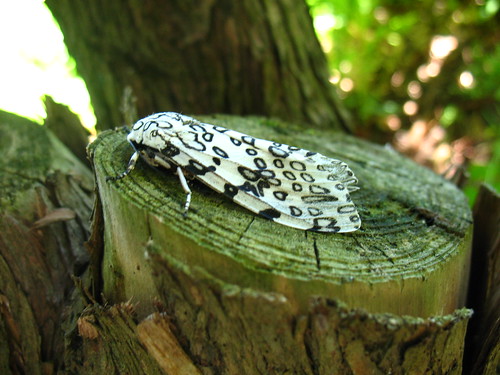

Giant Leopard Moth, Ecpantheria scribonia Giant Leopard Moth, seen in New Jersey
Friday, August 22, 2014

Six-legged abundance, and how to discover it

margined leatherwings (Chauliognathus marginatus_beetle_P6220530

Despite growing up in an entomological family, and I mean that literally, and later been surrounded by people that know and care about insects, insects, and insects, it is not until this spring and summer where I suddenly felt a real urge knowing the insects in my backyard.  I cared about the plants, the birds, the mammals, the clouds, the rocks... but the insects had just been there and been cool and fun, but I didn't bother so much with the science of them.

But, then I was part of a Bioblitz and everything counted.  I had to beat my sister in the species count on the long-term Bioblitz, so insects became important.  (She won.) A good digital camera made the observations permanent (thanks for the loan, PP).  But the most important help and driver was actually the internet.  The amazing and helpful people on Bugguide.net that help me identify everything (from a photo), be it a common stinkbug or a rare beetle.  My Dad, who sends encouraging, insightful notes full of anecdotes via e-mail.  My Mom and sister, keeping up with the butterflies on their end over on the other side of the ocean.  Suddenly, insects have become attainable.

Also, and I have to admit it, Facebook is a great resource for species expertise.  If you just stay away from the entertainment news and junk on Facebook, it can actually be a useful thing.  I have gotten so much help with strange insects from internet people, many of which I have never met, never talked to in person, and have no clue where they live or how they look like.  I reciprocate, of course, telling people on iNaturalist and plant ID groups on Facebook what their unknown plants are when I can.

This is true citizen science, the broadening of biodiversity knowledge to the backyards and driveways of our homes, to people that are just interested and not professionally involved in the science of bugs, plants, and so on.  And all this knowledge is freely shared, no money, no accounts, no subscriptions, and certainly no expectation of accounted returns.  We are just all in this biodiversity knowledge curiosity together...  like a kiddie pool!  Except the whole world's nature is our pool.

So, here are some recent finds from our garden, and some I figured out myself, and others I got a lot of help with. Click on the photos and you can see larger versions of the photos and what the species are on Flickr.  This is just a gallery of insect beauty and biological diversity in a regular backyard in New Jersey, USA.

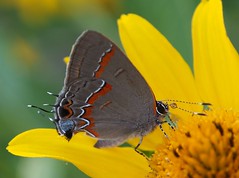
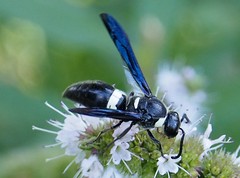
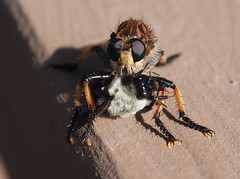
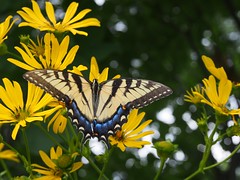
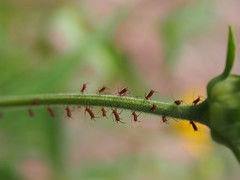
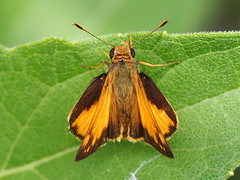
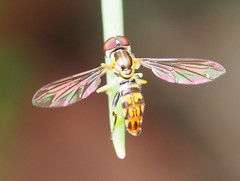
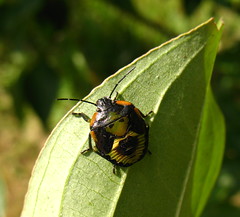
Redbanded hairstreak P8180860cropped Monobia quadridens - Four-toothed Mason WaspP8180863cropped Robberfly with caught bumblebee P8180810 Eastern Tiger Swallowtail P8170772 red aphids P8170638 Zabulon skipper male P8170596.cropped Toxomerus geminatus P8170614cropped Chinavia hilaris (green stink bug) Hemiptera IMG_6664 Clymene moth Haploa clymene IMG_2798 Harmonia axyridis (Multicolored Asian Lady Beetle)  IMG_6591

Thursday, July 24, 2014

Insect Biodiversity - small and big, in and out, up and down...

Since March I have focused a lot of attention on local biodiversity, both dead and alive, and both inedible and edible.  When you least expect it, you can see something intricate, interesting or gorgeous.  Here are some of the things I have seen in the last 6 months, as a small sample...
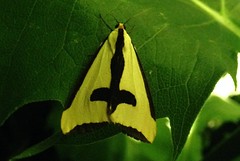
Clymene moth Haploa clymene IMG_2798
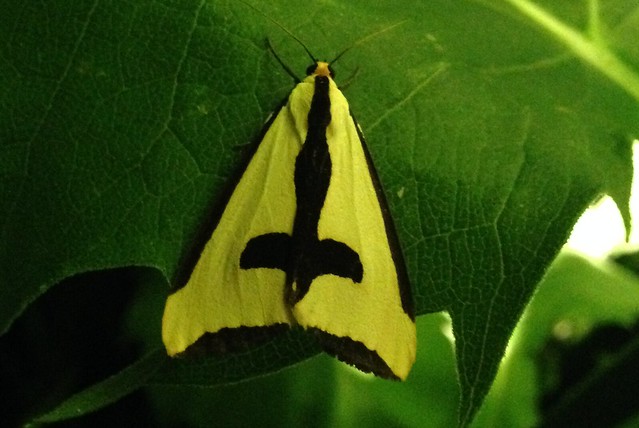
Clymene moth, seen one evening in July from our porch
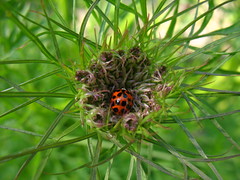
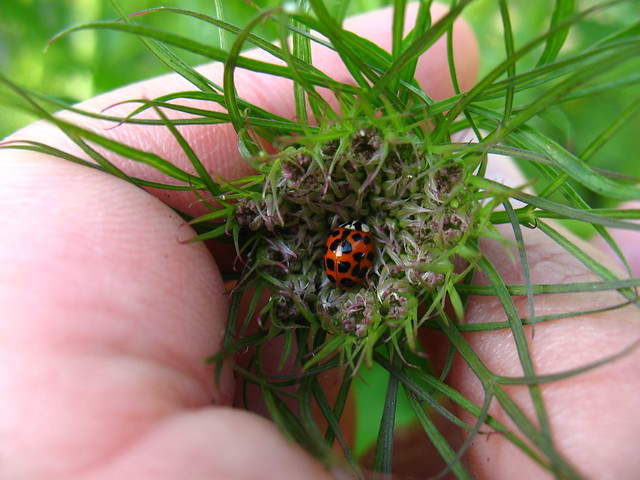
Harmonia axyridis (Multicolored Asian Lady Beetle) IMG_6593
An Asian lady beetle (not a nice ladybug) is hiding inside a flower umbel of Queen Anne's lace.


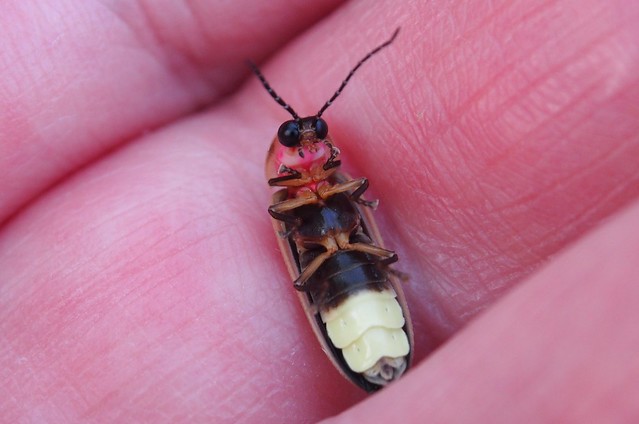
Photinus _firefly P6220560
Firefly showing off its bottom end, the one that blinks at night. Fireflies are beetles, not flies. 
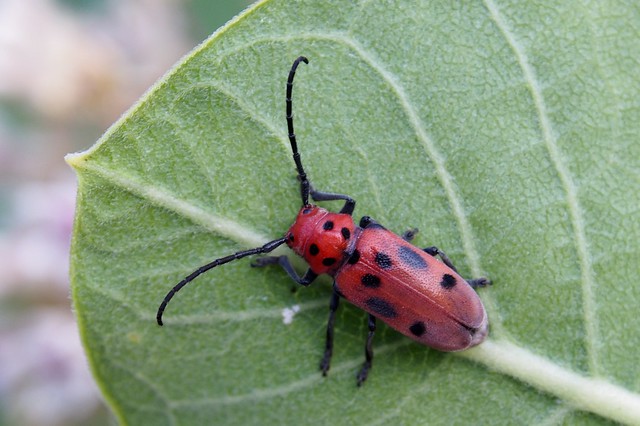
Tetraopes tetrophthalmus (Red Milkweed Beetle)red beetleP6220536
This unreal-looking long-horned beetle is called red mikweed beetle - I love the dots and the bent antennas.

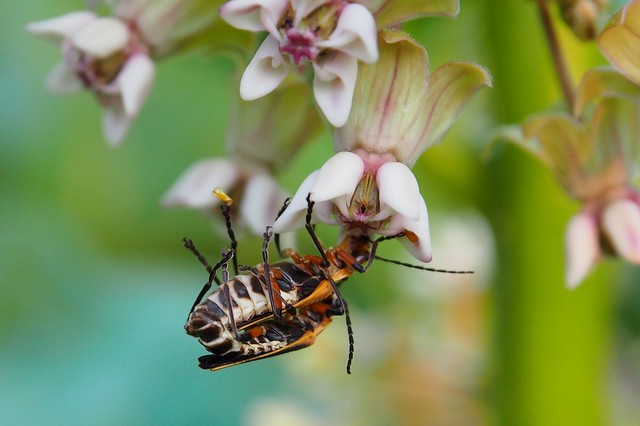
margined leatherwings (Chauliognathus marginatus_beetle_P6220529_cropped
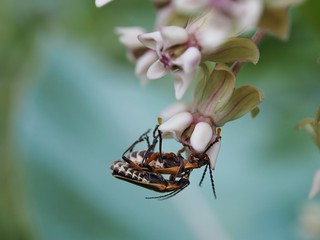
These mating beetles have to be careful so they don't get stuck with their snouts in the milkweeds' intricate pollination systems.


All of these are from my backyard and I didn't have to look very hard to find them.  Living things are amazing, indeed.

Saturday, July 5, 2014

What is out there? Bioblitzing's amazingness...

A week ago I participated in a Bioblitz, a biodiversity inventory, at the old Doris Duke estate Duke Farms in Hillsborough, New Jersey (USA).  Her large working farm, park, and mansion has now been transformed into a sustainable natural area with large untouched forests, giant wildflower meadows, and bike trails and a science activity center.  It is a great place to visit.

A bioblitz is a concentrated biodiversity inventory by a group of people, experts and the public usually together, that takes place usually during one day or 24 hours. We were out for 6-7 hours during a hot and sunny June day, but spent the most time in the shady forest.

My group was going to look for plants that not yet had been found.  That might sound strange, but since there already was a long list of plants, we were going to look for the missing things, the gaps, and also go to some of the special areas that are inaccessible to the public to look for new species.  Of course, if we saw other cool non-plant things, then we should take note of those too.  So, what did we find?  Lets look!
Bioblitzing in wetlands P6280555

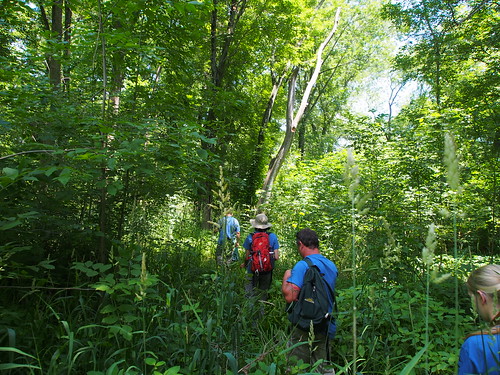
We walked into a floodplain forest that often gets flooded during heavy rains.  The grasses and other plants reached our shoulders, and it was moist like the tropics.  Not many new plants, but a lot of animal life.

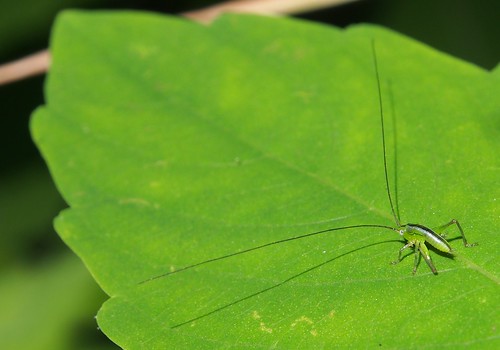
katydid nymphP6280571

A katydid nymph, very colorful and tiny.  I saw it first because its long antennae sparkled like thin metal wires in the sun. It is some kind of meadow katydid, but too early to tell what species it will become when it grows up.

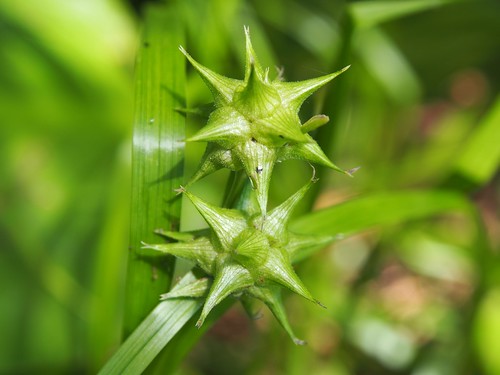
Carex cf grayi P6280545

This is a sedge, probably Carex grayi or a closely related species.  The inflated 'bottles' contain the fruit inside.  They look like green stars in the vegetation, and each sedge head is about 2 cm in diameter.

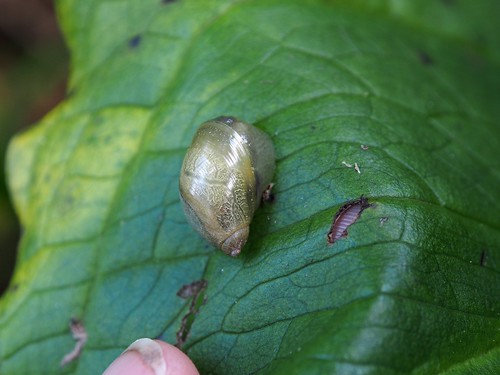
Amber snail maybe, P6280551

Lots and lots of snails were eating the skunk cabbage, and this one had a translucent shell.  I think it might be an amber snail, but I can't find any good book on land snails for northeastern USA.  Too bad, because that would be fun to learn more about.

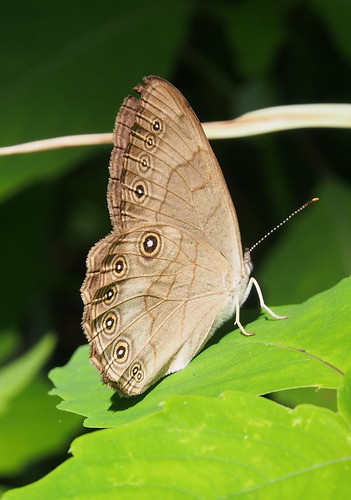
Appalachian Brown Satyrodes appalachia

This butterfly has an appropriate name - Appalachian brown (Satyrodes appalachia).  It was sitting on the same plant as the katydid nymph.  I have just started to look at butterflies and they are so different from the Swedish ones.  The names are weird too - like 'brown', 'comma', and 'question mark'.  Very descriptive, but unexpected. Or maybe not :).

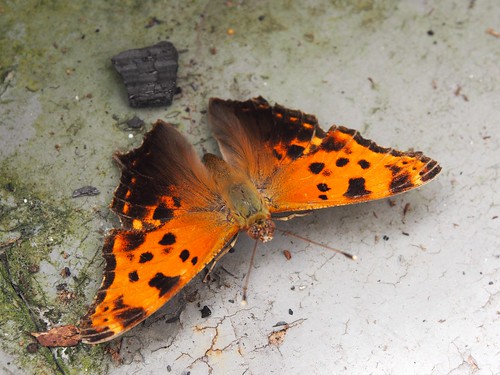
Eastern comma Polygonia comma P6280594

And here, this is an Eastern comma (Polygonia comma), a butterfly.  On its underside of its wings (which you can't see here) it has a white mark that looks like a comma, thereby its name.


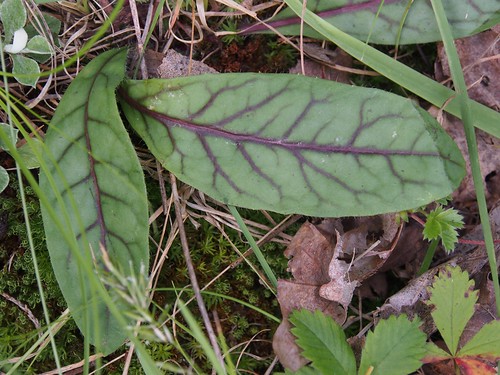
Rattlesnake weed, Hieracium venosum_P6280543

Didn't we see any plants?  Yes we did, but they were less fun to photograph!  Here is one that you can identify by its leaves only, which is always nice... no need to look for hairs on fruits or count petals!  This is rattlesnake weed (Hieracium venosum - those veins sure look like filled with blood!).  It is in the sunflower family and related to dandelions and such. And it is a wildflower, not a weed.

Exomala orientalis (Oriental Beetle) P6280540

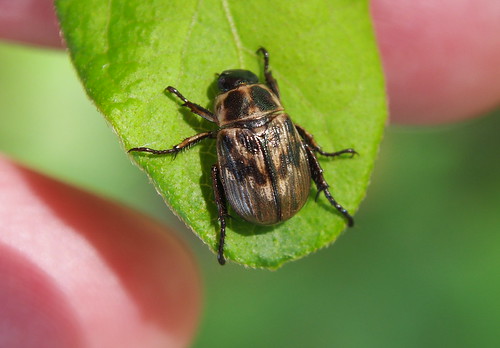
Some species are not native to this area but are very common exotic newcomers.  This is oriental beetle (Anomala orientalis or Exomala orientalis) has its ancestor in Asia, but now is common in this area.  I have seen it on our porch several times, attracted to the porch light in the evenings.  It loves garden plants!

Vanessa virginiensis - American Lady P6280528

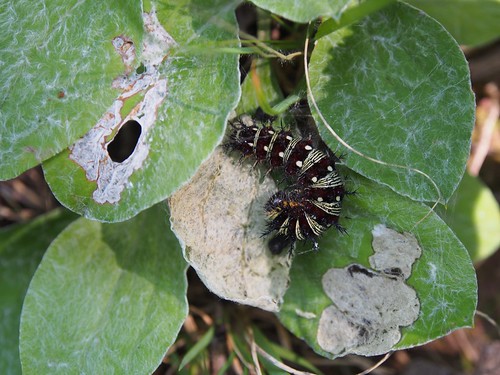
This ferocious-looking butterfly caterpillar will grow up and become an American painted lady (Vanessa virginiensis). It is eating a pussy toe plant (Antennaria) we found in a small area on sandy soil near huckleberry bushes.  I found one ripe huckleberry to taste, and they are very similar to American blueberries in looks and taste.


hardwood forest with storm damage

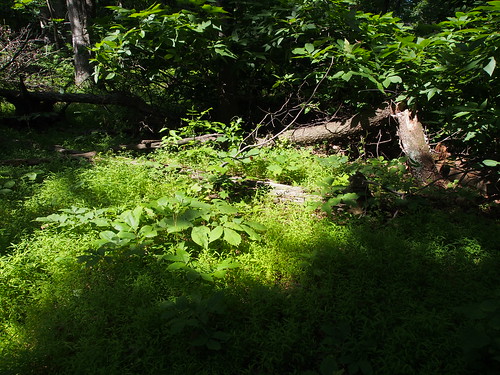
Here is the forest, which after the hurricanes we have had are more open with light gaps from fallen trees, and the invasive Japanese stiltgrass is thriving.  Forests around here have a lot of oaks, maples, and hickories.  Sometimes also tuliptrees.

Lonh-horn beetle, Graphisurus fasciatus P6280515

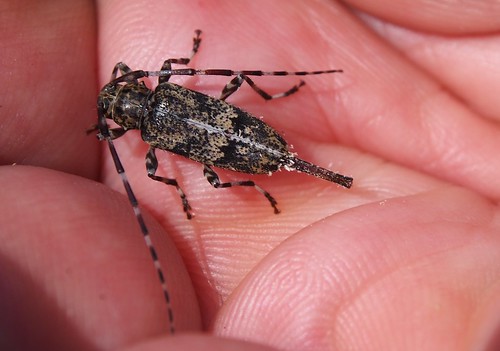
Long-horn beetles are always fun!  This is a female Graphisurus fasciatus, with a egg-laying tube at the back.  In the hand it sat very still, but as soon as we put it back on the tree trunk it scurried off very quickly.

Lucanus capreolus P6280470

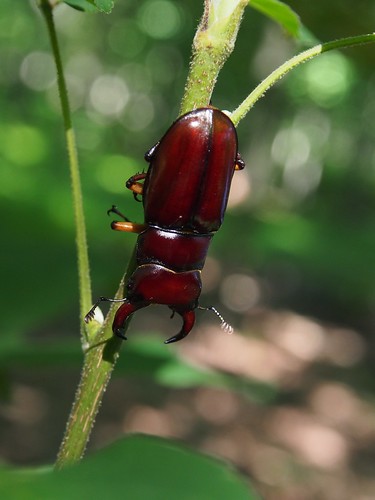
This was probably the coolest animal we saw!  A 4 cm long stag beetle (Lucanus capreolus).  They are said to be very common, but I have never seen one before. 

Hickory gall midge Caryomyia P6280519_closeup

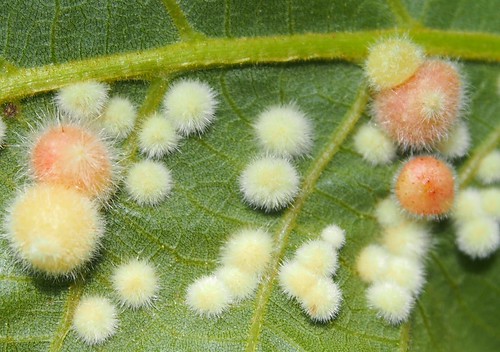
Weird fuzzy golf balls?  No, tiny galls on the underside of a shagbark hickory leaf.  Inside each gall is a tiny developing larvae of a fly or wasp, in this case a small fly.

Winged Euonymus P6280504

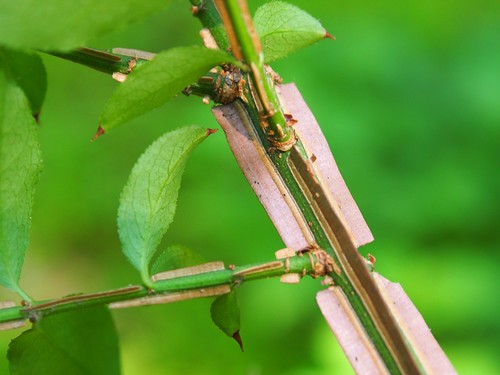
Some invasive plants are really cool, but people don't like them even if they have fascinating characters.  This is burning bush, also called winged euonymus (Euonymus alatus). Look at those cork lists along the stem!  How can you not love that!?

Aralia spinosa P6280500

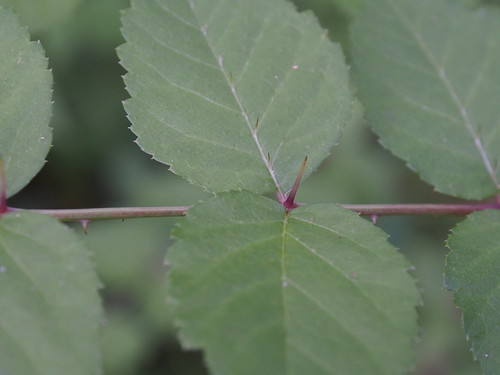
Spiny aralia (Aralia spinosa) has a suitable name.  These spines are on the leaves.  I wonder who it is trying to scare off? 

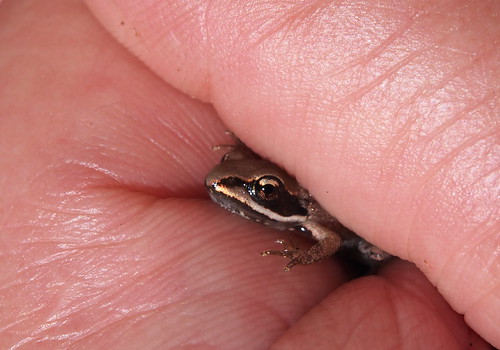
baby wood frog P6280492

One of several wood frog babies we saw.  Don't worry, it is not getting crushed.

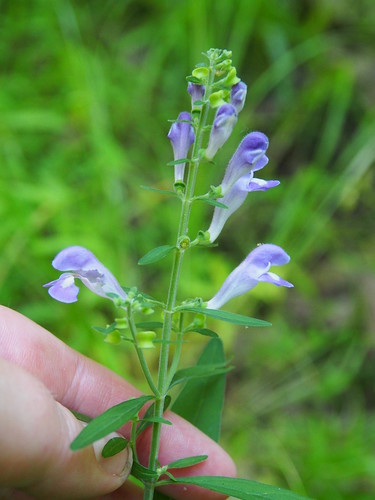
skullcap, Scutellaria integrifolia P6280482

A new species for me, a skullcap (Scutellaria integrifolia).  Look at the flowers, the top part looks like a cap you can put on your head.

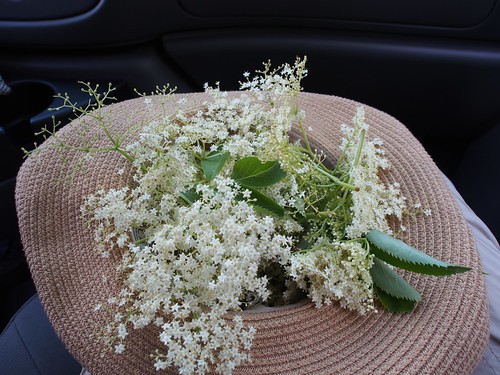
Elderflower collecting P6280582
Towards the end of the bioblitz we saw a big flowering elderflower bush (Sambucus nigra/americana), and I was allowed to pick some of the fragrant flowers in the only thing I had with me, my hat.  The flowers ended up in a jar with lemon peels and vodka and now we have Swedish-style elderflower akvavit in our freezer! Yummy!

Monday, September 2, 2013

Insects and critters in New Jersey - a photo essay from this summer

False Potato Beetle (Leptinotarsa juncta)
A dead False Potato Beetle (Leptinotarsa juncta) was waiting for me, dead, outside the door to my office building one day. It is similar to the infamous Colorado potato beetle, but its stripes are brown, black and white.

galls on grape leaf (Vitis)
Some amazing galls by some unknown insect on grape leaves in our garden.  Each yellow 'bottle' was about 1 cm long.

sunflower and fly
This is a fly (2 wings), not a bee (4 wings), sunning itself in the sunflower.

caterpillar of Amorpha juglandis (Walnut Sphinx)
LA found a small, but distinctive, larvae of a walnut sphinx (Amorpha juglandis).  Spinxes are big moths that fly at night. This was the first photo from New Jersey in the Bugguide.net, a great online photo guide!

We also saw two mosquitoes in the last week that looked like the invasive Asian tiger mosquito.  I am less happy about that. They were tiny, flew during daytime, and have black and white-striped bodies and legs. They can spread diseases, that is their problem (and ours).

I love all the life in our garden, even if it sometimes bites and stings. This morning the fog had made all the spider webs visible, like white cotton thread.  Giant praying mantis are hanging out in the butterfly bush, aiming for the big swallowtail butterflies.  In the garden, too many marmorated stinkbugs are creating problems... it is always something.

More insect photos are coming soon! 

Sunday, June 23, 2013

Spirogyra butterfly garden in Costa Rica

Yesterday I went to a tiny, rather unknown, little butterfly garden in downtown San Jose, the Costa Rican capital.  In a backyard on a slope down towards a river a family has developed a net-enclosed butterfly forest, with host plants, nectar-bearing flowering plants, and many, many butterflies. I was alone there, and in this tranquil place the butterflies didn't mind me - you could get inches away from them and take the most amazing photos. 

They rear their own butterflies, and the garden is a complete ecosystem with eggs, larvae, and pupas present.  This is nice, much different from butterfly houses where they buy the pupas (chrysalis) from other places and then let them hatch.

Here are some of the native butterflies of Costa Rica, all photographed yesterday and with a little quick snapshot camera, not with a macro- or telelens.  It was amazing how close you could get to the insects. 


Friday, May 10, 2013

Stamp of the Day: Baltimore checkerspot

This is an American stamp of the Baltimore Checkerspot (Euphydryas phaeton), a butterfly in black, white, and orange. Its caterpillar lives on a plant called White Turtle Head.  Don't you love these common names!?  It has also sometimes switched over to the weedy Lance-leaved Plantain, which came to the US from Europe with the colonialists.

The post office released this stamp for the particular use on large envelopes for greeting cards.  How practical!  I use them for letters to Sweden that need more than the usual postage. More on the stamp, the art, and the orange, black and white here. These were the color of the coat of arms for Lord Baltimore, who not only gave name to the city, but also this butterfly, and the bird called Baltimore Oriole, which we have in our yard.  It hasn't arrived yet this year, but it will, and it builds hanging woven nests in the big silver maples along the road.

This butterfly is relevant to me, because tomorrow I am driving to Baltimore to pick up AREA who has finished her first year in college (yeah! congratulations!!!).  I doubt we will bring back any butterflies or birds in the car, but there will be art, more art, kitchen stuff, a table, microwave, unused foods, and who knows what that will need to be emptied out from her college apartment and stuffed into my car.  Welcome home AREA!

Monday, August 20, 2012

Prowling around in our garden


A praying mantis is on the prowl in the cup plants (Silphium).

after the praying mantid meal...
And after the meal, all that is left is a wing of the swallowtail butterfly.

Friday, July 1, 2011

life at an angle


Club Tips, originally uploaded by mycologie.

Phyciodes tharos is sitting on a Rudbeckia, and nope, will not fall off. At that angle, we humans certainly would.
Photo by mycologie, check out her other gorgeous photos.

Wednesday, June 8, 2011

Obs-lista June 7-8, 2011

An 'obs-lista' is an observation list of the species you have seen at a particular place, during a particular time, or for a particular project.  When we grew up in Sweden we used to make lists like these for certain trips and cross off as many species as we could.  This is not a complete list at all, just a few notes of special things seen in New Jersey and Pennsylvania during the last 24 hours.

Japanese knotweed (Polygonum cuspidatum)- this invasive species has taken over like a 1.5 m tall dusty green plague along the railroad line between Trenton and Levittown, Pennsylvania.  It was initially planted as a nice garden plant in the US, but quickly became a horribly invasive weed.  The rhizomes in the soil shoot up new shoots over and over and the plant spreads sideways very quickly.

Cedar waxwings ('sidensvansar') - they are back!  Every June we see cedar waxwings that come and eat the fruits on our Amelanchier tree ('häggmispel').  Only problem is that our Amelanchier tree died last summer from a fungal disease.  The cedar waxwings didn't really look hungry, so I hope they find some other berries to eat.  I love these birds and their 'sirring' sounds.

Monarch butterflies - they are back too!  I have only seen one so far, but still, one butterfly can lay a lot of eggs on a milkweed plant (assuming she mated first...). Apparently there is another invasive milkweed called swallow wort that monarchs also lay their eggs on, but the larvae become sick from that species.  Monarchs, stick to the real milkweeds (Asclepias), so you don't fail to make more monarchs.

Box turtle.  This was a sad occasion this morning.  A nice sturdy box turtle had tried to cross our road but got run over.  All that was left was the 15 cm long shell, broken in one end.  I put the shell up on a rock in the forest.  These ancient creatures are amazing, but they don't do well on asphalt with fast cars.

Colorado beetle.  Only one seen so far on our property, and I hope this is not the beginning of this year's garden pest.  It seems like every year a different insect species becomes a problem.  We have had invasions of Japanese beetles, brown marmorated stinkbugs, Asian lady beetles, toxic blister beetles, and bagworms during different years.  I have no problem with killing such insects, but not with poisons - we mostly use the drowning technique. We picked the blister beetles off our beets and swiss chard by hand last year, with gloves on, since they can cause bad dermatitis and poisoning. Not only the weather is out of control but the invasive animals and plants too!

Fire flies - they are back!  I love fireflies.  Their green glow make nice streaks in the hot summer evenings, and make this place tropical (in the good sense).  The heat makes it feel tropical in the bad sense.  Tomorrow it is predicted to be 100 degrees Fahrenheit (=37 Celsius) here. Too hot!

Tuesday, May 31, 2011

Waiting for the monarchs...


They haven't arrived here yet from Mexico where they overwinter, but their food plants (toxic milkweeds) are growing strong and steady in our backyard so whenever they show up they can lay their eggs and make more monarchs.

Gorgeous drawing by Devon (aka firefly hunter) on Flickr (click on image for more great insect drawings)