Showing posts with label book review. Show all posts

Monday, August 26, 2013

Emigrants from Sweden

The summer has turned over and autumn is closing in on us again here in the Northern hemisphere. Daylight is still 14 hours and 30 minutes, when the winter is here we´ll have the shortest days with 6 hours and 7 minutes. The migrating birds have started to group together already.

But, no need to ponder on that now. On the other topic now, Emigrants from Sweden to America, as it was in the 19th century. The book series about a Swedish group of people who were leaving a poor life in the rural Småland, written by the Swedish author Vilhelm Moberg, has been reprinted. What´s interesting are the book covers, embroidered by a Swedish needleworker, Karin Holmberg.

I think they are beautiful, and maybe very Swedish. LS, what do you think?


Tuesday, August 6, 2013

Stamp of the Day: Lighthouse (Svenska Högarna, Sweden)


Anybody that has read Tove Jansson's books about the Moomin Trolls knows that she has a special relationship to the sea.  The book Moominpappa at Sea ('Pappan och havet' in Swedish) takes place during a summer at a lighthouse far out in the archipelago on a little island, remote, scary, and beautiful.  Lighthouses are amazing buildings, sturdy by design, but isolated and lonely.  To get up to the action, the light, you have to step and step and step upwards through dark stairs, like a tunnel through a mountain.
These days lighthouses are endangered.  Most have no living people in them, and many have stopped shining.  Some are for sale. Some are taken by the oceans.  And most ships has GPS monitors that take you through the night.  Just 100 years ago, a blip in the time on Earth, there was just the sea, a boat, and a light at the distance, and nothing else to rely on.  Well compasses too, of course.  And sunrise and stars.  

Now it is all electronic, and abysmally insecure, unfortunately. A few irate or unresponsive electrons (=no juice!) and you are met by a black screen.  Few people in the past had a non-functioning compass (unless you put an iron rod next to it), but I think we all have swore over bad GPS directions or digital maps that suddenly show you driving in a river when in fact you are on a street in a city.  GPS is so convenient and insecure at the same time, it is scary.  It is like a teddy bear that can be lost at any time, and then what do you do.

Today's stamp is from Sweden, and shows the lighthouse at Svenska Högarna (which means 'The Swedish Mounds', which is here on Google Maps. It is out in nowhere, in the Baltic Sea between Sweden and Finland.  Tove Jansson could have used this as her lighthouse for her book, that is for sure. It is one of the few lighthouses in Sweden that still has staff year-round.

Monday, April 8, 2013

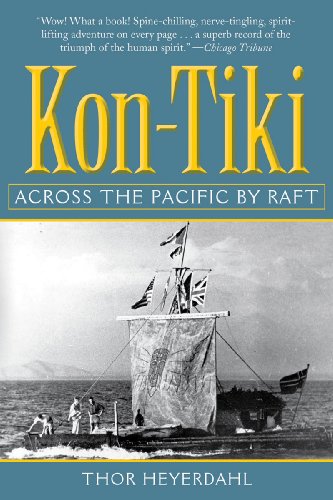
Stamp of the Day and Book Review: Kon-Tiki by Thor Heyerdahl


I recently reread a most amazing book that I hadn't read for probably 30 years - Kon-Tiki: Across the Pacific by Raft, by Thor Heyerdahl.

It was like seeing an old friend, and realizing that the old friend was even more interesting, nicer and fun than I remembered from before.  The book is a classic of course, and describes the rather crazy trip of 6 explorers on a small balsa raft from Peru to Polynesia and their 101 days at sea.  They proved that pre-historic people could have traveled such distances before modern navigation and metal tools.

Thor Heyerdahl's prose is great, he pulls you into the story and the diary, and there were only a few times I felt 'I want to know more! Give me details!'

Kon-Tiki is both an adventure story and an academic description of fieldwork, a great combination.  The thing I remember most from when I read this book as a teenager was the description of picking up the flying fish that had landed on board during the night, and making fried flying fish for breakfast each day. Somehow that image had etched itself into my memory.

Now I have more images, of whale sharks, crashing onto the reef around the final island, and the monotony of just sea, sky, and a tiny raft...

It is now 55 years since this trip was done, and it has been memorized on many postage stamps. Here are a few from Norway and French Polynesia:


Sunday, February 10, 2013

Book reviews: Patagonian travels, one great, one not

 A few months ago I picked up an old Swedish book given to me by a friend, who I have long forgotten, but it was a book I had wanted to read for a long time: Bruce Chatwin's In Patagonia.  I think my copy might be the first edition from 1981 in Swedish.  I dug in and started to read, with high expectations, because this was a 'real travel writer'!.  As you might know, I mostly read right before I fall asleep, maybe half an hour a day, at the most.
  Bruce Chatwin leaves work and travels to Patagonia, seemingly unplanned, a place he has always wanted to visit.  His travel diary is not a diary in the regular sense, more broken pieces and fragments of text from his experiences in Patagonia with inserts of history, commentary, and cultural reflections.

And here is the main problem.  Bruce stands outside the whole travel experience.  He reports like a objective journalist, not a person present in the moment.  And he even fails at being objective, because many times you can clearly feel the aversion he has to the people he meets.  It is not a boring book, and the text is excellently written, beautiful in fact, but it is not a good book.  You don't get a feel for the place, and it is too fragmented.

The detachedness of Bruce Chatwin is disturbing.  I can't remember any of the persons he describes in such detail, no stories, no places, no names or characters. No recollection.  There is no focus at all.   How can that be?  It was like nothing as memorable.  I know that this is considered one of the best travel books ever written, but I will have to disagree, strongly.  So I gave up, 10-20 pages from the end.

A few weeks later I needed a book with me when I had to wait for my daughter at the dentists.  I looked in our bookshelf and found "The Old Patagonian Express" by Paul Theroux!  I remember buying this book for my husband, but none of us had read it yet.  I brought it with me, read a few pages at the dentist, and was hooked.  And last night, I finished it.  What a difference.  What joy.  I envy people that haven't read this book, they have such a good read in front of them.

Paul Theroux's book was published a year (1979) after Bruce Chatwin's book and they were friends.  The books are like night and day in difference.  While Bruce Chatwin talks about Patagonia, he never explains how he got there, and his book has not one structured path in it.  Paul Theroux, on the other hand, has a plan, and he loves travel, which for him means to GET TO another place, not BE IN another place.  And I think he is right.  True travel is the transportation phase, the active movement through places, not being dumped in a place and staying there.

The way Paul Theroux traveled to Patagonia is the focus, the structure, of the whole book.  He gets on the subway and then commuter train in Boston in a snowstorm, and then takes local train after local train down to Mexico, through Central America, along the Andes, through long Argentina, and then eventually ends up on The Old Patagonian Express, the narrowgauge steam train that goes to Esquel.  And then the book is over.

This book is not about Patagonia, this book is about human nature, nature and humans. Culture, politics, some natural history, pestering travel companions, good and bad hotel rooms, dusty old railroad cars, giant steaks in dining cars, delays, landslides, revolts, and rats chewing holes in the ceiling above your bed.  It also has great interactions between Paul Theroux and the people he meets, from street urchins in Colombia to impossible Mr Thornberry in Costa Rica and the Argentinians need to be superior while having the right to complain about anything in their own country (and nobody else should).

It is a fantastic story, a meandering travel path through not only North and Latin American geography, but also classic literature (Paul Theroux discusses the books he reads during the trip), and it feels real and human.  He is not trying to be some übermensch, not someone that stands above or besides his co-travelers or people he meets.  He just is.  Now I have to read his other travel books!  Wow, what a read!  Yes, A+ and five stars of course.

There are a lot of great passages in The Old Patagonian Express, and here is one that I think fits this review pretty well:

Reading alters the appearance of a book. Once it has been read, it never looks the same again, and people leave their individual imprint on a book they have read. One of the pleasures of reading is seeing this alteration on the pages, and the way, by reading it, you have made the book yours.

And now, The Old Patagonian Express is mine, forever.  The physical book is still my husband's book, of course. 

Monday, November 5, 2012

Book review: We Took to the Woods by Louise Dickinson Rich


I had heard about this classic book first published in 1942 and never out of print since then, as a must read for people that were interested in sustainable living and organic farming. When I started reading it, I immediately realized that this wonderful gem of a book doesn’t really have anything to do with sustainable living and organic farming, however, it is a great and fun read about how to survive as a family that lives partly isolated among the mountains and lakes of northwestern Maine. They lived on a 5 mile long road that connected two lakes that functioned as waterways.  Every fall and every spring they were totally isolated while the ice on the lakes froze or unfroze, until either a car on the ice or a boat on the water could again connect them to the ‘outside’.   

Their life is content, but not sustainable in our sense that you can live on the land without anything from the outside – they get their income from transporting tourists and logging supplies along their 5-mile road, they need to ‘import’ most food and all other supplies like gasoline, engine parts, and kerosene, and only get deer meat, fresh fish, and some corn locally (their back yard).  

Louise moved to ‘the woods’ when she got married, and subsequently had a baby during a winter storm (without problems), and at one point didn’t leave the ‘neighborhood’ of the few neighbors within a couple of miles away for a few years.  But people came to them, timber workers in logging camps in the winter, tourists looking for wilderness in the summer.  She describes her life, her practical problems with food, storms, clothes, and cooking, and her love for the nature and culture of the local people with great love and humor.   

You smile when you read it, and the writing is suffused with common sense that is ever more important in even today’s world, 70 years later, and eons away from a cottage without electricity.   It is a wonderful read, and Louise puts life in great perspective, looking out from a mountain top in Maine onto the world and its stresses and overabundance of things we don’t really need to thrive. So read the book, it is great!

And of course, in light of the recent horrific hurricane Sandy, an experience that will taint our lives in the future more than we expect, I think, a book like this is even more relevant.  What is important in life, really? What do you need to survive, to love, and to be happy?  It certainly isn’t instant gratification through fast food, expensive clothes, or pretty, but useless things.  Recently I have been very happy over having a non-damaged house and a safe family after the storm, over the incredibly orange sunrises we have had, and the fact that great books work without electric power of any kind.  That is, real printed books on paper, my favorite kind of book.

Some select quotes from this book to illustrate these points, and remember, this was written in 1942, not 2012:

“Christmas in the woods is much better than Christmas on the Outside. We do exactly what we want to do about it, not what we have to do because the neighbors will think it’s funny if we don’t; or because of the kids, who will judge our efforts not by their own standards but by the standards set up by the parents of other kids. We don’t have any synthetic pre-Christmas build-up – no shop window displays, no carol singers in department stores, no competition in the matter of lighting effects over front doors.”

“Here I can be a rotten housekeeper, and it doesn’t make much difference.  After all, this is the woods. People don’t expect quite so much in the line of shining silver, polished glass, and spotless woodwork. […] Now I am learning to spend my time wisely; and I don’t think it’s very wise to spend two hours waxing the living-room floor on a lovely day when I could be out fishing. “

“We went up the road and across Pond-in-the-River Dam just as the sunlight struck the tops of the trees on the ridge. The valley was still in shadow, with steam rising white from the churning water and turning to a lovely pearly pink as it reached the sun-shot air above. I knew how fish feel as they swim about in the depths and look up to see the light of day above them.”

Wednesday, June 6, 2012

A bunch of books...

Do books come in bunches?  Or are they in piles?  Groups?  Heaps?  Anyway, here is a couple of short reviews of books I have read in the last couple of months, from the great to the not so great.  So, the best first.

Tracy Chevalier: Remarkable Creatures.  What a great novel!  It is in the early half of the 1800s and a poor girl gets her living from discovering and selling fossils from the beach by her home village along England's southern coast.  An unmarried woman and her sisters move to town, mostly because it is a cheaper place to live than London, and she befriends the girl and learns about and collects fossil.

They discovered the most amazing fossils of the time, fossils that were bought and transported to natural history museums in London, Paris, Oxford, and so on.  These fossils were fodder for a lot of discussion in this pre-Darwin era, and fueled scientific thinking.  Plesiosaurs, ichtyosaurs...  However, the women didn't get proper credit, since they were women and fossil collecting and science were unwomanly activities. A few of the contemporary paleontologists gave them proper respect and credit, but the divide was enourmous, especially for Mary who started out illiterate and extremely poor.  For example, women were not allowed even into the meetings of the British Geological Society.

The young woman's name was Mary Anning, and her older friend was Elizabeth Philpot, who specialized in fish fossils.  This book tells the story from their viewpoint.  The general story is true, but it is a novel so gaps have been filled in with possible scenarios.  It is a great book that not only describes natural history and its discoveries in historical context, but also highlights and make the inequality come to life. And that inequality is not just between genders but also between classes and religious groups. I highly recommend this book. So, 5 stars.
Sandra Newman: The Western Lit Survival Kit.  This book is fantastic! Well, near fantastic, because sometimes she goes overboard. I read the whole thing straight through, laughed, smiled and took note on which classics that I wanted to read and which ones I never need to open. Actually, I don't feel the need to read any of the classics after reading this book, I have too many books already here at home waiting to be opened.  Probably around a 100 unread books... and only a few of them are classics.  Like Marco Polo... I want to read that one, but I digress. 

Her style is out of this world funny and knowledgeable. Ah, we need to let high school students have a look in this book! The book is exactly what the subtitle says "An irreverent guide to the classics, from Homer to Faulkner". Each classic book is graded on Importance, Difficulty, and Fun, and she of course admits that that is a very subjective scale she has graded these on. She is not always trying to be dead serious, which is what I like, but some other bibliophiles that have reviewed this book have a problem with that. 4 stars.

Jill Ker Conway has written three memoirs about her life as a child in Australia, student, emigrant to the US to study history at Harvard, her scholarly work on women in history, her years as a Dean at a Canadian university, and then as the President of the small all-female Smith College in Massachusetts.  I reviewed the two first books here on this blog, and they are fantastic and refreshing. 

The writing is exquisite, intellectually so rewarding, and she makes you think.  There was much more anti-woman stuff going on in academia going on back then, but some things are still the same.  And many things that we struggle with today have not changed at all, and they are not based on gender.  People unwilling to change, people that want too much change, the will to look beyond what you have learned in the class, the willingness to discuss without arguing, and so on.

I read her third book recently, A Woman's Education, which is smaller and less strictly a memoir in a way.  It describes her years at Smith College, and goes in depth into how it was to administer a small independent school.  It wasn't all easy, not at all.  What infuses the book is her caring about students and their education, on a very deep, serious level. 

I admire her, she has been a big inspiration in my recent work.  She tries to change the view of some older professors, make reformations in educational thinking, and is seen as a rebellion, but it is how things have to be done.  The world changes and so do we and so do how we do things.  This book I am keeping! 5 stars.

Last book in the pile.... Daniel Beard's The Field and Forest Handy Book. This is a reprint of a 1912 book about camping, scouting, outdoor recreation, hiking, etc., and includes great illustrations, which I think were made by the author as well. Daniel Beard was a co-founder of the Boy Scouts of America, and boy, is this a boyish book.  Girls do not exist.  At least not outside any house.  The book is really a time capsule of how things were back then.

There are many useful skills described in here, how to make a raised platform for a place to sleep in a swamp, how to make a logomaran so you can drift down a river (never ever use fresh wood, or you might sink), how to make fire without matches, how to make a play house, what to eat in camp, and that you should bring a flour sack to make into a pillow case.  He even have instructions on how to build a fire engine. Oh, and even how to make a herbarium is in here.

This book is not really about true survival based on old traditional knowledge like the book Wildwood Wisdom (reviewed on this blog), but about fun wild stuff boys can do outside.  Some certainly has survival tones to it, but some is more silly, like How to Play Pirate and How to Make an Aquarium.  Under Novel Food Used in Camp, he writes: "...Wolf meat is said to be sticky and disagreeable.".  Times were different back then.

Grade?  I am not sure.  Maybe 2-3 stars, but it has certainly historic interest and I would have loved this book when I was 12-14 years old. I learned a lot of useful information that I probably won't have much use for in my life, but that is OK. One day it might come in very handy.

OK, that is it for this batch.  If you read all the way to down here, good for you!  Now you know more than before :)

Saturday, March 3, 2012

Book Review: Om jag var din hemmafru av Lotta Lundgren (Swedish cookbook, English review)

Fantastic Swedish cookbook: Om jag var din hemmafru av Lotta Lundgren

Om jag var din hemmafru by Lotta Lundgren, is an amazing cookbook (in Swedish only, for now), by Lotta Lundgren, a former advertising copywriter who changed careers to become a food writer and chef.  I got this book as a present, and I love it, not only for the amazing gorgeous photos (which Lotta as the model!), but also for the food writing.  The recipes are fine, but the best is the intros to each dish and the irreverent humor that is everywhere, in every line. 

It is hard to explain this in English, but she has a fantastic tongue-in-cheek, silly, intelligent, and contemporary humoristic take on life, food, love, and eating in her Swedish text.  It is just GORGEOUS from both a visual, intellectual, and foodie viewpoint.  I have so far cooked two things out of the book, but I have read the whole cookbook, from front to back page.  And that is usually not the case!  Often Swedes are too serious, and this book just loosens everything up!

In many ways this is an anti-book book, a book that suggests that you don't take life, food, recipes and work so seriously - that you just let go and enjoy it.  Many of the recipes do not give exact measurements.  Lotta, THANK YOU! 

USA needs this cookbook, but I am not sure most people here would get it, considering the backwards, horrible trends among some groups here (anti-love, anti-good food, anti-birth control, anti-personal freedom - just thinking about the recent republican presidential campaign makes me shudder of disgust).  At least we Swedes have this book to be happy about. 

Sweden publishes the most cook books per year per capita, which is pretty amazing.  But Swedes care about food, good food, organic and local products, and they also travel near and far so they are used to many different cuisines.

(If you can read Swedish, here is a great review of the book from Kulturdelen)

Fantastic Swedish cookbook: Om jag var din hemmafru av Lotta Lundgren

[Large photos by Vilseskogen on Flickr, Creative Commons; book cover by Norstedts]

Wednesday, February 22, 2012

Book review: Högre än alla himlar av Louise Boije af Gennäs

(This review is in Swedish, since the book is in Swedish and not yet translated to English.  The book isn't worth reading in English anyway unless you want to read many, many beautifully crafted words about spoiled upper class Stockholm citizens.  You can read about Louise Boije av Gennäs here. )

Jag har just sträckläst den här boken, och den har lämnat en blandad eftersmak.  Den är värd fem stjärnor och också två, och men det lutar nog åt tre, fast jag vet inte riktigt.  Det är ovanligt att man tycker att en bok är oerhört välskriven och samtidigt saknar kärna, ide, och tyngd, men så är det med denna.

Första kapitlet börjar som en Per Anders Fogelström Stockholmsroman - det är nyårsafton och en vindby flyger runt Stockholm, beskrivet i allegorier, vackra ord, och symbolismer till tusen.  Jag har nog inte läst Fogelström på 25 år, men det var honom jag tänkte på när jag läste:
"En vilsekommen rufsig kråka lyfte från Mosebacke, fångade vinden i vingarna och lät sig hastigt föras bort mot Högalid där tvillingtornerns Alfa och Omega - alltings början och slut, döpta efter Ansgar och Olaus Petri - vakade över Tengboms mäktiga tegelmonument och staden från samma höjd över östersjon som Stadshusets Tre Kronor."

Och så vidare, det går på och på.  Det blir for pretentiöst. Metaforerna står som spön i backen.  Det blir så mycket metaforer och insmugna historie- eller annan bildingsfakta att det blir kinesisk chop-chop salad till slut.  Mish mash, blandsallad med för mycket och för finhackat av allt.  Jag fick känslan att författarinnan har skrivit för att få Nobelpriset i literatur, inte för att skriva en bra historia, inte för att förmedla något, inte för att hon älskar sagor och berättelser. Det är synd, för jag tror att hon älskar sagor egentligen.

Det finns en historia i boken, även om den är svag i handlingen och mest kanske visar vilka folkklasser (= högt upp) och intellektuella kretsar (= välutbildade) författarinan rör sig i.  Ofta får man känslan att hon beskriver något självupplevt, kanske mest för att en del andra beskrivningar inte är lika trovärdiga, ingående, känslosamma, och långvindiga.

Så, vad handlar boken om, undrar du?  Det är egentligen inte så viktigt, faktiskt. Det är sex personer som bor i Stockholm, alla är väldigt eller lagom mycket perfekta, och boken beskriver de första åren på 2000-talet i deras liv.  Första kapitlet introducerar alla sex personerna till läsaren på en gång i en total villervalla på en nyårsfest. Efter det kapitlet var jag redo att ge upp för jag kunde inte komma ihåg vem som var vem, var ihop med vem, förälder eller bror till vem, och gay, författare, rik eller misslyckad skådis... Totalkaos, fast välskrivet!

Men jag stod på mig och läste vidare och i resten av boken så är de olika kapitlen mest från en persons synvinkel i taget, så då är det lättare att hänga med.  Här i USA har det pratats mycket om äkthet (authenticity) i media nyligen, och de här människorna känns inte äkta.  De känns som det vackra folket i en TV serie, eller de man ser innanför fönstren på en restaurang som är så dyr att man själv inte kan äta middag där någonsin.  Konstigt nog är det bara två av de sex personerna i boken som faktiskt är riktigt rika, men det hela genomsyras av kommentarer som visar att de alla står över allmänheten i sina intellektuella förmåga och utbildning, och alla har dessutom finstämd designkänsla (det är Svenskt Tenn hit och dit). Det är inget fel i det, men det finns ingen riktig motvikt. 

Det är himla svårt att sätta fingret på vad som är fel, men det är en känsla i maggropen att det hela är vackert, tragiskt, stressigt, underbart, men faktiskt utan innehåll.  Nästan som kejsarens nya kläder - det här är en bok om ingenting, fast med massor av ord.  Konstigt nog har boken fått massor med bra recensioner i pressen.  Kulturskribenterna verkar älska den, men läsarna är inte lika överväldigade och ger blandade kommentarer (från en till fem stjärnor på AdLibris).

Nyligen har jag läst flera böcker av etablerade författare, och alla böcker var för långa; böckerna skulle har varit minst 30% kortare.  Det är nästan som att när en författare har lyckats så glömmer han/hon bort att sovra och redigera sin text.  Barbara Kingsolver's The Lacuna är praktexemplet på detta; jag har fortfarande hälften kvar att läsa av den boken, och det var ett år sedan jag började läsa den. Hon skulle ha avslutat den efter 200 sidor. 

Den här svenska boken är också 500 sidor!  Alldeles for lång, och långsam... men språket är vackert!  Men det blir för mycket av det goda.  Det blir för mycket Falsterbo semestrar, det blir för mycket om att vänta och föda barn, och det blir för lite av det som gör en bok levande. (Jag vet, mitt resonemanget går inte ihop.) Men vissa delar är magnifika, det är bara att de delarna dränks i ett sammelsurium.  Någon skulle nog kunna kalla det hela 'ett intellektuellt och begåvat ordbajseri', men så långt vill jag inte gå. 

Nu när jag har skrivit så här långt, sa tror jag att den där irritationskänslan över den här boken kanske faktiskt har formulerats sig till ett svar varför jag inte tyckte om en så välskriven bok:  Den berörde mig inte och den är för pretentiös. Den är totala motsatsen till True Grit (se den filmen!). 

Det är som en del konst man ser.  "Visst, den målningen är ju bra, väldigt välgjord och tekniskt avancerad, men den förmedlar inget alls. Bara. Tomrum. "  Det är så synd, för jag tyckte verkligen om hennes tidigare bok Stjärnor utan Svindel.  Vad hände? Och nu har jag skuldkänslor för att jag skrev en så kritisk recension, men det här är vad jag tycker, ärligt talat. Och helt uppenbart fick boken mig att tänka till och skriva en väldigt lång recension, haha! Så, tänker ni läsa boken nu, eller?

Thursday, February 2, 2012

Book review: Wildwood Wisdom by Ellsworth Jaeger

This is a most wonderful book.

I have read this book nearly from the first page to the last, and looked at the over 400 handdrawn wonderful illustrations, and contemplated the ways and means that people in the past survived and thrived in the wilderness.  This book has been my late-night companion before my eyes close for sleep for maybe a month or more, and it has been a great read.

Wildwood Wisdom by Ellsworth Jaeger was published in 1945, and has recently been reprinted by First Shelter Publishing, a company that specializes in 'keeping worthy old books in print'.  Jaeger also provide all the amazing and lovely illustrations.

So, what is the book about?  It is about how to survive in the North American wilderness pre-1950s, before nylon, Goretex, GPS, cell phones, and all the fancy equipment we have today.  It builds a lot on Native American tools and techniques, as well as the European trappers and explorers of the 1700s and 1800s.

It is a how-to-book for anything you might need to know while living outdoors.  How to start a fire?  Jaeger presents a dozen ways.  How to skin a skunk? No problem, just be careful and cut off the skunky glands by the tail.  How to make snowshoes?  It is here too.  Food, shelter, bathroom issues, edible and toxic plants, making buckskin and pelts, stalking animals, building shelves out of tree fungi, and how to cook over open fire - just open and read.  And admire the illustrations...

Everything is practial and with exact enough detail that you can copy the methods and sew your own buckskin coat, make a pancake on a hot rock, or built a tepee (see image to the right).  I learned so much from this book; things I might never need to know, but that I love to know.  Today someone at work said - "you are like a sponge soaking up knowledge, and that is so wonderful", and I feel just like that.  THere is so much interesting things out there, from the past, from today, from the future, and real things, hands-on things that exist.  I am not sure things on the internet really exist, but an ax or a pancake, they do really exist.

So, for anybody that goes camping, kayaking, or hiking, this is the book to get them for Christmas.  It works in Europe too, even if you don't have skunks, rattlesnakes, or poison ivy.

The only thing I noticed that was wrong was some of the information about edible fungi.  Some of the mushrooms that were considered edible in the 1940s have now been reevaluated to 'Don't ever think about eating these'.  Otherwise, the book is a true goldmine of great information.  Get it while you can!

Saturday, December 17, 2011

Book review: How to survive the end of the world as we know it by James Wesley Rawles

After recently reading S M Stirling's Emberverse series and liking it (at least the 2 first books in each series), I decided to look into the survival literature, just in case 'what if' happened. Rawles' book How to Survive the End of the World as We Know It describes how you prepare for a doomsday scenario where government and facilities such as electricity, fuel and food deliveries, and communication breaks down.

His advice is to live in a place that can be self-sufficient for years, and that is defendable against rioters and other criminals when law and order is no more. He describes in details which food items that store well, what medicines to keep on hand, where to get training in First Aid, canning, shooting, and how to learn how to barter (and what to barter with).

The beginning of the book was OK, but it was lacking details for many things when it comes to food production, preservation, and medical issues. Most of the book is focused on details in radio communication, weaponry, and defense tactics. I realize that such knowledge and tools might become a way of surviving, but in the end, what will matter is if you can feed yourself for a longer time.

Of course this book includes a lot of right-wing frenzy, but the truth is that many of us could be much better prepared for a week or more without power, water, and ways of communicating - situations that have and will continue to happen based on hurricanes, storms, and other such events.

For example, more of us should know first aid. But going to army surplus and buying razor wire for cash (so it can't be traced) and hiding old silver coins in the walls for when the dollar is gone, that is not really my thing. But apart from the fear-mongering, there are some really good advice in it. I wish he had included more summaries such as tables and been somewhat less repetitive with his favorite abbreviations. The third, forth... fiftieth time he uses WTSHF (= when the shit hits the fan), it is kind of tiresome.

One interesting fact I learned was that dried wheat grain can be stored for 30 years if they are in moisture- and vermin-proof containers.

His best advice overall are:
1. Don't become overly dependent on gadgets.
2. Learn First aid.
3. Buy tools that last, which are usually older tools.
4. Don't assume that you have access to anything in the rest of society. Be as self-sufficient as you can.

Sunday, October 2, 2011

Book review: The Help by Kathryn Stockett

After a long stretch of semi-interesting to really bad books (see this, for example), I opened up this book and just loved it.  I don't want to write a long review, because the book has to be experienced, be loved, and be enjoyed on its own terms, because this is what it deserves.  The Help by Kathryn Stockett is about the black maids in southern US in the 1960s, their lives, loves, and despair, and about the white women that hire them, use them, depend on them, and sometimes, respect them.  I insisted on reading it before I watched the newly made movie based on it, so now I am ready.  If you have read the book, the movie is never better than the book, I think. But this book gets a 9 out of a 10, so I am not worried about the movie being really bad. I heard some had complained that a white woman shouldn't write a book about black women, but come on, that is the stupidiest thing I have heard.  If that is so, then women can't write about men, Swedes can't write about Norwegians, and black men can't write about white men.  We are foremost people, humans, and not our color, citizenship, or gender.  Compassion and understanding is deeper than skin color or culture, at least it ought to be.  So, if you want a great read, a good story, and deep thought mixed with fun stories, this is the book.  It is just like life is. Just read it. A++

Monday, September 5, 2011

Book Review: and I shall have some peace there by Margaret Roach

I like biographical books describing someones sudden change in life, travel to new places, or how they deal with new environments and experiences.  There are many great books about such challenges, from very introspective, to nature writing, to childhood tragedies.

So, when I picked up this book, I thought it would be about something similar, how a person did find peace on her own little dirt road.

Margaret Roach was an editor at Martha Stewart Living for many years, and lived a fast and stressed Manhattan life.  On the weekends she drove up to a cottage she owned a few hours north of New York City, where she tended a garden on a slope near the Berkshire mountains.

In the book she describes how she quits her job, leaves the city, and moves up to the cottage (hmm, I just realize that I have no idea how big her house is or how it looks), to live there full-time.  This is when the trouble starts, both in reality for her, and with the book.  She never describes WHY she left, what it was she wanted to get away from.  It is just very vague. Same thing when she is in her cottage, WHY is she lost and feel invaluable?  Her writing is great, but the content is fragmented, and there is hint after hint, but very little data about her (except she needs to point out several times that she is very petite and only a size 2, and a vegetarian for 30 years... it gets a bit tiresome).  I wish that she had described the situations and challenges better.  After reading the book I can't even picture her garden or house, nor the landscape it is situated in. I can picture many of her snakes though...  It is just not descriptive in a sense where you can understand, it is just fragments, like specks of paint on an old T-shirt.

She leaves her job at the start of the American recession in 2008, while the health care debate is going full steam and we are about to elect a new president.  The world is full of war, environmental problems, health care issues, unemployment disasters, and stock market crashes.  But all she cares about is to move to her little cottage, tend her garden and be alone.  That is all well, but she never seems to realize that she is incredibly lucky by obviously having amassed a fortune big enough to buy such a place, not work for pay, and still be able to have health insurance, enough food, and all others of life necessities. This is not how most people's lives are, so if she want us to understand her personal challenges and life story she better have to describe them better because most people would LOVE to be in her position. But, I have a feeling she thought that writing this book would be a great way to get some more money (she says so), so the content of the book was less important than that it was a book, period.

Maybe many upper-class women at a similar age (50s) can connect with her feeling of being lost in the world, but I cannot.  Is that because my world is filled with valuable things such as education of a new generation and research that improves society, knowledge and people around me...?  I can see that if you work at Martha Stewart Living how mostly caring about wall color, having a perfect geranium, and collecting green glass could get tiresome in the end.  Tiresome and maybe with a loss of doing things that really matter in the world.  But the solution to this would not be to create a garden just for you, but to do something that matters and brings change to many, I would think.  But Margaret Roach did not. There is a lack of balance here, and the lack of balance consist throughout the whole book.

She really lives a luxurious life in that she could make this decision and spend 2 years gardening and write a book...  but she seems totally unaware of what is going on in other people's lives and the world and is 100% self-centered.  In fact, after reading the book I must say that she portrays herself as very selfish.  Many people would love to have a garden they could spend all their time in, but few can realize this dream.  Margaret does, and she opens up her garden to the public a few times a year, but the rest of the time it is mostly her and the garden and a few friends.  The worst things that seem to happen is when a gray fox family moves into the garden and starts a communal fox bathroom in a corner, which she fights day after day with coyote urine. She comes through as a spoiled Manhattan rich girl, unfortunately.  I am sure she is a nice person, but her self-centered focus gets tiresome early on in the book.

Her deep fear of snakes is a theme in the book, as is her longing for 'being someone'.  So, there are snakes, and I am afraid of them too, and eventually she deals with them and manages her fear.  But everything is so personal, in the sense that you get the feeling she thinks the frogs are there for her, and her only.

People love her book, and her blog (which is equally self-promoting and selfish, I think), but I got rather annoyed.  If you want to make the world a better place, then go out and do something about it.  Make small changes in your local community if you like, you don't have to join the Peace Corps.  It is a great way to feel important and valuable, if you become valuable to others and creative positive change. (All Margaret seems to have done is to flip burgers on the grill once in a while at a local community picnic.)  But hunkering down behind a garden gate that you rarely open more than once a week and become an hermit living on past earned money, it is luxury and not a challenge.  Well, maybe a mental challenge, of course, depending on how your mind works.  I don't like to critize people that write biographies and stories like this, but I have to say that this book rubbed me so much the wrong way.

Summary: Rich girl moves to country where she writes and gardens, full of self-pity, selfishness, fear of snakes, and in the end realizes she is somebody. Grade: C (but the writing is good).
(Note: I am sure Margaret Roach is a nice person, and this review is only based on the book. But if you write books like this you set yourself up to get criticized, especially if you turn out to be as navel-gazing as portrayed in this book.)

Thursday, July 28, 2011

Book review: The Feast Nearby

The full title of this book by Robin Mather is "The Feast Nearby: How I lost my job, buried a marriage, and found my way by keeping chickens, foraging, preserving, bartering, and eating locally (all on $40 a week)". This is the truth.  I didn't make that up.  Being into books about canning, local food, and reinventing your life recently, this book called out to me from the Amazon.com website, and its 5-star reviews must mean that it is actually a great book, right?  So I ordered it.

Well, it wasn't what I expected. Not at all.  I feel kind of bad writing this review, because I bet Robin Mather is a very nice person in person, but her book fell flat.  There are a lot of books out there right now about back-to-the-soil, back-to-the-rural, or just plain back-to-the-kitchen and I wonder if she just thought she could ride the wave.  After all, the author had been a food journalist over many years so she could write.


I actually believed that the book would be about "How I lost my job, buried a marriage, and found my way by keeping chickens, foraging, preserving, bartering, and eating locally (all on $40 a week)".  In smaller print on the cover it also says "essays and recipes".  Here is the first revelation - half the book are recipes. Long, winding recipes.  If I want a cookbook I buy a cookbook.  If I want an autobiography I buy that.  I am not sure what to do with this hybrid book.  It won't be among the cookbooks, and if it is among the novels, then I will never find the recipes. And there is no list of the recipes in the book. There is an index, but that covers everything, not just the recipes. I am sure some of the recipes are very tasty, but they were used to fill up a thin book into a thicker one. 


What I wanted to read about was how she lost her job, how she overcome her sadness over the marriage that was gone, and how she only had $40/week to live on and budget with.  But the book lacks depth and details about these things.  Nowhere is there a budget.  Her marriage is just mentioned in the beginning as a side issue, something that forced her to move to a little cottage.  It is not really a book about moving to a new place - she already knew a lot of the suppliers and had friends in the area.  In fact, it often reads like a marketing piece for her friends that provide local food.  (Which is not bad, but not what I want to pay for.)  

And the foraging and bartering is minimal, honestly.  We are not talking about someone that picks 20 kinds of weeds and make a salad out of it because she has nothing else to eat. She is not growing any of her own food (despite the cover picture, which is not of her or her carrots). For example, how could she buy that expensive coffee and still be under $40/week?  There are other things that I wonder about - didn't she get unemployment insurance after she was laid off?  That would be more than $160/month for food I would think...  I just wonder, especially since she never clarifies her economic circumstances.  At one point she needs to earn money to pay for fuel oil, so she then freelances a few weeks and then gets the money, so why couldn't she do more of that at other times.  I just don't feel like we are given the whole picture. This might be because of privacy reasons, but if you hold back on those things, you can't have such a subtitle on a book.


Part of the book is rambling, preaching arguments about the bad food industry, the goodness of local food, the great thing about having chickens, and details about her pets.  Barbara Kingsolver has written so much better about the first themes (and Michael Pollan too, even if he is too rambling and fact-and number-crazy as well), that it feels old in this book.  We have heard this before.  

It would have been so much more interesting to read about the author's own feelings, fears, frustrations, happiness, and experiences, instead of reading another 'eat-local-it-is-good' book.  I believe in eating local and fresh food too, but I don't want to be preached and lectured to. Why spend so much time on explaining UHT pasteurization, CAFO animal farms, and coffee roasting facts?  I just didn't find her writing interesting.  It was well-written, factually accurate, but boring.  Why is each chapter focused on mostly one ingredient? Wasn't this to be about her life, not food ingredients? Why is half the book recipes?  It honestly feels a bit like a copycat of Kingsolver's Animal, Vegetable, Miracle book, but not even half as good. Sorry, I might be harsh, but at least I am honest. 


Instead of this book, I suggest you read Animal, Vegetable, Miracle by Barbara Kingsolver (about local food), or The Dirty Life by Kristin Kimball (about growing your own food and starting a farm), or American Terroir by Rowan Jacobsen (about food ingredients).  All of these three books are fun, fascinating, and great entertainment and education at once.  


Now, there is some good things about this book too.  The book is exceptionally well designed and printed with nice font choices and paper.  But I still can't recommend it for reading.  I know I might be in the minority on this, but I think that with the limited time we have in the world, it is best to stick to books that are fun to read. This books get a C+, sorry.

Sunday, May 22, 2011

Book review: Lost & Found by Jaqueline Sheehan

I have always loved books when people live on islands, and especially if they are suddenly there and have to create a new life for themselves.  When I was a kid it was Robinson Crusoe, later more modern day tales of people running away from something or seeking solitude or a new kind of life.  This book fits that trend as well, and takes place on an island outside the city of Portland in Maine in the US. 

A woman is suddenly widowed and decides to change her life, at least temporarily, by moving to a tiny island where nobody knows her.  She applies for, and gets, the part-time Animal Warden job, which is mostly catching the cats the summer tourists left behind when vacation is over, but also dealing with skunks and racoons. 

One day an injured dogs shows up, shot with an exquisite homemade old-fashioned arrow in the shoulder.  Nobody claims the dog, so the animal warden takes it in and fosters it back to health.  The mystery deepens and eventually the story is sorted out.  There are many wonderful characters in the book, including an older woman with synesthesia and a teenage girl with anorexia.  I won't tell you more about the story here, because then I spoil it for you.

This is a really well-written book, and it could have become a shallow, sappy, and superficial romantic story, but it is not.  The descriptions of the characters are great, and describes how people think and feel in depth.  The author is a psychologist and it shows (in a good way).  Even if part of the book is really sad, in the end it is a feel-good book that is easy and fast to read. 

Just two things bother me, and it has nothing to do with the author and her writing.  Whoever put a brown labrador on the cover hadn't read the book, or just wanted any good dog photo on the cover.  The dog in the book is a black lab.  And, the symbol at the beginning of each chapter in the book is a golden retriever, not a lab. I grew up with labradors, and there is a big difference between the two breeds. Goldens are more air-headed, and were never good hunting dogs.   Another major design flaw.  Harper Collins, shape up.  Details like this matter - I like factual accuracies, not sloppiness.

Saturday, April 2, 2011

Book review: The outermost house by Henry Beston

Henry Beston decided to try to live a full year in a tiny cottage on the sand dunes of Cape Cod, that little shoe-like stretch of land that juts out below Boston on North America's East Coast and frequently battered by stormy Nor'Easters.  This was in 1926, and his only human companions were the people at the Coast Guard Stations, who walked the beach nightly to look for ships in distress, since this is a famously disastrous coastline with many sandbars, bad weather, and stormy skies.  But the ships and people form only a small part of his diary, which is probably among the best nature writing I have read in English.

He describes, feels, and paints with words the migration of the seabirds, the swallows in the air, insect life, stranded fishes, and grassy dunes.  Straightforward, gorgeous, and filled with impressionistic sentences, this is a wonderful book to read.  Beston describes a different time, without phones and regular transportation, but the same birds are still flying north every spring, and the same beach plums are ripening in September.

I got my 1949 edition on Bookmooch, but this title is still in print.  It is considered a classic, but I have read many classics that don't live up to becoming my own classic books.  This one is far beyond classic.

Beston's cottage and land was given to the Audobon Society in 1960, and was finally reclaimed by the sea in 1978, when the storms had eroded the beach so much that the house was swept away during a big winterstorm.

 Cape Cod Beach Sandstorm
(Cape Cod Beach Sandstorm in April by Bob Gaffney on Flickr)

Here are just a few examples from the book:   

[Beston's foreword]   "Nature is a part of our humanity, and without some awareness and experience of that divine mystery man ceases to be man. When the Pleiades and the wind in the grass are no longer a part of the human spirit, a part of very flesh and bone, man becomes, as it were, a kind of cosmic outlaw, having neither the completeness and integrity of the animal nor the birthright of a true humanity."

[autumn, ocean and birds]  "For the animal shall not be measured by man. In a world older and more complete than ours they move finished and complete, gifted with extensions of the senses we have lost or never attained, living by voices we shall never hear. They are not brethren, they are not underlings; they are other nations, caught with ourselves in the net of life and time, fellow prisoners of the splendour and travail of the earth.  "
 
[midvinter] "A year indoors is a journey along a paper calendar; a year in outer nature is the accomplishment of a tremendous ritual. To share in it, one must have a knowledge of the pilgrimages of the sun, and something of that natural sense of him and feeling for him which made even the most primitive people mark the summer limits of his advance and the last December ebb of his decline."
 
[midvinter] "Animal life has disappeared into the chill air, the heavy, lifeless sand.  On the surface, nothing remains of the insect world.  That multiplicity of insect tracks, those fantastic ribbons which grasshoppers, promenading flies, spiders, and beetles printed on the dunes as they went about their hungry and mysterious purposes, have come to an end in this world and left it all the poorer."

Monday, March 7, 2011

Book review: Hundraåringen som klev ut genom fönstret och försvann av Jonas Jonasson

One more book review of a Swedish book in Swedish on this blog, but this one it on its way to be translated into English and a multitude of other languages.  It was a long time ago I read such a hilarious book.  It helps that the long beginning takes place in a small village not far from where I grew up, and that the author successfully makes fun of Swedish society, world history, politicians and incompetent bureaucrats, and puts together an obviously too-incredible story, but it is fun!  Just like crazy movies like Young Frankenstein is fun.  It is not because the story is believable, but because the book (or movie) creates laugh-out-loud moments in your life. 

In Swedish this book by Jonas Jonasson is called 'Hundraåringen som klev ut genom fönstret och försvann', which means The 100-year old who stepped out the window and disappeared. It will be made into a Swedish movie in 2012.  Jonas Jonasson is a former Swedish journalist who had the first draft of this book in his drawer for over 20 years or so.  The story seems simple, but it is not.  An old man turns 100 (named Allan) and decides to escape before his birthday party at the old-people home, and steps out the window.  And then the story starts, which includes murders, elephants, police, journalists, mafia, drug dealers, akvavit, swedish summer, swedish women, and much more... all written in a hilarious Swedish based on 1940-1950s intricate and sometimes stilted grammar with words of today thrown in. Throughout the book the 100-year old reminisces about his colorful life, where he has traveled the world, and in fact, helped (or not) world history personalities such as Franco, Roosevelt, Mao, Einstein's brother, Stalin, and he visits and deals with the associated gulag camps, atom bomb makings, secret submarines, and Iranian revolutions.  The book gives a great work-through of 20th century history, but of course it is all wrong because Allan is inserted in it.  But hilarious! I won't tell you the ending of the story, but it is good to the end.

I loved this book.  Apparently many (snobbish?) book critics in Sweden didn't like it at all, and thought it was silly, overwrought, or just plain dumb.  Well, dumb, that is Danielle Steele.  Overwrought, sure, but that is the point!  Just like a Mel Brooks movie, get it!?  Remember Springtime for Hitler - just the same thing, but this is nearly better, I think.  Silly - come on, good culture can be FUN. One critic complained that the book wasn't believable (hello, it wasn't meant to be!). This is pure entertainment, not serious literature... I am keeping this book so I can read it again next time I get the flu and have to lay in bed for a day or two. It will make me laugh many times again.  (And thanks to BOS for sending it to me!)

So, English-speaking readers, keep your eyes open and get it when it comes out in your country in the translated form.

Sunday, March 6, 2011

Book review: Yrsa Stenius - Makten och kvinnligheten

(Sorry English-speakers, this review is in Swedish, since the book is in Swedish and not translated into English.  Here is the short review: great self-biographical novel from famed leftist journalist, author, and ex-chief editor of Aftonbladet Yrsa Stenius about power, gender, and how we deal with it all, or not deal with it...  insightful, brutally honest, and well worth the read, that is, if you can read Swedish.)

Jag har alltid beundrat Yrsa Stenius.  Jag har inte alltid hållit med henne, men jag har beundrat hennes styrka, och hennes Finlandssvenska dialekt har på något sätt fått hennes ord och kommentarer att kännas mer viktiga än andras.  Jag vet, det är nog inte så, men finskans allvar och samtidiga humor i livets svarta ögonblick färgar nog av sig i finlandssvenskan, iallafall inbillar vi det oss.  I somras hörde jag Yrsa Stenius i en podcast från ett svenskt radioprogram och hon var fantastisk - hon fick mig att tänka, och sånt gillar jag.

I boken Makten och kvinnligheten, som är självbiografisk och väldigt självutlämnande utan att vara överdrivet personlig, så skriver hon om sin livskris efter att hon avgått som chefredaktör för Aftonbladet.  Boken handlar om hur vi vill ha makt och blir beroende av den, hur vi ofta tror att vi är inget utan makt, och behöver iallafall lite makt över någon eller vår situation, och hur makten utnyttjas och påverkar.  Och kvinnor reagerar annorlunda än män generellt när de ställs inför någon med makt, får makt, eller förlorar den.  Makt låter som något mest politiker har, men Yrsa skriver om den i vardagslivet, och makten vi har (eller inte har) över våra livsval, våra kärlekar, karriärer, och hur makten eller bara aningen av lite makt kan påverka oss i livet.  Hon beskriver hur hon klappade ihop och hamnade på psyket efter att ha förlorat sin makt, och till slut vågade vara maktlös, och hur hon hittade tillbaks till sig själv och sin självkänsla.  Jag tror Yrsa Stenius är en av de modigaste människor jag känner till i Skandinavien, för iallafall i Sverige undviker man att sticka ut från mängden, undviker att prata om obehagliga ämnen (och där ingår makt), och den intressehämmande men alltför vanliga ytligheten flyter ofta över alltihop, speciellt i medie- och politikervärlden. I den här boken rannsakar hon sig själv och sina val, och bygger styrka ur sina svagheter. Många kvinnor (och män) borde läsa den och tänka efter ett tag.  Underbart och tack, Yrsa! 

Här är ett kort utdrag:

"Simone de Beauvoir uppmuntrade inte mitt kvinnliga självförtroende, så som jag alltid har påstått. Nej hon stimulerade mitt personliga självförtroende trots att jag var kvinna.  {...} Jag brukade henne till att fördriva mina kvinnodrömmar, plåna ut dem ofullgångna ur mitt medvetande. Jag ersatte dem med något dubbeltydigt som handlade om framgång i männens värld, om att förtjäna deras uppmärksamhet, uppskattning och uppvaktning genom att vara en av dem, lika duktig, om inte duktigare "

Sunday, December 26, 2010

Book review: Half Broke Horses by Jeanette Walls

Jeanette Walls wrote the fantastic but also tragic memoir The Glass Castle (I guess I never reviewed it here on the blog but it is an A+++ book), and this book, Half Broke Horses is her follow-up.  It is not a memoir in the usual sense, because it is about her grandmother, and to some degree her mother, but she didn't have all the facts about her grandmother's colorful and adventurous life.  But she had some, so she wrote a 'true-life novel' where she filled in what could have happened between the things she knew and had (photos, letters, etc.).  Her grandmother was independent, wild, and not the typical southwestern girl - she helped her Dad break in wild horses at a young age and became a school teacher in remote, rural villages in desert Arizona as a very young girl.  Half Broke Horses is different than The Glass Castle, less immediate, less heart-breaking, but still a great book where you get the feel for everyday life, tragedy, and adventure out in Texas, Arizona, and Chicago in the early 1900s.  I loved it, mostly for the personal style of writing in direct and short sentences about life as it is - not to intellectual and reflective, but straight-forward, funny, and unhappy, just as it can be, and because she can describe characters as real people, not simplified caricatures. Lovely book, well worth reading

A sample (when her grandmother has decided to learn how to fly an airplane):

    "A fellow came out of a shack behind the plane and sauntered up to the Flivver. He had a windburned face, a cigarette dangling from his mouth, and a pair of aviator goggles pushed up on his forehead. He rested his elbows on Jim's open window and said. "Looking to learn her?"
   I leaned across the gearbox. "Not him," I said. "Me."
  "Whoa," Goggles said. "Ain't never taught a woman before." He looked at Jim. "Think the little lady's up to it?"
   "Don't you 'little lady' me," I said. "I break horses. I brand steers. I run a ranch with a couple dozen crazy cowboys on it, and I can beat them all in poker.  I'll be damned if some nincompoop is going to stand there and tell me that I don't have what it takes to fly that dinky heap of tin."

Tuesday, December 7, 2010

Book review: The dirty life by Kristin Kimball

Another name for this memoir, The Dirty Life by Kristen Kimball, could have been The inconvenient life or The unexpected happiness in a ditch or under a cow belly.  Kristin Kimball is a New York City journalist when she shows up at an organic farm in Pennsylvania to interview the youngish farmer, Mark.  He was too busy running the farm so he put her to work, weeding, to begin with. During the second day she finally managed to get some answers to her questions, and by then she also had her old interest in farming come alive again (she was always interested in food).  

This book describes the development of her passion for farming, and first her relationship and then marriage with Mark, who is a somewhat crazy hippie-like man.  She is brutally honest, funny, and writes eloquently about everything from her mom's appalled face when Mark shows up with a newly slaughtered turkey in a plastic bag (with the neck hanging out) at their first Thanksgiving, to the feeling of warm, good soil that is just waiting for the spade and shovels and plows.

They move away from New York, trying to find some land to farm organically and 'completely', in the sense that they want to be a self-sustained farm that produces everything a family might need year round: grain, sugar (maple syrup and honey), vegetables, milk (and cheese and yogurt), pork, chicken and eggs, beef, sheep for lamb, and so on. That is a lot complex than to farm just one thing (milk cows or corn for example), but also much more rewarding.

They find some land they are allowed to lease in upper New York State and start Essex Farm.  Mark is a true back-to-old-times person, hating any kind of plastic and waste of resources.  They decide to try to do as little as possible with tractors and instead they buy two draft horses, which will help them to plow and weed and transport manure and maple syrup buckets around, you name it. There is a great interview with Kimball here.

The first year they work all the time, live on nearly nothing except on what they can grow and are worried because they are not sure that the neighbors are willing to become members and get everything they need from the farm instead of from the regular grocery store.  But, if you build it they will come. The neighbors, many of them retired farmers from farms that now are abandoned, help them out with sage advice, ancient rusty but important draft horse equipment from old barns, and a hand here and there when needed.  And they start to sign up as members to get part of what is produced at the farm.

Today, 7 years later, the farm has over 100 members and is thriving.  Kristin Kimball wrote her book on early mornings between 4 and 7 in the fire station, before her daughter woke up and the work at the farm started.  I really loved this book, and read it faster than most because it captures you.  Not only is the story both compelling (and sometimes disgusting) and interesting, Kimball's way with words is beautiful, often poetic.  But mixed with a great sense of humor - she never takes herself too seriously, but she also can be very serious at times.

I am not ready to become a farmer with draft horses after this book, but I sure would love to have a farm like this close-by to get great, real, local, handmade food from.  I am so glad Kimball wrote this book because I hope it will inspire both young people to become farmers and conscious eaters and 'cookers', as well as all of us to think about what it is that we really need in our lives.  Flat screen TVs and the latest world news don't seem that important after you have read this book.  A bunch of hay and a sunset and a well-cooked meal is more real.  So, read it.  It is one of the top ten books I have read in 5 years, and I mean it.  So, grade A+, 5, or *****.

[Disclosure: I did not get paid to say anything of this. :)  Better put this in here so I am not like those corrupt and greedy economy professors in the movie Inside Job, which I recommend the whole world to see, but more on that later.]

Some excerpts:
"A farm is a manipulative creature.  There is no such thing as finished. Work comes in a stream and has no end. There are only the things that must be done now and things that can be done later. The threat the farm has got on you, the one that keeps you running from can until can't, is this: do it now, or some living thing will wilt or suffer or die.  It's blackmail, really."

About preparing bull testicles for dinner after a slaughter:
"I peeled off a layer of membrane only to find another layer. Maybe a testicle is like an onion, I thought, and if I keep peeling I will end up with nothing.  So I left some of the white and squiggly purple stuff on until I got to slicing them into rounds and discovered that the true interior of a testicle is light brown in color, with a fine granular texture - more prairie uni than prairie oyster, if you ask me.  I tossed the slices in seasoned flour and pan-fried them in butter, and served them for breakfast along with scrambled eggs and toast.  The taste was interesting, not too far from a very fresh sea scallop, which the slices resembled in shape and size."

"My existence, from daybreak to dark, became focused on the assassination of weeds. Before that first year, I'd filed "agriculture," in the card catalog of my head, in the same general place as "nature." As in many things, I was so wrong. Farming, I discovered, is a great and ongoing war."

"It was September, deep harvest season, days of pulling carrots, pulling beets, stacking hundred-pound bags int he root cellars.  Mark scythed the rows of black beans and kidney beans, dry and hard in their brittle pods, and I forked them, stems and all, onto the wagon, which the horses drew slowly down the row."

"The food at harvest season is so right the less is done to it, the better.  Sunday dinners were exercises in simplicity. Green salad, practically naked. Steamed green beans with butter. Beets roasted in a hot oven, sliced and tossed with a whisper of oil, a suggestion of vinegar, a bit of dill on top."

Friday, November 26, 2010

Book review: American Terroir by Rowan Jacobsen


This is one great book: American Terroir by Rowan Jacobsen.  One not too thick, not too dense, not too preachy, not too boring, not too silly, not too detailed, not too American book.  American terroir (not terror, not terrier, but terroir – as in the land and microclimate that give wines special flavors, "the taste of place") is a book that takes us on a tour around North America to ten great food products, and their greatness are because of where they are grown and the history and climate of the place.

Rowan Jacobsen writes in a funny but detailed way, giving you an abundance of history, science, and culture in short but dense sentences that never become a chore to read.  In fact, when I fell asleep reading this at night I was unhappy because I wanted to continue reading it, not go to sleep. This is in stark opposition to Michael Pollan’s The Omnivore’s Dilemma (TOD), which I am struggling to finish after a year of trying to get into it.  I ought to like TOD, because I ought to like Michael Pollan and his work for better food and agriculture in America, but I just don’t like it that much.  This book, this little gem of red rowanberries, this I LOVE! 

The chapters deal with the following ingredients and food products: maple syrup from Vermont, coffee from Panama, apple cider from New England and apples from Washington State, honeys from everywhere, potatoes from Prince Edward Island, wild mushrooms and native plants in southeastern Canada, oysters from Puget Sound in the Pacific Northwest, avocados from Mexico, Yukon River King Salmon, unusual wines from California, cheese from Vermont, and chocolate from Chiapas in Mexico. 

While reading this book my brain kept constant notes on which people I would recommend each chapter to (coffee to my brother, salmon to my husband, etc.) but in the end, I will have to recommend the whole book to everybody.  There is no best chapter, they are all great.  It is easy reading, but chock-full of great facts and stories. Each chapter ends with a few recipes and a list of suppliers and websites for more information.

Rowan Jacobsen manages to teach the reader a lot of plant genetics, breeding history, soil science, and microbiology without the reader even noticing – we are too busy just enjoying the story.  By highlighting not just the local food and sustainability, but the connection of these foods to the natural places, history of its people, and personal stories, Jacobsen made me want to know more and more about our little corner on this Earth and its connections to the past.

This book was a great surprise and a great find, and I recommend it to anybody – chocolate fanatics, oyster nerds, historians, and food people, grandmothers, teenagers, and husbands, Swedes, and Americans, and any mycologists and farmers out there.  It is just a GREAT book, probably one of the best non-fiction books I have read in 5 years.  (Catching Fire by Richard Wrangham was also great, but this is more mainstream). It seems like many people like this book - I just found some of the reviews here. A new classic, indeed. 

The only thing I missed was a detailed index, please, publishers, don't skip on this.  We need indices! Books on paper don't have Google attached to them.

 Here are some excerpts to give you a feel for the writing style:

(on maple syrup):
"Caramelization is one of those unlikely tricks that reminds you that the world is magical and mysterious. It's the flavor equivalent of using a prism to transform white light into a rainbow. In this case, the prism is heat, which breaks and odorless sugar molecule (sucrose) into a rainbow of delightful aroma compounds."

(on cheese):
"Cheese used to be something that nature did spontaneously, We didn't design the cheese so much as guide it, like an equestrian riding a horse. The cheese powered itself and the cheesemaker gave it some direction."

(on oysters):
"A geoduck looks like something that might owe a lot of money to Jabba the Hutt. A giant clam that burrows so deep that armor becomes superfluous, it maintains a vestigial shell that sticks to its backside like a G-string on a sumo wrestler."

(on apples):
It turns out that, given a choice, people overwhelmingly go for the reddest apple. So growers kept selecting for the reddest. They were not, however, selecting for the tastiest. Eventually, Red Delicious apples eclipsed fire-engine red and reached a color imaginatively described as 'midnight-red'. And most are virtually inedible, with dry flesh and thick skin.  Good-tasting apples have small, tightly packed cells that break apart at first bite, spilling their juice in all directions.  Red Delicious have cottony, dry cells with too much air in between."